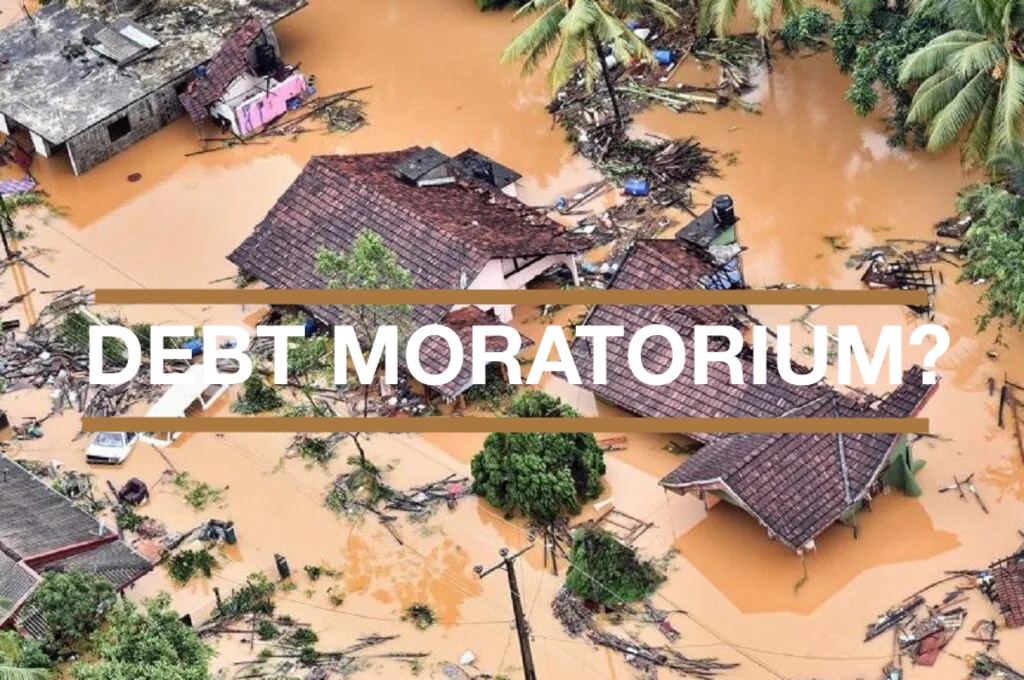
Sri Lanka is once again facing the painful aftermath of a natural catastrophe. The floods and cyclone of 2025 have left thousands of families without homes, destroyed the livelihoods of small and medium enterprises, and inflicted severe damage on property, machinery, farmlands, and inventory. At a moment when people are struggling simply to rebuild what they have lost, loan repayments have become an unbearable burden. This is precisely why the government must act decisively and direct all banks — including private commercial banks — to grant a comprehensive moratorium on loans for households and SMEs.
This is not a novel or unreasonable policy. In fact, Sri Lanka has already relied on similar measures during moments of severe national distress. During the COVID-19 pandemic and again during the 2022–2023 economic crisis, the government mandated debt moratoria to stabilize the economy and relieve pressure on the public. Those measures were widely acknowledged as life-saving interventions that prevented mass business failures, loan defaults, and social instability. The logic that justified debt moratoria then is even stronger now.
The current crisis is not the result of mismanagement or irresponsible borrowing. It is the direct consequence of a natural disaster of national scale. When people lose homes, when farmers lose equipment, when small businesses lose stock and working capital overnight, expecting them to continue regular loan repayments is both unrealistic and deeply unfair. A moratorium is not debt forgiveness; it is simply breathing space so that borrowers can get back on their feet.
The agriculture sector, in particular, stands on the brink of severe devastation following the floods and cyclone. Thousands of acres of paddy fields, vegetable plots, tea and rubber plantations, and livestock farms have been submerged or washed away. Farmers have lost not only their current harvests but also seeds, tools, irrigation systems, machinery, and in some cases the very soil fertility needed for future cultivation. Agriculture is deeply seasonal, and the destruction of one cycle often means income loss for an entire year. Expecting farmers to continue servicing their loans — for tractors, fertilizer, inputs, and rural development credit — while their livelihoods have been wiped out is both impractical and unjust. A dedicated moratorium for the agricultural community is therefore essential to prevent long-term rural poverty, ensure food security, and safeguard the stability of Sri Lanka’s agrarian economy.
There is also a compelling moral and economic rationale for requiring all banks — public and private — to participate. In 2025, banks are reporting record profits, benefiting from higher interest margins, fee income, and the improved macroeconomic climate after restructuring. These profits have been achieved during a period when the public has already endured unprecedented economic hardship. In such circumstances, it is entirely reasonable and socially responsible to expect the financial sector to shoulder part of the national recovery effort.
A temporary moratorium will not destabilize the banking industry. On the contrary, it will protect it. Without relief, thousands of borrowers will inevitably fall into default, creating a spike in non-performing loans that will eventually harm the balance sheets of the very banks resisting intervention. Moratoria smooth out these risks, preserve long-term loan viability, and support the wider economic recovery that banks themselves rely upon.
Moreover, SMEs form the backbone of the Sri Lankan economy — accounting for the majority of employment, regional trade, and rural economic activity. If these businesses collapse under the weight of disaster-related losses and rigid repayment schedules, the consequences will be far-reaching: higher unemployment, reduced production, lower tax revenue, and slower economic recovery in 2026 and beyond. A moratorium is therefore not merely a relief measure; it is an investment in the country’s economic future.
The government cannot allow fragmented, voluntary, or selective relief schemes. Experience has already shown that without a mandatory directive, banks will adopt inconsistent approaches, leaving many borrowers unprotected. A nationwide, uniform moratorium — with clear guidelines, eligibility criteria, and timelines — is the only fair and effective solution.
Sri Lanka is still in recovery mode from the shocks of the past five years. The people cannot carry another burden alone. The financial sector, strengthened and profitable, has the capacity and responsibility to support the country in its hour of need. A loan moratorium is not a handout; it is a humanitarian necessity and a strategic economic safeguard.
The government must act now. Lives, livelihoods, and the country’s future stability depend on it.