

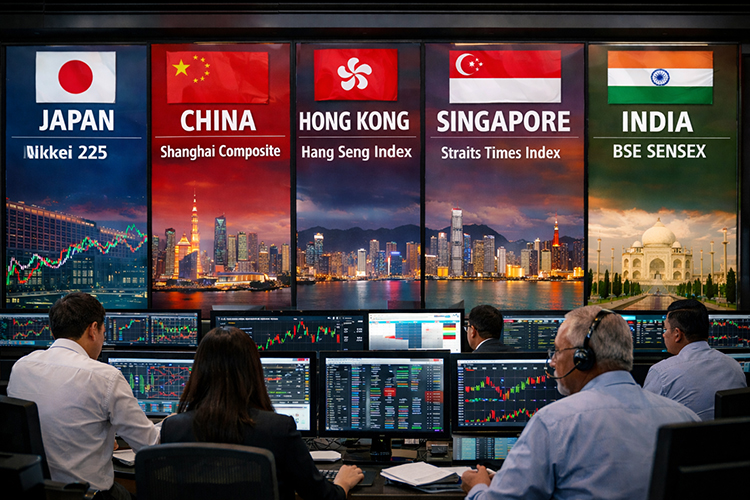
Asian stocks experienced a downturn on Friday, marking a second consecutive week of declines. The ongoing conflict involving the U.S. and Israel against Iran has dimmed hopes for a swift resolution, maintaining elevated oil prices and casting uncertainty over global markets, leading to inflation concerns.
In the midst of this turmoil, the U.S. dollar has emerged as the preferred safe-haven currency, exerting pressure on other currencies. It is on track for a second week of gains, having risen 2% since the conflict began at the end of February.
Oil prices hovered near the critical $100 per barrel mark, though they showed slight relief in early Friday trading after the U.S. granted a 30-day license for countries to purchase Russian oil and petroleum products stranded at sea. Brent futures were last recorded at $99.85 per barrel, while West Texas Intermediate crude stood at $95.05 per barrel.
The MSCI’s broadest index of Asia-Pacific shares eased by 0.5%, heading towards a 1.5% weekly loss. Japan’s Nikkei dropped 1.3%, South Korean tech stocks decreased by nearly 2%, and Taiwan equities fell by 1%.
As Iran intensifies its military actions across the Middle East, with its new Supreme Leader Mojtaba Khamenei pledging to keep the Strait of Hormuz closed, investors are preparing for a prolonged conflict and sustained high oil prices.
The prospect of rising inflation has led markets to quickly revise their expectations for central bank actions this year. Traders are now anticipating just a 20-basis-point reduction from the Federal Reserve, down from the 50 basis points of cuts expected last month.
“Markets were positioned for Fed cuts this year, but the rationale for such cuts has diminished with the U.S. engagement in Iran,” noted Prashant Newnaha, senior rates strategist at TD Securities. “Markets are recalibrating for a higher terminal rate.”
The global selloff in stocks and bonds shows no signs of abating. U.S. stocks fell sharply overnight, and the two-year Treasury yields, which typically align with Fed interest rate expectations, reached a six-month high on Thursday.
“With the likelihood of sustained high oil prices, investors should brace for ongoing volatility and potential further downside in the near term,” stated Vasu Menon, managing director of investment strategy at OCBC in Singapore.
Inflation Concerns Mount
Jose Torres, a senior economist at Interactive Brokers, commented on the adverse effects of rising oil prices on corporate margins, inflation expectations, rate-cut prospects, and yields, which are driving market volatility and leaving limited safe havens for participants.
“Indeed, diminishing optimism for Fed rate reductions amid rising cost pressures is affecting traditional safe havens such as silver, gold, and government debt,” he added.
The two-year note yield eased by 3 basis points to 3.730% after reaching its highest level since August 22 on Thursday. The yield has increased by 35 basis points in the two weeks since the conflict began.
The yield on the longer-dated 30-year bond has risen by 24 basis points this month.
Investor attention will shift to a series of policy meetings next week, involving the Federal Reserve, the Bank of Japan, the European Central Bank, and the Bank of England, with most expected to keep rates steady. The Reserve Bank of Australia is broadly anticipated to raise rates next week.
In currency markets, the euro last stood at $1.1527, inching higher for the day but still on course for a weekly decline of nearly 1%. The dollar index reached 99.599, set for a 0.8% weekly rise.
The yen strengthened slightly to 159.13 per dollar, hovering around the 160 mark, though speculation around potential intervention has been muted. Analysts suggest that Tokyo’s threshold for intervention is higher due to the oil price shock.
“What was once a ‘line in the sand’ at 160 has evolved into more of a moving target,” remarked Tony Sycamore, market analyst at IG. “Given the challenging macro backdrop, it’s impractical for authorities to expend limited intervention resources—whether verbal or physical—attempting to safeguard the 160 level this time.”
Gold rose by 0.7% to $5,114 per ounce on Friday but was set for a 1% decline for the week.