The year 2025 draws to a close under a cloud of immense tragedy, as Cyclone Ditwah unleashes floods and landslides that claim hundreds of lives and destroy vast amounts of public and private property. Public outrage quickly spread across social media, with many accusing the National People’s Power (NPP) government of failing to issue timely warnings—despite the Director General of the Meteorology Department, Athula Karunanayake, predicting an unprecedented weather event as early as 12 November on the television programme Big Focus.
Speaking to presenter Kalindu Karunaratne, Karunanayake warned that conditions could rapidly worsen on or after 14 November, though he stopped short of officially labelling the development a cyclone. Two weeks later, on 27 November, Cyclone Ditwah struck Sri Lanka with catastrophic force.
Some critics compared this alleged lapse to the Yahapalana administration’s failure to prevent the 2019 Easter Sunday attacks, despite receiving actionable intelligence. Big Focus devoted nearly an hour to the developing weather situation, featuring Karunanayake, Director General of the Disaster Management Centre (DMC) Maj. Gen. (retd.) Sampath Kotuwegoda, and NBRO scientist Imaya Ariyarathna. Their presence raises critical questions about what actions—if any—were taken following their public discussion.
Given that the Meteorology Department operates under the Ministry of Defence, headed by President Anura Kumara Dissanayake and his deputy Maj. Gen. (retd.) Aruna Jayasekera, it is necessary to ask whether the Department formally notified the Ministry of the impending danger. If Karunanayake was confident enough to issue such a stark warning on national television, why didn’t he—or the institutions represented—advise the government immediately?
Most troubling is the apparent lack of coordinated action during the ten days between the Big Focus warning and the cyclone’s landfall. Instead of demanding a Parliamentary Select Committee to examine institutional failures, the main Opposition, the Samagi Jana Balawegaya (SJB), initially pursued a political agenda. Only on 1 December did the SJB raise the matter forcefully in Parliament, catching the government off-guard.
Amid the brewing political tensions, some Opposition groups sought to cancel the ‘Sri Lankan Day’ national programme—scheduled for 12–14 December by the Ministry of Buddhasasana, Religious and Cultural Affairs—and redirect its funds toward disaster relief. Yet the more urgent issue remains why no specific nationwide warnings were issued after the televised discussion.
Meanwhile, lawyer and political commentator Nayana Tharanga Gamage criticised TV Derana for repeatedly airing Karunanayake’s warning, alleging the channel was fuelling anti-government sentiment for political reasons. He linked this to Derana’s association with Dilith Jayaweera, leader of Sarvajana Balaya and a National List MP.
Despite the political noise, the fact remains that the three institutions present on Big Focus—the Meteorology Department, the DMC, and the NBRO—owe the public an explanation for their inaction. Had the NPP been sitting in Opposition, it would almost certainly have demanded accountability. Even with an early warning, the cyclone’s destruction could not have been entirely prevented. But experts agree that lowering reservoir water levels systematically—rather than releasing huge volumes suddenly—could have reduced downstream flooding and saved many lives.
By early December, the death toll had surpassed 800, with more than 400 people still missing. The human cost of Cyclone Ditwah now exceeds that of the Easter Sunday attacks, which killed around 270 people.
The economic fallout will be severe. Already struggling to stabilise the national economy, the government will face intense pressure to revise its fiscal strategy. Tourism, still recovering from past crises, is expected to suffer a significant blow. With the scale of destruction being “unprecedented in modern history,” both government and Opposition must set aside political rivalry and work jointly on relief, reconstruction, and re-evaluation of financial commitments—including agreements with the IMF, the World Bank, and other lenders.
Despite overwhelming focus on rescue and relief, long-term consequences risk being overshadowed. Crucial questions arise, such as whether the Meteorology Department informed the Examinations Department about the weather threat. The Advance Level examination began on 10 November—just two days before Karunanayake’s warning—and rescheduling now would be extremely difficult. One can only hope that students were not among the victims.
International Assistance
Pakistan announced a series of C-130 flights to deliver fully equipped Urban Search and Rescue teams, field hospitals, and nearly 100 tons of relief supplies. A Pakistan Navy ship already in Colombo for the International Fleet Review (IFR) also joined humanitarian operations. However, as of publication, Pakistan claimed it could not dispatch the aid flights due to India not providing adequate time for air transit, though India maintained that approval had been granted.
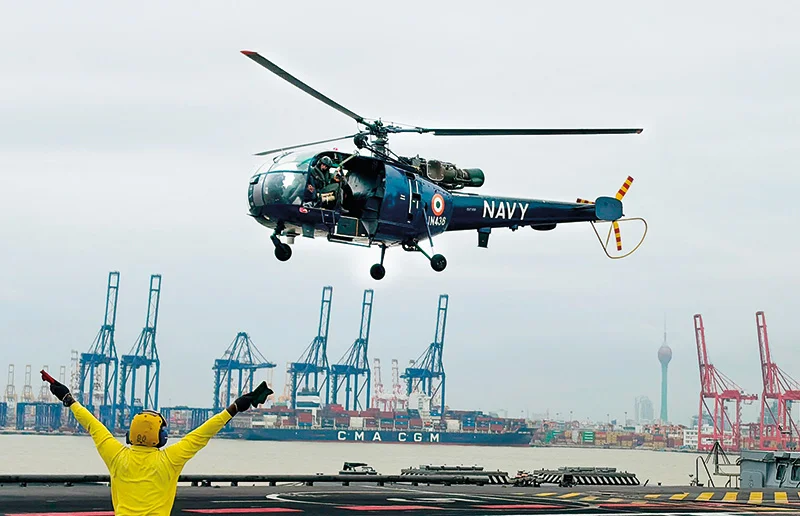
India, under its “Neighbourhood First” policy, responded with exceptional speed. INS Vikrant and INS Udaygiri, present for the IFR, carried significant quantities of food and essential supplies for victims. Indian Navy and Air Force helicopters airlifted stranded civilians—including pregnant women, infants, and foreign tourists—from inaccessible areas such as Kotmale. Two IAF transport aircraft arrived with 21 tonnes of relief material and 80 National Disaster Response Force personnel.
China, Japan, the US, Australia, the UK, New Zealand, and other nations also extended support. However, India’s involvement evokes mixed emotions for some, given its historical role in Sri Lanka’s conflict period.
Tragedy Amid Rescue Efforts
During rescue operations on 30 November, the Sri Lanka Air Force lost Wing Commander Nirmal Siyambalapitiya, a veteran pilot with over 3,000 flying hours, when his Bell 212 crashed during an emergency landing attempt. Five Navy personnel from the Chalai detachment also drowned during relief efforts.
Nevertheless, Sri Lanka’s armed forces continued their rescue missions across affected regions, receiving widespread appreciation on social media—even as public anger grew over institutional failures.
Many recalled the “Helping Hambantota” controversy after the 2004 tsunami, when funds meant for disaster victims were allegedly diverted. That scandal had become a major issue in the 2005 presidential election.
A Nation Weakened Further
This latest calamity has dealt Sri Lanka another crippling blow. Rebuilding infrastructure, homes, and livelihoods will be an immense undertaking. Regardless of politics, the government must accept accountability for failing to act on the Meteorology Department’s assessment and must begin planning urgently for short-, medium-, and long-term recovery—especially in the agriculture sector, which suffered unprecedented losses.
Sri Lanka now faces its most daunting challenge in recent history: to recover, rebuild, and regain economic stability in the face of devastating human and material loss.