The writer is said to be the Managing Director of a 100% export-oriented FDI entity operating in Sri Lanka. From social media – identity protected
I am writing this from the waiting area of the Department of Immigration. I have just paid my visa fees. My passport is about to be stamped. Technically, this is a success story.
But as I sit here, having secured another year of legal residency to run my export company, I do not feel successful. I feel exhausted. And more importantly, I feel a deep sense of disillusionment that compels me to speak out not just for myself, but for every foreign investor currently navigating this administrative labyrinth in silence.
I have lived in Sri Lanka for six years. I chose this country. I brought my capital here. I built a company that employs brilliant young Sri Lankans. We bring foreign currency into the country every single month- the very “dollars” that the economy so desperately craves. In return, I ask for one thing: the legal right to stay here and work.
The “Ten-Day Tax” on Productivity
Whatever “efficiency” is promised in glossy Board of Investment brochures vanishes the moment you hit the ground. To renew my visa this year, I did not just fill out a form. I embarked on a journey that cost me 10 full business days over a stressful one-month period.
That is two weeks of a CEO’s time removed from business development, removed from client management, and removed from revenue generation. Instead, that time was spent navigating a scattered archipelago of government silos that refuse to talk to each other.
One department demands a letter that another department won’t issue until a third department stamps a form. You become a glorified courier, physically ferrying papers between high-rise towers in Colombo and counters in Battaramulla. We are forced to hire expensive legal counsel not to solve complex legal disputes, but simply to interpret the unwritten rules of basic administration.
This is the hidden tax on FDI: the sheer volume of unproductive time required just to remain compliant.
The User Experience of Failure
The dysfunction follows you to the very last step. At the Department of Immigration, the digital screens meant to guide applicants are switched off. The massive instructional boards on the wall list procedures that are outdated or simply incorrect. There is no sign telling you that after paying your fee at the cashier, you must physically walk the receipt back to a different room to trigger the next step. You sit there, waiting for a number that will never be called, until a kind stranger whispers the “secret” process to you. It is a system designed to confuse, not to serve.
“Start Earlier Next Year”
The most telling moment, however, came right before the end. When I finally secured the hard-fought recommendation from the Ministry, I asked the official a simple, hopeful question: “Now that I have successfully navigated this ‘new’ process, will it be easier next time?”
The official looked at me- a kind, well-meaning person like almost everyone I met in this process- smiled and gave the only advice the system seems capable of offering: “Start earlier next year.”
There was no promise of improvement. No roadmap for digitization. Just a polite admission that the inefficiency is permanent, and the burden is entirely on the investor to accommodate it.
The Verdict
I love this country. I love the talent of my team. I love the potential of Sri Lanka. But potential does not pay the bills, and passion does not survive endless bureaucracy.
If a fellow entrepreneur from the ‘west’ asked me today: ” should I set up my headquarters in Sri Lanka?”
Six years ago, I would have said yes.
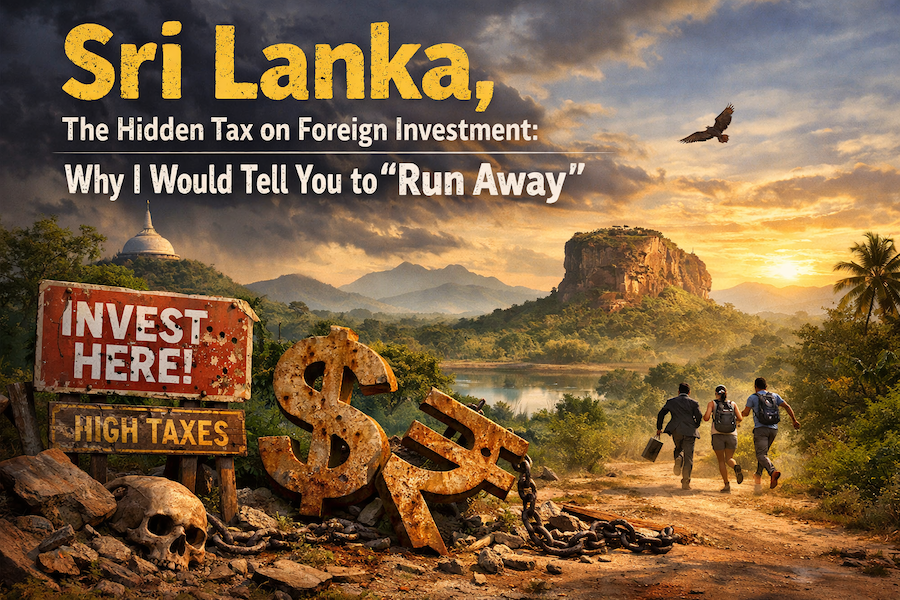
Today, sadly, my answer would be: “Run away.”
Run to Vietnam. Run to Thailand. Run to Dubai. Run anywhere where the government treats your time as a resource to be respected, not wasted.
We, the foreign investors, are not asking for special treatment. We are simply asking for a system that allows us to do what we came here to do: build businesses, hire locals, and grow the economy. When the administrative cost of staying becomes higher than the value of doing business, the capital will leave.
I am staying for now because I have a duty to my team and my clients. But the silence of the foreign business community is ending. We are tired. And we deserve better than a system that makes us fight for the privilege of contributing to your economy.
Yes, I think the embassies should be informed about the difficulty of doing business legally in Sri Lanka and encouraged to make the government aware of how complex the system is.