Be that as it may, the transition from opposition to government is often where political narratives are most severely tested. Elections are fought on urgency, clarity, and the promise of decisive action. The electorate is told that change is not only necessary, but possible – quickly, visibly, and without the compromises that defined the past. It is a compelling proposition, and in Sri Lanka’s recent context, it proved powerful enough to deliver a decisive mandate.
But governing introduces a different reality altogether.
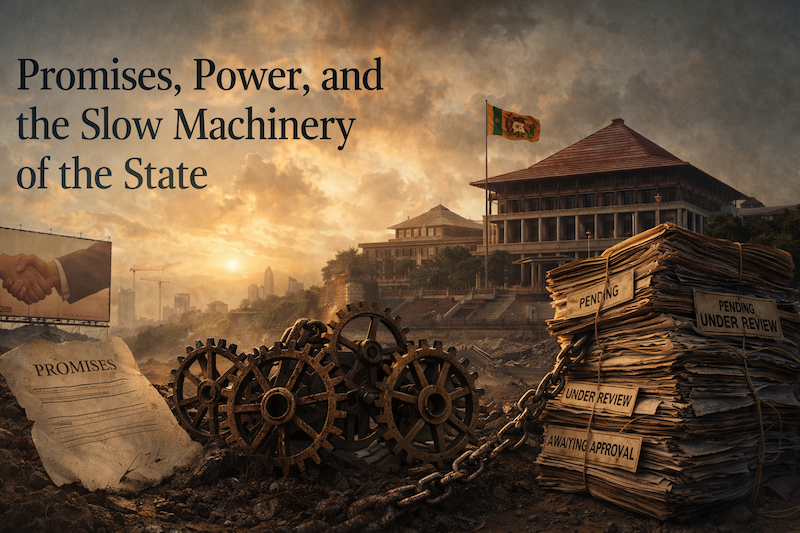
It is one thing to win over the public. It is quite another to command the machinery of the State. That machinery does not move on rhetoric or electoral momentum. It moves through process – through files, approvals, inter-departmental clearances, and institutional hierarchies that have developed over decades. Each layer is designed, in principle, to ensure order and accountability. In practice, it often produces delay.
This is where expectation begins to diverge from experience.
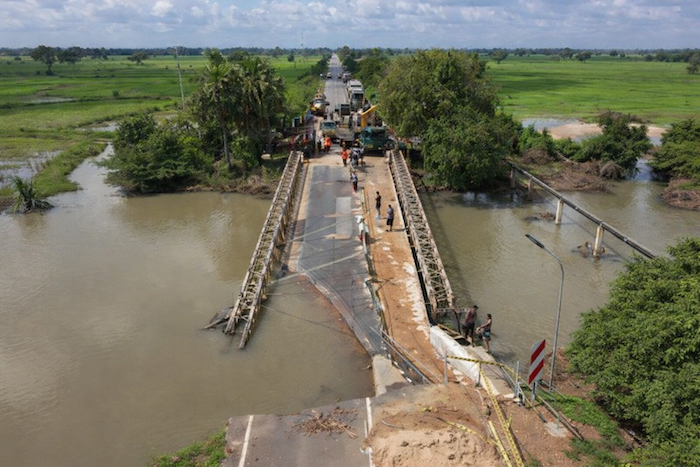
The analogy is not entirely misplaced. The public was led to expect pace – something sharper, faster, more direct than what had come before. Yet what they encounter instead is a system that turns rather than accelerates, that absorbs pressure rather than responding to it. The issue is not necessarily capability. It is the nature of the system itself.
President Anura Kumara Dissanayake entered office with a clear message of reform and renewal. There is little doubt that he secured the confidence of the electorate. The more difficult question is whether that confidence has translated into control over the administrative apparatus required to implement his agenda. Because without that alignment, even the strongest political mandate can struggle to convert intention into action.
Bureaucracies are not inherently resistant to change, but they are inherently cautious. Their instinct is to preserve continuity, minimise risk, and operate within established frameworks. Ministers and governments may change; the system remains. That continuity, while valuable in maintaining stability, can also act as a brake on reform – particularly when the pace of political expectation exceeds the comfort of administrative practice.
This creates a structural tension at the heart of governance. The political leadership is expected to deliver quickly, to demonstrate results, and to justify the mandate it has been given. The administrative system, meanwhile, operates on timelines and processes that are not easily compressed. The result is a slowing of momentum that is often interpreted as hesitation, even when intent remains intact.
It would be simplistic to characterise this entirely as failure. Equally, it would be disingenuous to ignore the growing gap between promise and delivery. That gap is where public confidence is most vulnerable. It is also where political capital begins to erode if not addressed. The central issue, therefore, is not whether promises were made, but whether the structures required to deliver them have been effectively engaged, aligned, or, where necessary, reformed. Winning power at the ballot box is only the first step. Exercising it across the State requires a different kind of authority – one that extends beyond political legitimacy into institutional command. Sri Lanka has seen cycles of expectation before. Moments of political change have often generated hope, only to encounter the limits imposed by the system itself. The risk is not dramatic failure, but gradual dilution – where ambition is moderated, timelines extended, and outcomes deferred.
In that sense, the question is not simply whether this government will deliver, but whether it can move the system fast enough to meet the expectations it has created. Because in governance, intent alone is insufficient.
Delivery depends on what moves beneath it – and how quickly.