“Broken promises, missing files, and a system that failed – until two citizens refused to give up”
The Court affirmed that “even a private entity can be held liable in a fundamental rights application where its conduct is intertwined with state inaction”
Justice Nawaz, (Justices Wickremasinghe and Gooneratne agreeing) in an order marked for its ground-breaking nature and sheer Eloquence. The judgement is a fitting legal end to a 22+ year battle.
Be that as it may, what began as a simple promise of adequate parking in a Colombo condominium has now evolved into a landmark ruling by the Supreme Court – one that exposes not only the conduct of a private developer, but the failure of the very institutions meant to regulate it.
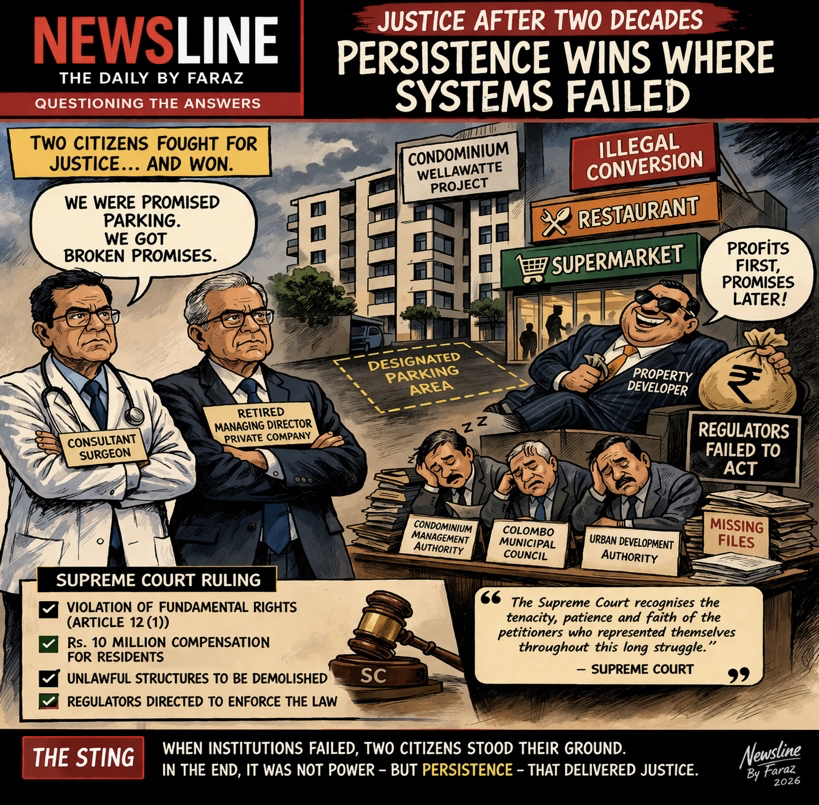
At the heart of the case were two apartment buyers – a consultant surgeon and a retired Managing Director – who invested their life savings in a property based on clear representations that proper parking facilities would be provided. What they received instead was a starkly different reality. A portion of the designated parking space had been converted into a commercial establishment, first a restaurant and later a supermarket, without lawful approval.
What followed was not an isolated grievance, but a prolonged struggle.
For nearly two decades, the petitioners moved from one authority to another – the Condominium Management Authority, the Colombo Municipal Council, the Urban Development Authority – seeking redress. Complaints were filed. Inquiries were conducted. Even a demolition order was issued. Yet nothing changed. Enforcement remained elusive. Files went missing. Responsibility blurred.
The Supreme Court has now called it out – clearly and unequivocally.
In a strongly worded judgment, the Court found that the developer had acted in clear violation of approved plans, prioritising commercial gain over the rights of apartment owners. More significantly, it held that state authorities had failed in their duties, allowing unlawful constructions to persist through inaction, negligence, and regulatory indifference.
This, the Court ruled, amounted to a violation of the petitioners’ fundamental rights under Article 12(1) of the Constitution.
But the judgment goes further.
In a significant development, the Court affirmed that even a private entity can be held liable in a fundamental rights application where its conduct is intertwined with state inaction. In doing so, it expanded the reach of constitutional accountability – making clear that private actors cannot hide behind the failure of public authorities.
The orders that followed were decisive.
The developer has been directed to pay Rs. 10 million in compensation, not to the individual petitioners, but into an escrow account for the benefit of all residents. The unlawful commercial structures occupying parking space are to be demolished, subject to structural safety assessments. And regulators have been directed to act – finally – to enforce the law.
Yet, beyond the legal findings, the judgment carries something more powerful.
Recognition.
The Supreme Court placed on record its admiration for the tenacity, patience, and perseverance of the two petitioners – who fought this battle alone, without legal representation. A consultant surgeon and a retired corporate leader, they stood before the highest court of the land and pursued justice not only for themselves, but for their fellow residents.
In a system often criticised for delay and inertia, their persistence became the difference.
This case is not merely about parking. It is about trust – broken by a developer, and neglected by regulators. And it is about what happens when ordinary citizens refuse to let that be the end of the story.
THE STING
When institutions failed, two citizens stood their ground. In the end, it was not power – but persistence – that delivered justice.