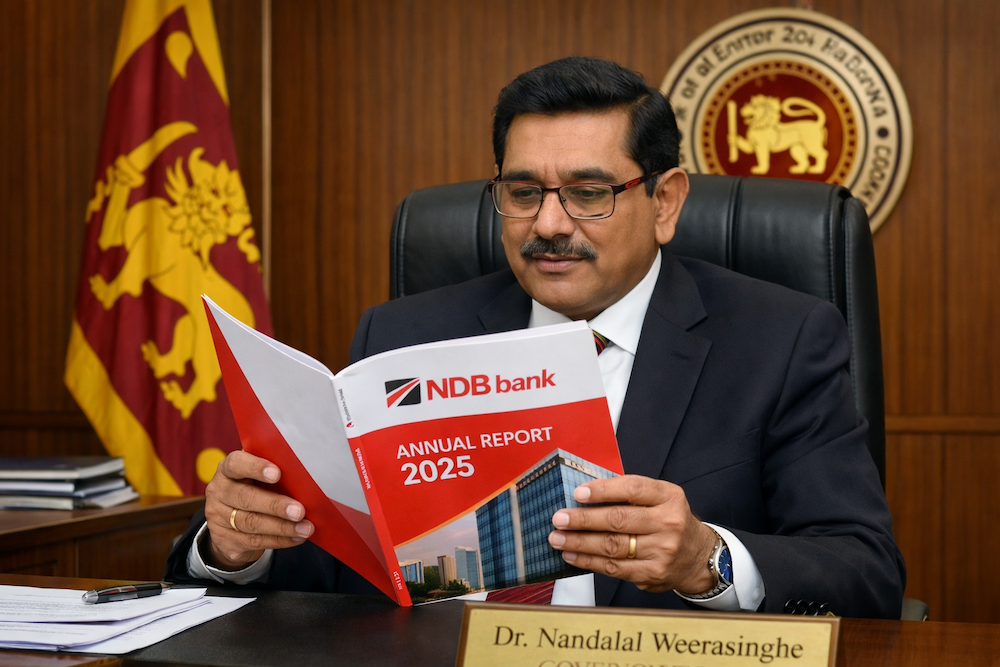
The Governor, The Board of Directors of NDB Bank and The Auditors are still in place
There is a pattern in Sri Lanka’s governance that is as predictable as it is corrosive: the instinct not to act. Not to decide. Not to confront. But to wait, deflect, and dilute. It is not incompetence in isolation. It is something more systemic. A culture of studied inaction masquerading as prudence.
Be that as it may, the cost of this inertia is no longer theoretical. It is measurable, visible, and increasingly indefensible.
Take the unfolding questions surrounding the NDB matter. A serious financial issue, one that goes to the heart of trust in Sri Lanka’s banking architecture, has been met not with decisive leadership, but with the familiar choreography of delay. Statements. Clarifications. Internal reviews. And above all, the preservation of positions.
In any system that values accountability, the first principle is simple: responsibility must be seen to be taken. The optics matter because they signal seriousness. When a Governor, entrusted with oversight and systemic stability, presides over a moment of such gravity, the response cannot be cosmetic. It must be consequential.
Yet what do we see?
Not urgency, but accommodation. Not accountability, but continuity. The very individual at the center of scrutiny remains in place, offering explanations that do little to inspire confidence. The system, rather than correcting itself, appears to be shielding itself.
And here lies the deeper problem.
Sri Lankan governments, across administrations and ideologies, have consistently demonstrated an aversion to decisive action when it matters most. The instinct is to manage the narrative rather than confront the issue. To contain fallout rather than enforce standards. To hope that time will dull public memory.
But time, in governance, is not neutral. It compounds failure.
The President, in such circumstances, is not merely a spectator to institutional processes. He is the ultimate custodian of public trust. Leadership, at its core, is about setting the tone. A summons, a demand for resignation, a clear signal that underperformance and lapses will not be tolerated. These are not acts of aggression. They are acts of governance.
Instead, what we witness is hesitation.
Perhaps it is political calculation. Perhaps it is institutional caution. Perhaps it is the perennial fear of destabilizing already fragile systems. But the irony is stark: by avoiding short-term disruption, the system invites long-term erosion.
Because every instance of inaction sends a message.
To the public: that accountability is optional. To institutions: that standards are negotiable. To officials: that consequences are unlikely.
And over time, that message becomes culture.
This is not merely about one bank, one Governor, or one episode. It is about a recurring failure to act when action is required. The bond scandal taught us this. The Easter aftermath reinforced it. Regulatory lapses across sectors echo it. The names change. The script does not.
Be that as it may, the country cannot afford this paralysis any longer.
Sri Lanka is attempting to rebuild credibility in the eyes of investors, multilaterals, and its own citizens. That credibility is not built on speeches or policy papers. It is built on decisions. Hard, sometimes uncomfortable decisions that demonstrate a willingness to uphold standards without fear or favour.
The question, then, is not whether action is difficult. It always is.
The question is whether inaction is any longer sustainable.
Because if governance becomes an exercise in avoidance, then accountability becomes a myth. And when accountability is a myth, trust is the first casualty.
And without trust, no system, however well designed on paper, can endure.
HOW DID THE SYSTEM FAIL?
- Utter incompetence?
- Reckless negligence?
- Direct involvement and connivance?
- Conscious aiding and abetment?
The Central Bank, through its Financial Intelligence Unit (FIU), operates a highly sophisticated system designed to detect and address suspicious financial transactions. These systems were first introduced in 2006/2007 by Ms. Mala Dayaratne, who served as Director of IT at the Central Bank of Sri Lanka (CBSL) at the time, under the leadership of then-Governor Ajith Nivard Cabraal.
Since then, the systems have been continuously upgraded and enhanced with technical assistance from the World Bank, the International Monetary Fund (IMF), and the United States. As a result, these internationally accepted and advanced systems have become highly sophisticated, capable of detecting transaction patterns based on amounts, individuals, banks, time slots, counterparties, repetition, and numerous other parameters.
When unusual or suspicious patterns are identified and flagged, they are escalated to the relevant levels of management. Serious cases are brought to the attention of the Governor and, potentially, the Monetary Board or Governing Board. This is why even repeated transactions involving relatively modest sums such as around Rs. 900,000 are often questioned by clearing banks, which must respond to FIU inquiries.
Given this, it is difficult to comprehend how the reported NDB loss of Rs. 13,200 million could have gone undetected by the FIU. It is now emerging that the siphoning of funds allegedly occurred via CEFTS transactions of approximately Rs. 5 million each. This would imply at least 2,640 similar transactions executed over a period of several months.
Under such circumstances, it is highly unlikely that the FIU would not have been alerted, or that the Governor would not have been informed.
This raises a critical question: why was no action taken by the Governor and the Central Bank in response to what appears to be a clear pattern of repeated suspicious transactions? What explains the apparent silence and inaction?
Image: AI Generated for illustration purpose only