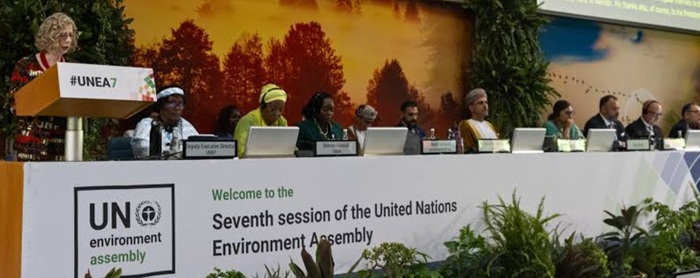
Sri Lanka’s draft resolution on “Enhancing the Meaningful Participation of Youth in Environmental Processes and on Environmental Education” was adopted at the Seventh Session of the United Nations Environment Assembly (UNEA‑7) in Nairobi.
According to the Sri Lankan High Commission in Nairobi, the resolution, proposed by Sri Lanka, reflects a shared commitment to empowering young people as key partners in addressing global environmental challenges and advancing sustainable development.
The adopted resolution underscores the critical role of youth as agents of change and calls upon Member States, the United Nations Environment Programme, and other stakeholders to provide youth with opportunities for full, effective, meaningful, constructive and inclusive participation in environmental matters and processes at local, national, regional and international levels.
It further emphasizes the importance of enhancing environmental education to equip present and future generations with the knowledge, skills and values necessary to protect the environment and build resilient societies.
Speaking following the adoption, the Sri Lankan delegation highlighted that, as a vulnerable island nation and biodiversity hotspot, Sri Lanka has witnessed firsthand the disproportionate impacts of environmental degradation and climate change on children and youth.
The resolution, therefore, seeks to ensure that young people are not only beneficiaries of environmental policies, but active contributors to their design, implementation and monitoring.
Sri Lanka expressed its deep appreciation to Bhutan, Burkina Faso and Thailand for their valuable co-sponsorship, and to all Member States that supported the resolution, demonstrating strong global recognition of the importance of intergenerational equity in environmental governance.
The adoption of this resolution at UNEA-7 marks an important step toward institutionalizing youth engagement and strengthening environmental education frameworks worldwide, reinforcing the principle that sustainable environmental solutions must be inclusive, participatory and future-oriented.