

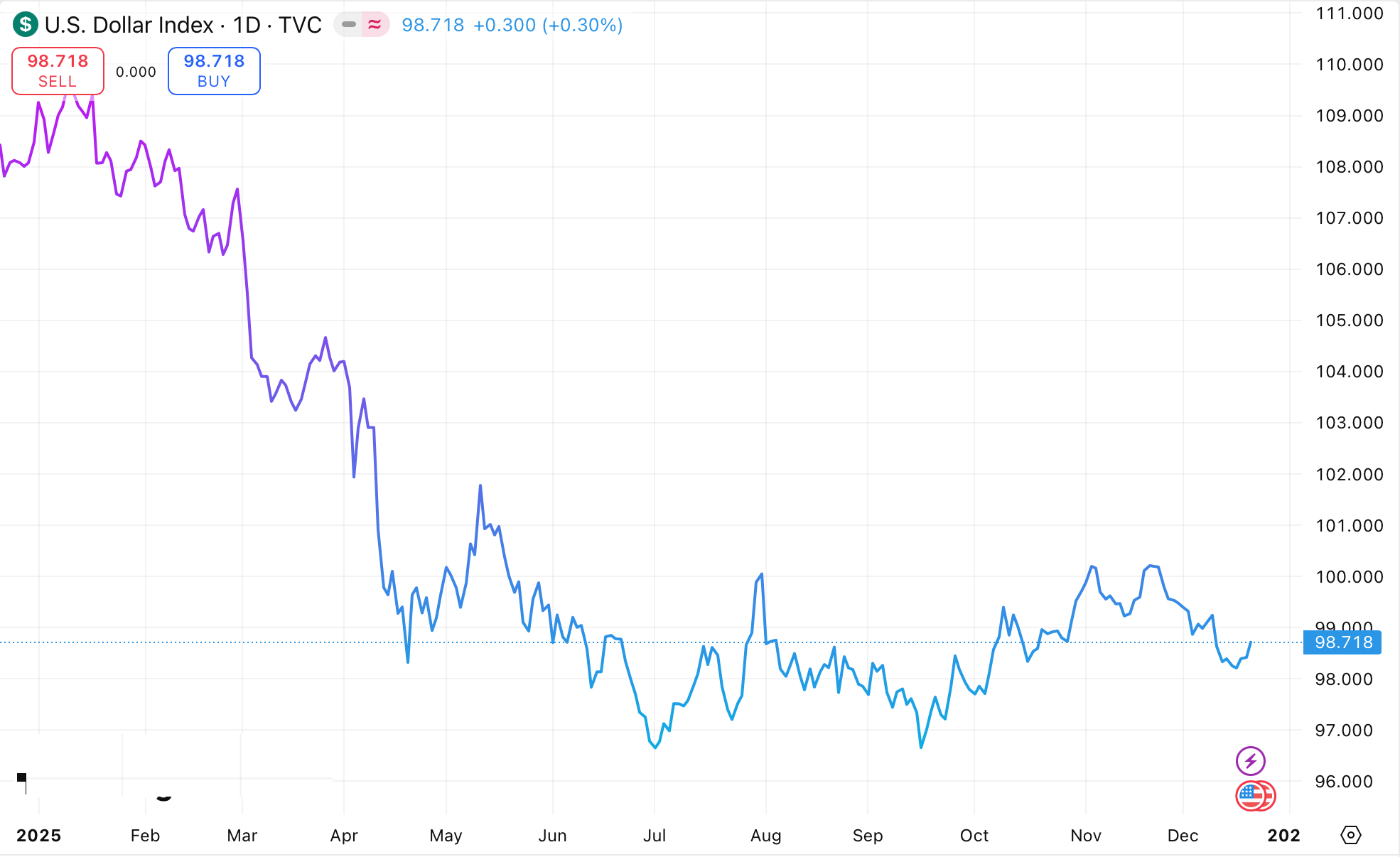
Analysts and currency prognosticators are pointing to a prolonged period of U.S. dollar weakness over the next several years, according to long-range projections from financial forecasting platform LongForecast.com. The widely followed U.S. Dollar Index (DXY) which measures the greenback against a basket of major global currencies including the euro, yen, pound and others is expected to trend lower through late 2026 before gradually stabilizing and eventually showing modest gains by the end of 2029.
EFA Forecast
As of December 21, 2025, the DXY stood at roughly 98.7, reflecting broader market caution amid slowing U.S. economic data and speculation about the Federal Reserve’s monetary policy trajectory.
Forecast Highlights:
– 2026 Outlook: The index is projected to slide throughout most of 2026, closing the year near the 89.6 mark, down from current levels representing an approximate decline of more than 10% from late 2025. This suggests sustained currency headwinds tied to investor expectations of slower U.S. growth and potential rate cuts.
– 2027 Trends: Forecasts depict modest recovery attempts, with the DXY climbing into the mid-90s by year-end. However, month-to-month variation is anticipated, reflecting volatility tied to shifting global monetary conditions.
– 2028–2029 Range: Through 2028, the index remains range-bound, often below 96 points, before late-2029 projections indicate a possible rebound above 100 levels not seen consistently since the mid-2020s.
Broader Market Context
The forecast aligns with recent movements in the dollar and macroeconomic signals in foreign exchange markets. In December 2025, the dollar hovered near multi-month lows as softer labor data introduced uncertainty into the Fed’s rate strategy. The DXY remained close to its weakest levels since October, underscoring investor skepticism about sustained dollar strength.
Elsewhere, the dollar has seen periodic downward pressure amid expectations of future rate cuts, while major central banks such as the European Central Bank and Bank of Japan consider divergent policy paths. This has helped bolster other currencies, including the euro and yen, against the dollar in recent weeks.
Analyst Perspectives
Long-term forecasts like those from LongForecast.com should be viewed with caution due to inherent unpredictability in currency markets; however, the overall tone reflects a broader narrative of dollar vulnerability driven by shifting interest rate expectations, comparative global growth prospects, and changing investor sentiment.
What It Means for Investors
A weaker dollar trajectory could have wide-ranging implications: U.S. exporters might benefit from more competitive pricing abroad, while importers could face steeper costs. Commodity prices often dollar-denominated may also react to changes in exchange rate dynamics. At the same time, international investors monitoring currency risk may seek hedging strategies to mitigate potential downside.
As with all projections, these forecasts are subject to revision as real-time economic data and policy responses evolve.