
If you like, let’s dive into the ledger of the nation’s finances, let’s look at the “hard numbers” that underpin the political rhetoric. Transitioning from one presidency to another is often a time of “re- baselining,” and in Sri Lanka, the base is a mountain of debt.
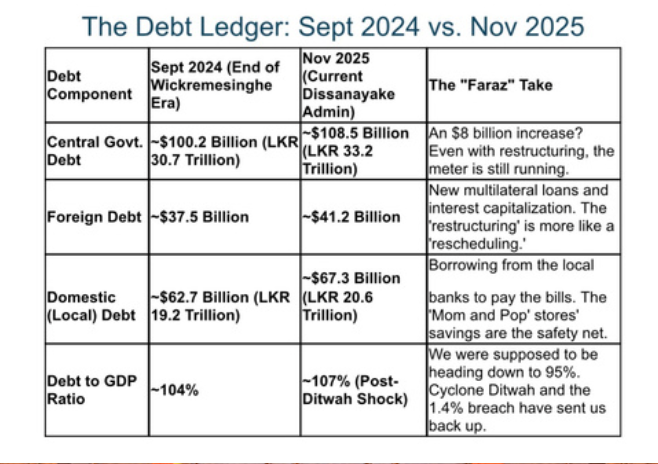
This here is the breakdown of the total public debt figures—foreign and local—from the end of the Wickremesinghe era to the current position under President Dissanayake as of November 2025.
The Faraz Perspective
Let’s talk about these ‘billions,’ shall we? Because when politicians talk about debt, they make it sound like it’s just a number on a spreadsheet in the Central Bank. But for you and me, it’s the price of eggs and the VAT on our electricity.
When Ranil Wickremesinghe left office in September 2024, he handed over a country that was ‘stable’ but still deeply underwater—roughly 100 billion dollars in the red. Fast forward to November 2025, and under President Dissanayake, that figure has crept up to over 108 billion.
How did we get here? Well, it’s a mixture of ‘new money’ for the Ditwah recovery, interest that we aren’t paying but is still being added to the pile (capitalization), and a government that has found it ‘necessary’ to breach its own borrowing limits by 1.4%.
We are told the debt restructuring is ‘successful.’ But as any man with a credit card knows, if you can’t pay the principal and you’re just moving the balance from one card to another, you aren’t ‘recovering’—you’re just buying time. And time, in this economy, is the most expensive thing we have.
Mr. President, the ‘System Change’ hasn’t yet found a way to stop the debt clock. We are borrowing a trillion rupees for a recovery that we haven’t even fully assessed yet. At some point, the music stops, and we have to find a seat.
Keep your eyes on the Central Bank’s weekly reports, and as always… God bless you all.