
Sri Lanka has suffered an estimated US$ 4.1 billion in direct physical damage following Cyclone Ditwah, according to the Global Rapid Post-Disaster Damage Estimation (GRADE) report released by the World Bank and the Global Facility for Disaster Reduction and Recovery (GFDRR). The assessment, finalised on 17 December 2025, indicates that the damage is equivalent to around 4% of Sri Lanka’s 2024 GDP, making Ditwah one of the most destructive cyclones to hit the country in recent history.
The cyclone, which passed over Sri Lanka between 27 and 29 November 2025, brought sustained winds of up to 90 km/h and extreme rainfall exceeding 300 mm within 24 hours in some districts, triggering widespread flooding and landslides. All 25 districts were affected, with the Central Highlands and major river basins experiencing the most severe impacts.
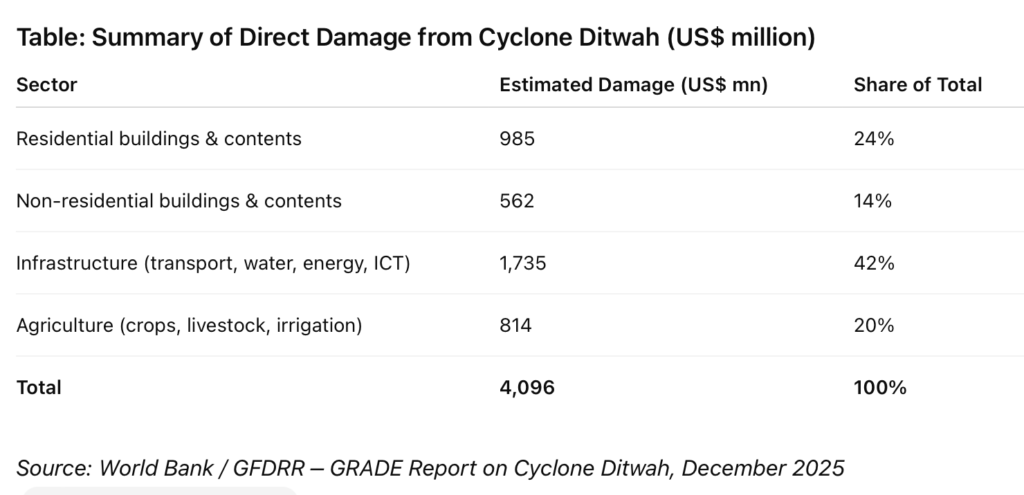
The report identifies infrastructure as the worst-hit sector, accounting for US$ 1.74 billion, or 42% of total damage. Roads, bridges, railways, water supply systems, and energy networks sustained extensive losses, severely disrupting connectivity and essential services. Residential buildings, including household contents, recorded damages of US$ 985 million, while non-residential buildings—such as schools, hospitals, factories, and commercial premises—accounted for US$ 562 million. The agriculture sector suffered losses of US$ 814 million, reflecting large-scale damage to paddy fields, vegetable crops, livestock, and irrigation infrastructure.
At the district level, Kandy emerged as the most affected area, with total damages estimated at US$ 689 million, followed by Puttalam (US$ 486 million) and Badulla (US$ 379 million). Together, these three districts accounted for nearly 40% of total national damage, underscoring the concentration of losses in flood- and landslide-prone regions.
The report cautions that these figures represent direct physical damage only and exclude indirect economic losses, income disruptions, and the additional costs of “building back better.” Based on international experience, total recovery and reconstruction needs could ultimately reach 1.75 to 2.5 times the estimated direct damage. The GRADE assessment is expected to guide the Government of Sri Lanka and development partners in mobilising emergency financing, activating disaster-response facilities, and prioritising resilient reconstruction efforts nationwide
Reported impacts
As further context for the event, the following section summarizes the impacts of the cyclone as reported by different agencies and actors. In the highlands in central Sri Lanka, areas within Nuwara Eliya, Badulla, and Kegalle Districts experienced torrential rainfall, triggering landslides, isolating rural communities and damaging access roads (UNDP, 2025). Flooding occurred in all districts.
Early estimates suggested the number of landslides was in the thousands (UNDP, 2025). The highest number of landslides was in the Ududumbara Divisional Secretariat in Kandy District which registered 135 landslides. Laggala (Matale District), Kothmale East (Nuwara Eliya District), and Lunugala and Passara (Badulla District) each registered over 60 landslides each (UNDP, 2025a).
Reports from December 12 suggested that nearly 1.6 million people were affected by Cyclone Ditwah, around 7 percent of the national population of Sri Lanka (DMC, 2025); however, this number varies between sources. The worst affected districts by people affected are Colombo and Puttalam. As of December 11, the Disaster Management Center’s (DMC) reported 640 fatalities and 211 missing (DMC, 2025).
Damage to residential structures is extensive. Over 6,000 homes were reported as fully damaged, with a further 112,000 reported as partially damaged. Kandy and Puttalam districts reported the most damage with more than 2,000 and 627 fully damaged, respectively, and 14,111 and 20,813, partially damaged, respectively (DMC, 2025).
Infrastructure systems have also been severely impacted. The transport sector has been hit particularly hard. Approximately 247 km of A- and B- roads10 were reported as damaged by ooding, with 40 road bridges destroyed. Many more local roads and private roads were affected, as well as many bridges (News.lk, 2025a).
Seventy percent of the railway networks were reported as unusable. A smaller share of lines sustained physical damage, and within those, some sections were signicantly damaged. The General Manager of Railways estimated the damage in the hundreds of millions of dollars (Newswire, 2025).
Education infrastructure was also badly affected, with over 1,000 schools reported damaged by the Ministry of Education (Adaderana, 2025). The preliminary estimate for damage to the Peradeniya University is reported by the university as at least Rs. 3 billion (US$ 9.7 million). Notable impacts were reported to health clinics and hospitals, including ooding damage to over 100 small hospitals, and three larger hospitals (Daily Mirror, 2025).
The water networks were reportedly substantially damaged, with 156 supply systems out of 342 completely broken, and a further seven dicult to access. Restoration works were reportedly progressing rapidly.
The agriculture sector employs nearly 30 percent of Sri Lankans, primarily in the production of rice. Vegetables, maize, subsistence farming and cash crops were also signicantly affected. At least 100,000 hectares of paddy were destroyed, with 150,000 hectares also affected/damaged. The Department of Animal Husbandry and Health reported that tens of thousands of heads of livestock (e.g. cattle, buffaloes, goats and pigs) have perished (Economy Next,2025). Additionally, media outlets reported nearly three million chickens have perished (Gossip Lanka News, 2025a).
Telecommunications networks were impacted by landslides and power outages but were reported restored within days (Ministry of Digital Economy, 2025). The electricity network was also impacted with around 55 percent of customers losing connection; however, restoration was reported to be fairly rapid (news.lk, 2025b).
The impact on cultural heritage assets was signicant, with around 855 sites across 19 districts reported to have incurred damage (Gossip Lanka News, 2025b).
Download Report: