
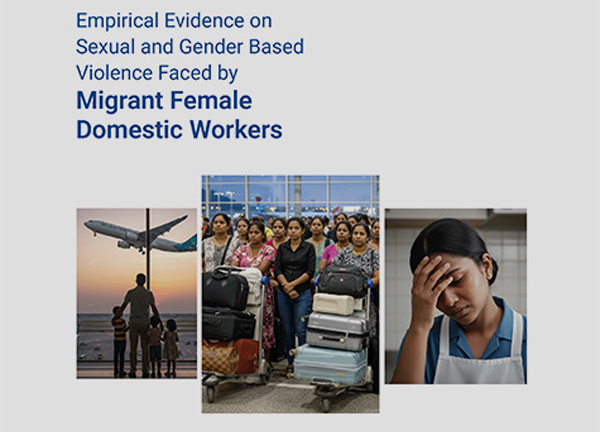
A recent study conducted by the Institute of Policy Studies of Sri Lanka (IPS) has shed light on the severity and nature of sexual and gender-based violence (SGBV) faced by Sri Lankan female migrant domestic workers in the Middle East. This research highlights the pressing need for enhanced protection frameworks to shield these vulnerable individuals from exploitation and abuse.
The study, titled “Empirical Evidence on Sexual and Gender-Based Violence Faced by Migrant Female Domestic Workers,” is based on complaint data filed with the Sri Lanka Bureau of Foreign Employment (SLBFE) and key informant interviews. It reveals that female domestic workers endure a range of violent experiences, including violations of basic human needs, harassment, deception, wage theft, and forced labor. These issues are compounded by systemic challenges such as the Kafala sponsorship system and informal employment arrangements.
Dr. Bilesha Weeraratne, the lead author of the study and Research Fellow and Head of Migration and Urbanisation Policy Research at IPS, stated, “Female domestic workers migrate under extreme economic pressure, yet their vulnerabilities abroad expose them to multiple forms of violence. Our findings indicate that, despite existing institutional and international frameworks, SGBV remains a critical issue that necessitates urgent, coordinated action.” Co-author Yashora Gunawardena, a Research Assistant at IPS, noted that the study’s innovative use of SLBFE complaint files offers new insights into the post-pandemic realities of migrant workers.
The report advocates for action across four key areas:
- Pre-emptive risk identification and awareness-raising mechanisms,
- Efficient and speedy reporting mechanisms,
- Effective support structures for positive coping mechanisms,
- Binding penalty measures to prevent further incidences of SGBV.
The study underscores the responsibility of recruitment agents, employers, governments, and civil society to minimize SGBV and support survivors. This publication acts as an urgent call to enhance existing frameworks, adopt innovative solutions, and reaffirm Sri Lanka’s commitment to protecting and promoting the rights and well-being of its migrant workforce.
For more details, the publication can be downloaded from the IPS website: www.ips.lk/empirical-evidence-on-sexual-and-gender-based-violence-faced-by-migrant-female-domestic-workers/