
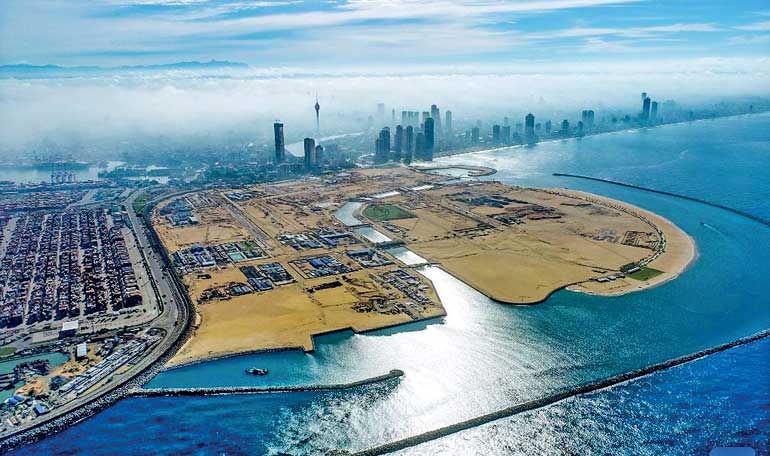
Sri Lanka has enacted new legislation concerning the Colombo Port City, setting a cap of 15 years on tax holidays for investments of one billion dollars or more. For smaller investments, progressively reduced tax rates will be applied based on predetermined criteria, as announced by Deputy Minister of Finance and Planning, Anil Jayantha Fernando.
Minister Fernando highlighted that previously, tax holidays extended up to 25 years were granted without established criteria. “We have now introduced criteria based on investment volume and job creation,” he stated. Investments of strategic importance are categorized into four classes: A – billion dollars, B – 500 million dollars, C – 100 million, and D – 25 million dollars. Additionally, businesses of secondary strategic importance will benefit from a reduced tax rate of 7.5 percent for four years.
Furthermore, under the controversial Strategic Development Project (SDP) Law, personal income taxes have been waived for businesses. As companies establish operations with reduced corporate income tax, personal income tax and value-added tax remain primary revenue sources for the government. However, Sri Lanka does not levy a value-added tax on electricity, unlike East Asian countries.
There is a notable trend of information technology companies relocating to Dubai and other areas due to Sri Lanka’s 30 percent income tax rate, compared to 20 percent in East Asia and 10 percent in the UAE. Dubai’s monetary stability, without a discretionary central bank, is also an attractive factor. Sri Lanka has a history of increasing income taxes under International Monetary Fund (IMF) programs following central bank rate cuts, which have led to currency crises since 1952. Analysts have criticized the parliament for not curbing the central bank’s power to cause currency crises through flawed monetary doctrines, which have intensified under recent ‘monetary policy modernization’ rejecting classical economic principles.
In East Asia, countries with stable monetary policies have income tax rates around 20 percent, with Singapore’s rates even lower. Sri Lanka is under IMF pressure to expand capital decumulation taxes (income and wealth taxes), which critics argue hinder domestic capital formation and increase dependency on foreign borrowing, similar to currency depreciation effects.
Economic analysts have noted that the IMF-proposed Wealth Tax is Marxian in nature and aligns with ‘progressive’ ideologies in America, as well as stimulus policies that have damaged Western public finances. Singapore’s Prime Minister, Lawrence Wong, formerly Finance Minister, rejected a wealth tax expansion proposal two years ago, favoring a value-added tax (GST) as a more effective measure. “Richer individuals who consume more inherently contribute more taxes through VAT,” Wong stated.
Sri Lanka’s current administration is also resisting IMF pressure regarding the Wealth Tax. Wong commented that such a tax is theoretically appealing but challenging to implement effectively, as demonstrated by various countries abandoning it. “Ultimately, it’s the middle and upper-middle-income groups who bear the burden of the net wealth tax, not just the very wealthy who can avoid it through tax planning,” Wong said. He also cautioned against Western fiscal policies, which have destabilized public finances through rate cuts and stimulus, following erroneous claims of deflation in America in 2001.
Stimulus measures, including money printing for growth, inflation reliance, tax cuts, or high government spending, have been introduced to Sri Lanka through IMF technical assistance, promoting potential output targeting and flexible inflation targeting.
Wong informed parliament that under Pillar One of the Base Erosion and Profit Shifting (BEPS) project, profits will be redistributed from where economic activities occur to where consumers reside. Consequently, Singapore may suffer revenue losses due to its small size. Pillar Two of BEPS establishes a global minimum corporate tax. Under this pillar, Singapore will implement a Domestic Top-up Tax (DTT), raising the effective tax rate of Multi-National Enterprise (MNE) groups to 15 percent.
“The goal of Pillar Two is for large MNEs to pay more taxes wherever they operate,” Wong stated. “When Pillar Two is enacted and Singapore adopts the Domestic Top-up Tax, we will gain additional revenue, assuming the affected MNEs remain,” he added, acknowledging this assumption’s significant uncertainty.
Despite BEPS’s intent to increase taxes on multi-national enterprises, their home countries are providing substantial subsidies to enhance competitiveness, Wong noted. Although Singapore may not match major powers in spending, it cannot remain static. “The MNEs based here aren’t permanently tied to us,” Wong noted. “They have mobility and choices, and will have more options when deciding on future investment locations. Within the region, there are alternatives with lower land and electricity costs and cheaper labor.”
These concerns are not hypothetical, as MNEs have already expressed these issues during consultations with the government. Sri Lanka also faces high electricity costs, partly due to untendered renewable energy projects (feed-in tariffs) and reliance on liquid thermal plants, unlike Asian countries with coal power. The current administration is moving towards competitive tendering. (Colombo/Dec08/2025)