
One of the defining trends in modern economic history is that debt defaults and external shocks have devastating and long-lasting economic effects, which are often amplified by natural disasters. This dynamic can create a “climate debt trap” – where the combination of high debt burdens and climate vulnerability severely constrains a nation’s ability to respond to crises and invest in long-term resilience. In this context, Sri Lanka offers a cautionary tale – and important lessons – for other developing economies navigating similar risks.
Following a pre-emptive external debt default in April 2022, Sri Lanka suffered a crippling economic contraction and rising inflation, culminating in its worst economic crisis since independence from British rule in 1948. Fortunately, the downward spiral was relatively short-lived compared to other debt-distressed economies. The economy began to stabilise in late 2023, supported by a US$2.9 billion 17th International Monetary Fund (IMF) programme, US$4 billion in emergency aid from India in 2022 and prudent monetary policy by the Central Bank of Sri Lanka under Governor Dr. Nandalal Weerasinghe.
A new left-leaning National Peoples Party (NPP) government, led by President Anura Kumar Dissanayake, took office in late 2024 with a broad reform agendaranging from digital transformation and improving governance to cutting public sector waste and increasing welfare provisions. Crucially, it took the politically difficult but pragmatic decision to continue with the revenue-based fiscal consolidation required under the IMF programme, despite having campaigned for renegotiation of its terms. The anti-IMF stance was not unexpected: the NPP represents a so-called ‘third force’ in Sri Lankan politics – a progressive coalitionof political parties, trade unions, women’s organisations and civil society groups challenging traditional parties in Sri Lanka.
That pragmatism paid off. During its first year in office, the NPP’s presided over a continued economic recovery. Data for end-November 2025 show GDP growth of 5.4% in Q3 2025 (up from 4.9% in Q2), year-on-year National Consumer Price Index (NCPI) inflation falling to 2.4% and foreign currency reserves rising to US$5.9 billion. Tourism has rebounded strongly, with arrivals exceeding 2 million in 2025, returning to late-2010s peak levels.
However, serious social scars remain. Income poverty is still estimated to affect around 22% of the population – roughly double pre-crisis levels – and child malnutrition remains alarmingly high. These outcomes stain a country once hailed by Economics Nobel Laureate Professor Amartya Sen as a “basic needs success story”, achieving high social outcomes despite low income levels.
The recovery enabled the NPP government to revert to its welfare-oriented mandate alongside the IMF programme in the 2026 national budget, presented to Parliament on 7 November 2025. The budget theme, Steady and Strong: Committing to Fiscal Discipline for a Resilient Economy, largely aligns with the IMF’s revenue-based fiscal consolidation path. It targets a primary surplus of 2.5% of GDP, government revenue of 15.4% of GDP and an overall fiscal deficit of 5.1% of GDP for 2026.
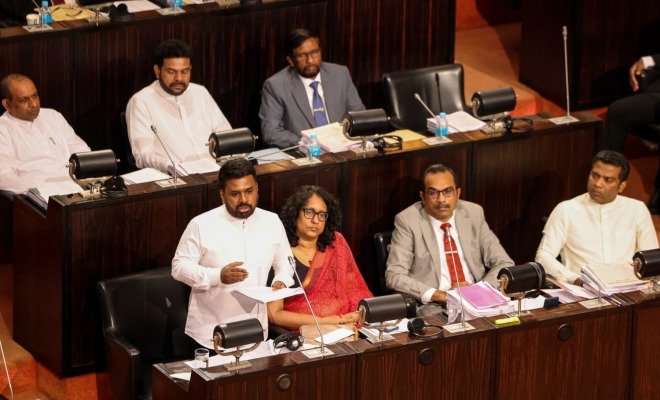
Image credit:President Anura Kumara Dissanayake presents the Budget 2026 to Parliament on 7 November 2025. Photo: The Parliament of Sri Lanka
Crucially, the government’s success in raising the tax-to-GDP ratio to an estimated 15.4% in late 2025 (up from 8.2% in 2022) – through widening the tax base and revenue administration reforms, alongside significant underspending on investment – the budget created fiscal space and political relief for the NPP’s core supporters. Key budget provisions include new housing for low-income families, investment in irrigation infrastructure vital for agricultural development, public servant salary increases, the creation of 75,000 public sector jobs and the controversial decision to import double-cab vehicles for MPs.
However, the budget’s headline growth target of around 7% in 2026 appears overly ambitious, particularly given the IMF’s more conservative projection of 3.1%, Sri Lanka’s moderate historical growth performance and an uncertain global economic environment. Critics also highlight the budget’s heavy reliance on the IMF’s macroeconomic framework, the lack of a concrete plan for developing the real sector and insufficient attention to export expansion and attracting inward investment.
The impact of Cyclone Ditwah
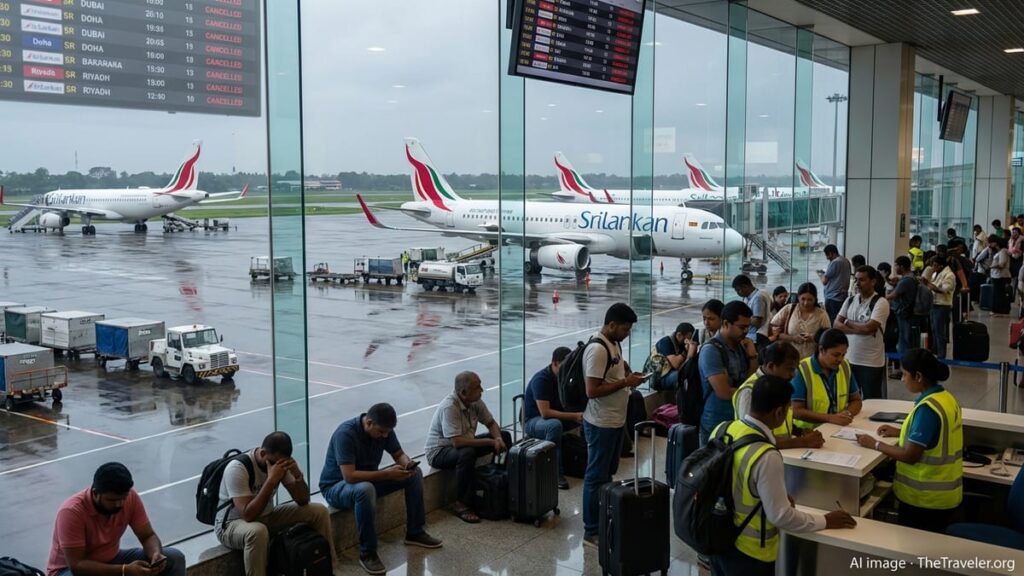
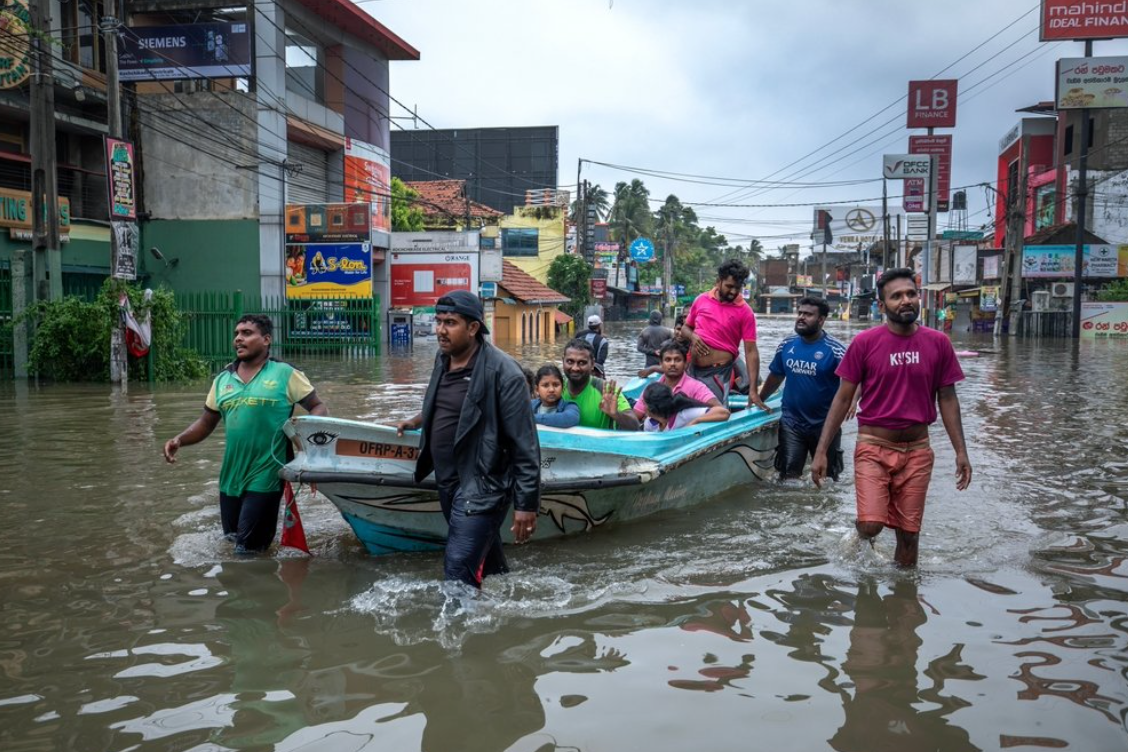
Tragically, natural-disaster-related external shocks appear increasingly frequent in the Asia-Pacific region, and Cyclone Ditwah has dampened the post-budget economic outlook in Sri Lanka. Between late November and early December 2025, Cylone Ditwah struck with strong winds and heavy rains, flash floods and landslides, causing extensive death and damage nationwide. Two international assessments have estimated the scale of its human and economic toll.
According to the United Nations in Sri Lanka, nearly 10% of the population was affected, with over 600 people dead or missing to date, and more than 91,000 homes damaged or destroyed. While the death toll and damage to homes were lower than during the 2004 Indian Ocean Tsunami – Sri Lanka’s worst natural disaster which caused 35,000 deaths/missing, damaged 110,000 homes and resulted in over US$1 billion in asset losses and US$330 million in lost output – the overall economic and infrastructure damage from Cyclone Ditwah appears higher, as all 25 districts were affected. The human impact was concentrated in central and south-central districts including Kandy, Badulla, Nuwara Eliya, Kurunegala and Matale, where hill-country communities faced landslides and severe access constraints.
The World Bank Global Rapid Post-Disaster Damage Estimation (GRADE) assessed total damage at US$4.1 billion – around 4% of Sri Lanka’s 2024 GDP. Infrastructure damage accounted for 42% of losses, followed by residential buildings (24%), agriculture (20%) and non-residential buildings (14%). While significant, these estimates may be conservative compared to similar natural disasters in Southeast Asia.
The NPP government’s policy response to Cyclone Ditwah has had three main pillars. First, it appealed for foreign aid for relief and reconstruction: the IMF Board approved US$206 million in emergency funding under its Rapid Financing Instrument (RFI); the World Bank committed US$120 million by repurposing funds from ongoing projects; while the Asian Development Bank (ADB) provided US$43 million for trade finance and disaster relief. Key bilateral aid commitments include India (US$450 million), Japan (US$2.5 million), the United States (US$2 million) and China (US$143,000).
Second, the government announced relief measures for affected households – including compensation for destroyed houses, cash grants of LKR25,000 (around S$104) per victim) and repairs to critical infrastructure. Third, a “Rebuild Sri Lanka Fund” was established, with a management committee appointed.
However, the Fund’s management committee – composed solely of senior officials and corporate leaders – has drawn political criticism for lacking broader representation and gender balance. Other concerns include inadequate early warning systems ahead of the cyclone, poor preparedness, slow distribution of aid to the worst-affected regions and limited financial flows into the Fund.
Five policy priorities for a resilient recovery
To build better and more resilient growth in the aftermath of Cyclone Ditwah, the NPP government should focus on five policy priorities:
- Develop a costed, post-Cyclone Ditwah reconstruction implementation strategy for the Rebuild Sri Lanka Fund. This should be done in partnership with the World Bank and Asian Development Bank, ensuring international oversight and leveraging multilateral development bank resources. Well-designed public-private partnerships (PPP) can complement gaps in state capacity. The strategy must emphasise early warning systems, disaster-resilient infrastructure (roads, railways, energy and housing), disaster bonds and insurance and institutional capacity- building. Well-targeted public reconstruction expenditure can have useful fiscal multiplier effects on growth.
- Prioritise use of internal resources rather than over-reliance on foreign aid, which is common in natural disaster situations. As of end-December 2025, total emergency aid commitments stood at approximately US$818 million – only around 20% of the World Bank’s damage estimate. The government should rapidly upscale relief using domestic resources, including underspent capital budgets held in state banks. A proportion of foreign currency reserves should be used to import essential food and medicine, improving affordability and availability, which would be politically popular.
- Engage the IMF to revise fiscal targets modestly within the existing programme. Sri Lanka’s strong programme implementation likely facilitated the rapid approval of the RFI without additional conditionality, and the IMF has postponed the fifth programme review to allow time to assess cyclone-related damage. It is pragmatic to negotiate easing of the primary surplus target to accommodate reconstruction needs. While some economists, including Nobel Laureate Joseph Stiglitz, and Thomas Piketty, have advocated suspending debt repayments, such a move risks alienating international capital markets and raising future borrowing costs. The 2022 sovereign default provides a stark reminder of the severe economic and social costs of debt distress and unsustainable solutions.
- Establish a dedicated disaster management agency or ministry. A previous government abolished the ministry responsible for natural disasters, transferring functions to the military, likely over-stretching security forces ill‑suited to civilian disaster coordination. A specialised ministry would improve preparedness, coordinate rapid response, allocate resources effectively and liaise across government agencies and the military. Development partners can assist in capacity building. Japan’s disaster-management system, known for rigorous preparedness, advanced early-warning systems and community training, could serve as a model.
- Implement ‘big bang’ reforms and growth policies to transition from IMF stabilisation to transformative growth. With significant debt repayments due from 2028, concerns persist over whether reserve accumulation will be sufficient to meet external obligations, import needs and reconstruction costs. Global economy volatility, geopolitical tensions and trade policy uncertainties add further complexity. The space provided by the IMF programme should be used to advance economic reforms and growth-oriented policies that shore up the recovery. A recent ODI Global–CEPA independent growth study outlines 30 policy proposals focused on macroeconomic stability, global supply chain integration, improved factor markets, poverty reduction and consensus-building, to capitalise on opportunities in tourism, the digital economy and niche manufacturing. The study also recommends appointing an independent growth commission to formulate a national growth plan and build a durable national policy consensus.
It is too early to conclude that Sri Lanka has fallen into a climate debt trap. However, Cyclone Ditwah, layered atop recent debt default, heightens economic risks in 2026 beyond those anticipated in the November budget. The budget’s growth target appears implausible given devastated agriculture, damaged infrastructure, disrupted tea and garment exports, increased import needs and mounting budgetary pressures from reconstruction costs. Balancing upside risks from reconstruction spending against downside risks such as increased inflation, the Central Bank of Sri Lanka currently forecasts growth of 4–5% in 2026.
The broader development lesson is clear: debt-distressed countries remain vulnerable to external shocks, and recovery paths are perilous. Nonetheless, even in challenging domestic and global economic conditions, well-designed, credible and inclusive public policies can steer a country’s growth trajectory towards more resilient and sustainable growth – and improved prosperity for its people
Source: ODI Global