
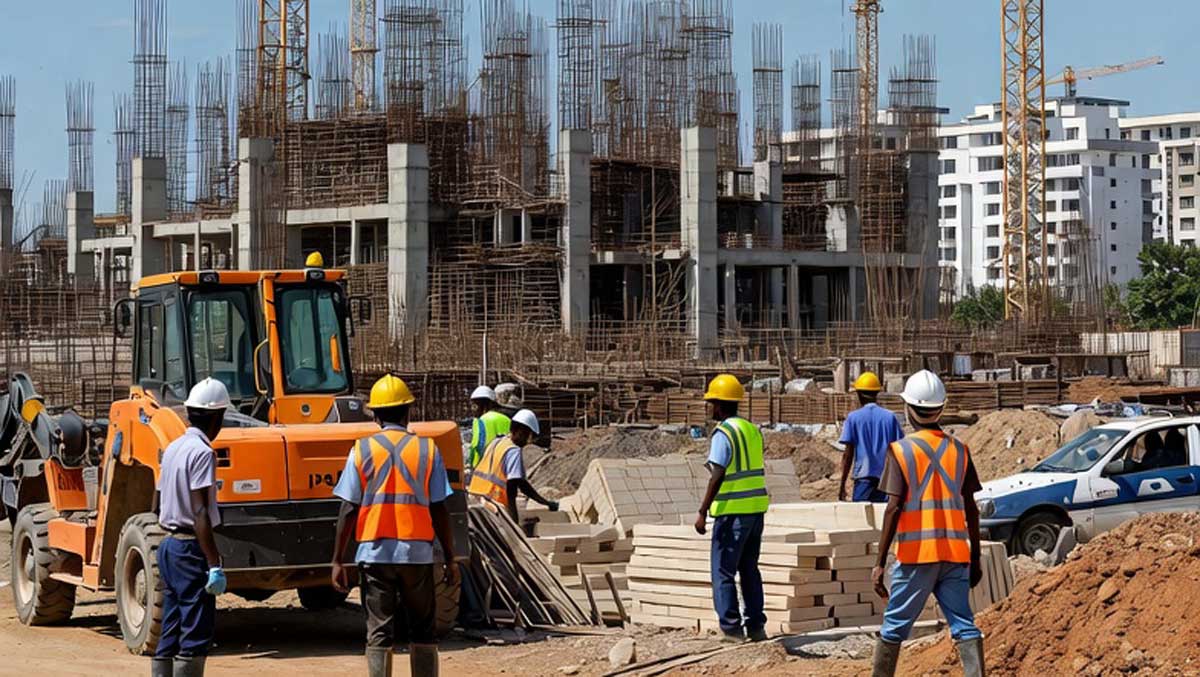
FINANCIAL CHRONICLE – Leading construction firms in Sri Lanka have submitted a request to import 7,500 workers to address an anticipated shortage of 20,000 staff by 2026, according to Kumudu Lal Bogahawatta, Secretary to the Ministry of Housing and Construction. Currently, the construction industry faces approximately 10,000 unfilled positions.
“The construction industry is experiencing human resource challenges,” Bogahawatta informed reporters in Colombo. “A significant issue is the recent trend of engineers emigrating. Although around 1,400 engineers graduate annually, only a few choose to stay in the country.”
He further highlighted a substantial shortage of skilled tradesmen and their assistants in the industry.
Sri Lanka is in the process of recovering from an economic downturn and external debt default, a situation exacerbated by interest rate cuts in 2020 aimed at flexible inflation targeting and potential output targeting.
Importing Labour
Bogahawatta stated, “We estimate the need for approximately 20,000 workers this year. Connecting with 20,000 new workers would be a significant relief.”
Reconstruction efforts following Cyclone Ditwah are also expected to increase labor demand. Currently, major construction companies are seeking to import labor, with foreign workers already present in the country.
“Leading construction firms are seeking permission to bring in foreign labor,” Bogahawatta noted. “They plan to bring in around 7,500 workers. Some have already arrived from India, Bangladesh, and Nepal.”
He added, “We do not intend to impose legal restrictions on them. However, we are working to provide productive locally trained workers as alternatives to foreign workers.”
Dignity of Labour
Despite the availability of unemployed youth in rural areas, there is a reluctance to pursue construction jobs due to perceptions about the industry. “Many young people in villages are waiting for employment opportunities,” Bogahawatta explained. “However, there are vacancies in the construction sector, indicating a disconnect between the two.”
“We aim to provide these youths with the opportunity to earn around 100,000 rupees and elevate their professional standing. There are issues concerning self-image among both skilled and unskilled workers,” he continued. “There is a need for approximately 10,000 workers. Our surveys indicate that the potential workforce exists but also needs job security.”
Bogahawatta elaborated, “We have initiated a process to offer necessary qualifications such as the NVQ and connect them with local construction companies or even foreign employment opportunities by training them as craftsmen.”
Boom Bust
Sri Lanka has experienced consecutive currency and stabilization crises due to inflationary rate cuts aimed at boosting inflation (flexible inflation targeting) or growth (potential output targeting). The real estate and construction sectors often suffer first during stabilization crises as rate cuts are reversed, resulting in half-completed high-rises and unsold apartments.
When the currency weakens due to rate cuts, housing becomes unaffordable at existing income levels, causing people to halt new construction projects or suspend ongoing ones. Consequently, construction workers tend to return to their home villages. Following a sovereign default, government projects were also suspended, leading some workers to seek opportunities abroad.
During the 2019 stabilization crisis, which followed monetary expansion to lower rates in 2018 under ‘flexible inflation targeting,’ the construction sector contracted by 14.8 percent, while overall economic growth declined from 4.3 to 2.9 percent.
Unlike 2019, when the rupee fell from 152 to 184 against the US dollar, in 2022 the rupee plummeted from 200 to 360 against the US dollar due to a failed currency float with a surrender rule in place.
In 2023, the construction sector contracted by 20.8 percent, following a 20 percent decline in 2022, amid a stabilization crisis triggered by 2020 rate cuts. However, in 2024, the sector expanded by 19.4 percent as the overall economy grew by 5.0 percent, with the central bank maintaining a stable exchange rate and construction costs controlled as the monetary authority missed its inflation target.
In the first nine months of 2025, the construction sector expanded by another 10.5 percent.
(Colombo/Jan16/2026)