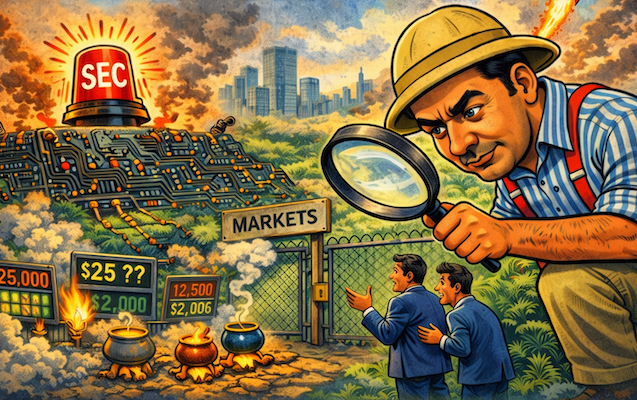
The Securities and Exchange Commission of Sri Lanka has done what it is supposed to do—eventually. It warned the public, referred the matter to the CID, and distanced the capital market from an unlicensed operator trading under the reassuringly nautical name of Blue Ocean Securities. The message was clear: this entity was not authorised, its app was not recognised, and investors should keep their wallets—and hopes— well away.
All of that is correct. All of it is necessary. And all of it came after the horse had already left the stable, checked into a hotel, and started charging admission.
This is not a critique of intent. It is a critique of timing.
Sri Lanka’s capital markets are at a fragile moment. Retail participation is rising, not because households have suddenly become sophisticated investors, but because traditional savings instruments no longer offer shelter. When interest rates fall and inflation lingers, people look elsewhere. That “elsewhere” increasingly arrives via WhatsApp groups, Telegram channels, glossy apps, and confident voices offering certainty in a market defined by risk.
hat is precisely when regulation must move from reactive to anticipatory.
The SEC’s warning on Blue Ocean Securities underscores a deeper structural problem: regulators in Sri Lanka are often excellent firefighters and hesitant fire inspectors. By the time public notices are issued, bank accounts traced, and criminal complaints filed, the damage—financial and psychological—has already occurred. Investors don’t remember the regulator’s warning; they remember the money they lost before it arrived.
This is not unique to Sri Lanka. But it is particularly dangerous here, because financial literacy is uneven, trust in institutions is thin, and economic stress lowers scepticism. In such an environment, unlicensed operators don’t need sophisticated deception. They only need speed.
Speed, unfortunately, is where regulation often loses.
The uncomfortable truth is that modern market abuse rarely announces itself formally. It does not apply for licences it does not intend to obtain. It does not wait for approval.
It moves first, markets aggressively, and grows quietly—until the numbers become too large to ignore. At that point, enforcement becomes unavoidable, but prevention has already failed.
The SEC’s mandate is not merely to punish violations after the fact. It is to protect market integrity in real time. That means scanning the digital periphery of the market as carefully as the trading floor. It means monitoring app stores, social media advertising, influencer endorsements, and suspicious claims of guaranteed returns. It means working with telecoms, banks, and platform providers before retail money is pooled, not after it has vanished.
Public warnings are useful. Criminal referrals are necessary. But neither is a substitute for early intervention.
There is also a reputational cost to reactive regulation. Each scam that flourishes before being shut down chips away at confidence in the market itself. Retail investors don’t distinguish between a fraudulent platform and the stock exchange they were told it resembled. When trust collapses, it collapses indiscriminately.
That is how markets stagnate—not because regulation was too strict, but because it arrived too late.
None of this requires draconian powers or regulatory theatrics. It requires prioritisation. A willingness to treat unauthorised market activity as a predictable risk, not a surprising event. And an acceptance that in a digital economy, silence is not neutrality—it is permission.
The SEC has shown that it can act. The question now is whether it can act earlier.
Because in capital markets, the most effective regulation is the one investors never have to read about in a warning notice. It is the intervention that happens quietly, before the app goes viral, before the testimonials appear, and before confidence is monetised into loss.
If the lesson from Blue Ocean Securities is merely that the SEC responds decisively once alerted, then the lesson is incomplete. The real test is whether the next such scheme is detected before it needs a headline.
Regulation, after all, is not about catching villains for applause. It is about making sure fewer people ever meetthem.
And that is a job best done upstream, not in the wreckage downstream.