Do the CSE’s Actions on 7 January 2026 Breach Fundamental Rights?
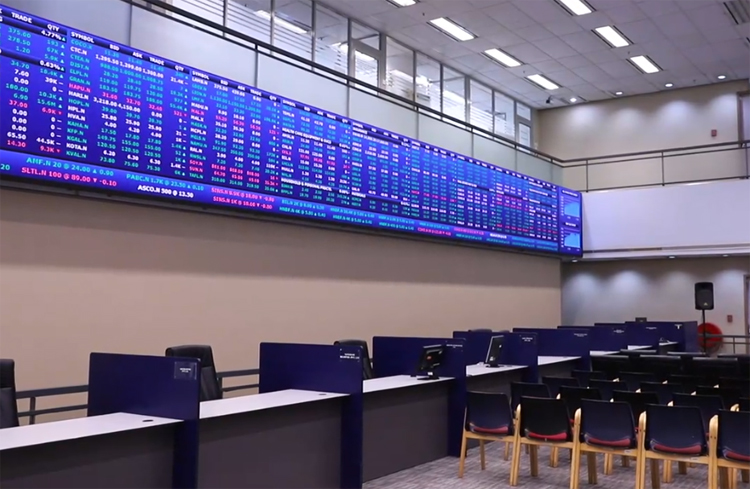
On 7 January 2026, the Colombo Stock Exchange (CSE), with the concurrence of the Securities and Exchange Commission of Sri Lanka (SEC), halted trading at 9.54 a.m. and cancelled all orders and transactions executed earlier that day, citing unusually high prices caused by market orders on the first day of trading of WealthTrust Securities Limited. The CSE further announced a structural change to its trading system, disallowing market orders on the first day of trading of newly listed securities.
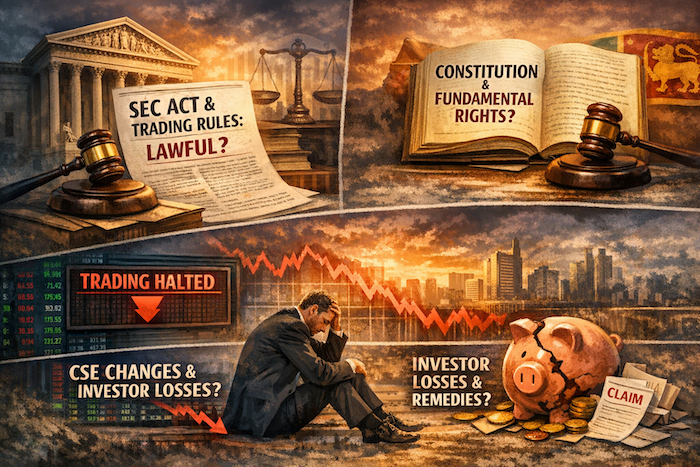
These actions raise three interlinked legal questions:
- Was the halt and blanket reversal of trades lawful under the SEC Act and Trading Rules?
- Do such actions amount to an infringement of fundamental rights under the Constitution?
- Can the CSE change core trading mechanics without amending the SEC Act, and what remedies are available to investors who suffered losses?
Statutory Powers: What the Law Clearly Allows
Authority to Halt Trading
The SEC Act explicitly mandates the creation and maintenance of a “fair, orderly, efficient and transparent securities market” and empowers the Commission to issue directives to market institutions to achieve that objective (Sections 3 and 16). In parallel, the CSE Trading Rules expressly recognize market-wide trading halts where necessary to preserve market integrity (Rule 15 – Trading Halts)
Accordingly, the decision to halt trading itself is squarely within statutory authority.
The Harder Question: Cancellation of Executed Trades
While halting trading is contemplated by law, the cancellation of already executed trades is legally far more sensitive.
Under the Trading Rules, market orders are a recognized and lawful order type, governed by detailed protection-price mechanisms designed precisely to prevent extreme executions (Rules 1.2–1.2.2). At the time of the trades in question, market orders were valid, system-enabled, and rule-compliant.
Neither the SEC Act nor the Trading Rules provide for a general, retroactive annulment of all trades of a trading day purely on price grounds, absent fraud, system malfunction, or illegality attributable to participants. The CSE media release itself does not allege fraud, manipulation, or rule breaches by investors, but rather “unusually high prices” caused by lawful market orders.
This raises a serious issue of legal certainty:
- Investors acted under existing written law and rules, which Article 16 of the Constitution expressly preserves.
- Retroactively nullifying lawful transactions undermines the predictability that is fundamental to any regulated market.
Fundamental Rights Analysis Under the Constitution
Equality Before the Law – Article 12(1)
Article 12 guarantees equal protection of the law. A blanket cancellation disproportionately affects one class of investors—those who traded early and lawfully—while restoring others to a position they never contractually earned. Such differential treatment, without individualized findings of wrongdoing, is constitutionally vulnerable.
Freedom to Engage in Lawful Trade – Article 14(1)(g)
The Constitution protects the freedom to engage in any lawful occupation, trade, business, or enterprise. Stock market trading, conducted under SEC-approved rules, clearly falls within this protection. While Article 15 allows restrictions prescribed by law in the public interest, post-facto cancellations not clearly authorized by law risk failing the test of proportionality and legality.
Executive Action and Judicial Review
Under Article 17 read with Article 126, any executive or administrative action that infringes a fundamental right is justiciable before the Supreme Court. Decisions of the CSE, acting under statutory authority, qualify as executive action for this purpose.
Can the CSE Change Trading Rules Without Amending the SEC Act?
The SEC Act allows market institutions to make and amend Trading Rules, subject to SEC oversight (Section 64). Therefore, disallowing market orders on the first day of trading going forward is legally permissible, provided it is:
- Prospective (not retrospective),
- Properly approved, notified, and transparent, and
- Consistent with the objectives of investor protection and market fairness.
However, such rule-making power does not cure or justify retroactive interference with vested contractual rightsarising from trades executed under the old rules.
Are Investors Entitled to Buy or Sell at Any Price?
In principle, price discovery is the core function of an exchange. The Trading Rules already embed safeguards (price bands, protection prices, auction mechanisms) to manage volatility. Once these safeguards are complied with, the law does not recognize a “fair price” imposed after the fact. If every sharp price movement is reversed ex post, the market ceases to be a market and becomes an administrative allocation system.
Remedies Available to Affected Investors
Investors who suffered losses due to the halt and cancellation have several legal avenues:
- Fundamental Rights Application (Supreme Court)
Alleging violations of Articles 12 and 14 through arbitrary executive action under Article 126 of the Constitution constitution-Latest. - Judicial Review / Writ Jurisdiction (Court of Appeal)
Challenging the legality, reasonableness, and proportionality of the decision. - Statutory Compensation Mechanisms
The SEC Act establishes a Compensation Fund for investors who suffer losses due to regulatory failures or misconduct (Part VI, Sections 158–161), subject to interpretation and applicability. - Civil Claims
If contractual or tortious liability can be established against intermediaries or institutions.
Conclusion
The market halt on 7 January 2026 can be justified under existing law. The blanket cancellation of executed trades, however, stands on far shakier legal and constitutional ground. While regulators must act decisively to prevent systemic risk, the rule of law demands that investor protection not become investor expropriation. Markets depend not on hindsight corrections, but on predictable rules applied equally, prospectively, and within constitutional limits.
In the final analysis, fairness in markets is not achieved by undoing lawful outcomes—but by ensuring that the rules governing risk are known, stable, and respected by both regulators and investors alike.