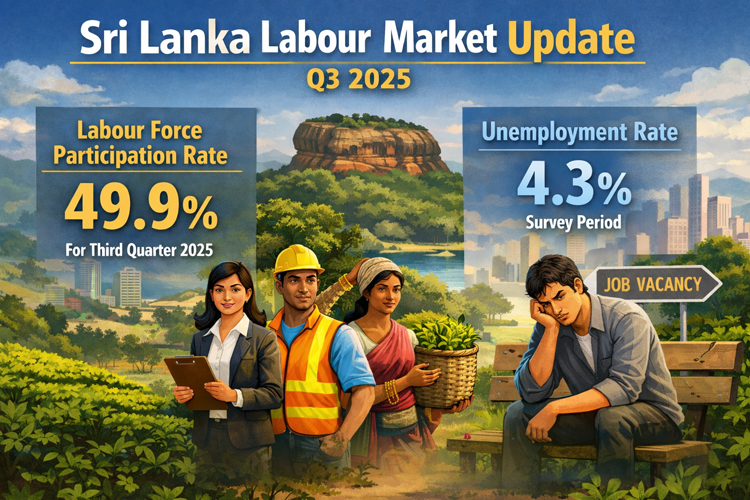
In the third quarter of 2025 (July–September), Sri Lanka’s labor force participation rate increased to 49.9%, as reported in the latest quarterly bulletin from the Department of Census and Statistics under the Ministry of Finance, Planning, and Economic Development. This represents a significant recovery from 46.9% in the same period in 2024 and 49.3% in the second quarter of 2025.
The economically active population was approximately 8.47 million, with males accounting for 63.3% and females 36.7%. Notably, female participation rose to 33.9%, up from 29.4% a year prior, while male participation was recorded at 68.6%. The inactive population was nearly equal in size at 8.49 million, predominantly female (71.2%).
Employment numbers reached 8.10 million individuals, an increase from 7.84 million in the third quarter of 2024. The services sector continued to lead, employing nearly half (49.8%) of the workforce, followed by industry (26.8%) and agriculture (23.4%). Both the industry and services sectors experienced gains compared to the previous year, indicating modest shifts away from agriculture.
The unemployment rate saw a slight increase to 4.3% from 4.2% in the third quarter of 2024, affecting 367,000 people. Gender disparities remain evident, with women facing a 6.2% unemployment rate compared to 3.2% for men. Youth unemployment (ages 15–24) continued to be high at 19.2%, with females in this demographic experiencing a rate of 22.8%. Unemployment is particularly pronounced among those with higher education (GCE A/L and above: 7.0%), especially among educated women (9.0%).
Private sector employees made up the largest employment category, while own-account workers were notably present in agriculture. Over two-thirds of employed individuals worked 40 or more hours per week.
These statistics suggest a gradual post-pandemic stabilization in labor market participation, particularly among women. However, challenges remain in reducing youth and female unemployment and in fully integrating educated workers into the workforce. The Department of Census and Statistics emphasized that estimates should be interpreted with consideration of sampling variability when assessing changes over time.