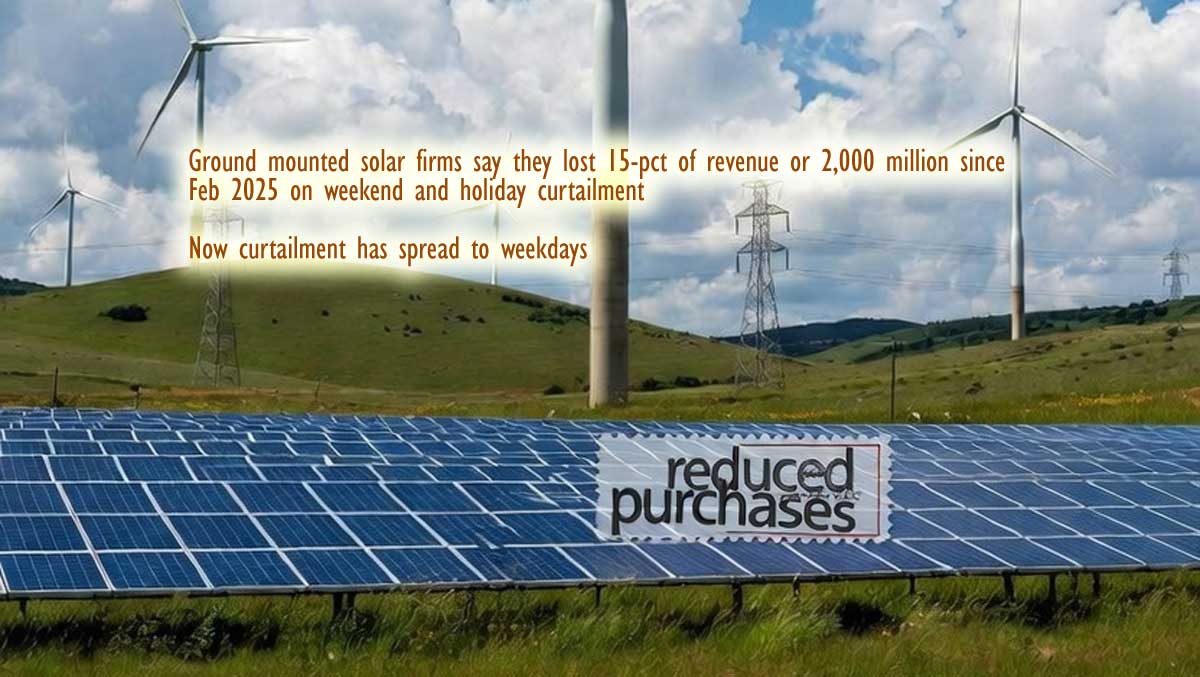
FINANCIAL CHRONICLE – Solar power producers in Sri Lanka are requesting compensation for reduced power purchases, citing an inability to service debts due to the curtailment of renewable power aimed at maintaining grid stability. This curtailment, which initially began on weekends and public holidays, has recently extended to weekdays.
The state-run Ceylon Electricity Board (CEB) initiated power curtailment measures in February 2025 following a national power failure caused by an excessive share of solar power in the grid, a phenomenon referred to as the ‘Sunny Sunday’ effect. This situation diminished the inertia provided by rotating generators.
The Grid Connected Solar Power Association of Sri Lanka reports that ground-mounted solar firms have incurred losses of approximately 2 billion rupees, equating to around 15 percent of their revenues due to curtailment. With the extension of curtailment to weekdays, solar companies are now experiencing up to three days of reduced power purchases, severely impacting cash flow.
“We are now unable to service loans taken to build the plants,” stated Prabath Wickramasinghe, President of the Association. “These plants were built as ‘must run’ facilities. This is a violation of the power purchase agreement.”
The solar companies are not demanding full take-or-pay style payments but are seeking reasonable compensation to avoid loan defaults. Wickramasinghe suggested that appointing a committee to determine payments transparently would enable firms to manage their debts.
Committee member Kishan Nanayakkara highlighted that unlike Independent Power Producers (IPPs) that receive a capacity charge, grid-connected solar companies rely solely on the full energy charge. Additionally, while some solar companies receive feed-in tariffs of around 25 rupees, others, having gone through competitive bidding, earn between 15 to 18 rupees per unit.
Feed-in tariffs are contentious due to their high, negotiated prices in Sri Lanka. However, companies engaged in competitive bidding have received prices transparently and fairly, without allegations of corruption or lobbying, and operate on thin profit margins.
Wickramasinghe cautioned that foreign investors might be deterred from participating in future tenders or might demand higher premiums if curtailment continues to threaten their businesses.
The proposed solution involves providing solar firms with a battery tariff to store energy and sell it to the grid during nighttime peaks. The CEB had previously published a rate of 45.80 rupees per unit for power sold at night through a battery energy storage system (BESS), but no action has been taken to implement this plan. Despite repeated requests, no guidelines or contract amendments have been provided, as noted by Nanayakkara, and the December deadline has passed.
Nanayakkara emphasized that until battery storage solutions are implemented, firms should receive sufficient compensation to manage loan repayments. Some companies, according to Association members, are leveraged at around 70 to 80 percent.
The power minister in Sri Lanka previously noted that after lobbying for high feed-in tariffs in the past, renewable firms invested insufficient equity in projects, resulting in high costs for the public or losses for the CEB. The CEB itself has suffered losses, as it was not permitted to increase tariffs until a default occurred, leading to currency depreciation between 2015 and 2022.
The last tariff increase occurred in 2012 following inflationary rate cuts that devalued the currency from 113 to 132 during an IMF program. Unlike utilities in India, China, and Vietnam, which have constructed large coal bases, the CEB was prevented from building such plants. Due to poor investment conditions under flexible inflation and output targeting, large renewable firms now operate on a dollar-denominated tariff. (Colombo/Jan22/2026)