For today’s youth, questions about life choices are surfacing earlier, accompanied by increasing uncertainty. Decisions regarding what to study and which career path to pursue no longer come with the clear guidance of previous generations. The evolving landscape of education and careers, combined with unpredictable long-term security, requires young people to approach these decisions differently.
Contrary to the common belief that social media is predominantly used for entertainment, young people are increasingly leveraging these platforms to explore life choices. Platforms like TikTok are being utilized for more than just escapism; they are becoming tools for understanding how others prepare for exams, what various degrees entail, what daily work life looks like, and which skills are essential beyond formal qualifications. This indicates a significant shift in behavior, transforming social media into a platform for observation and comparison. Through the lived experiences shared by others, young people are better able to evaluate their options and make informed decisions in a world where traditional guidance is less applicable.
Exam Preparation, Redefined through Search
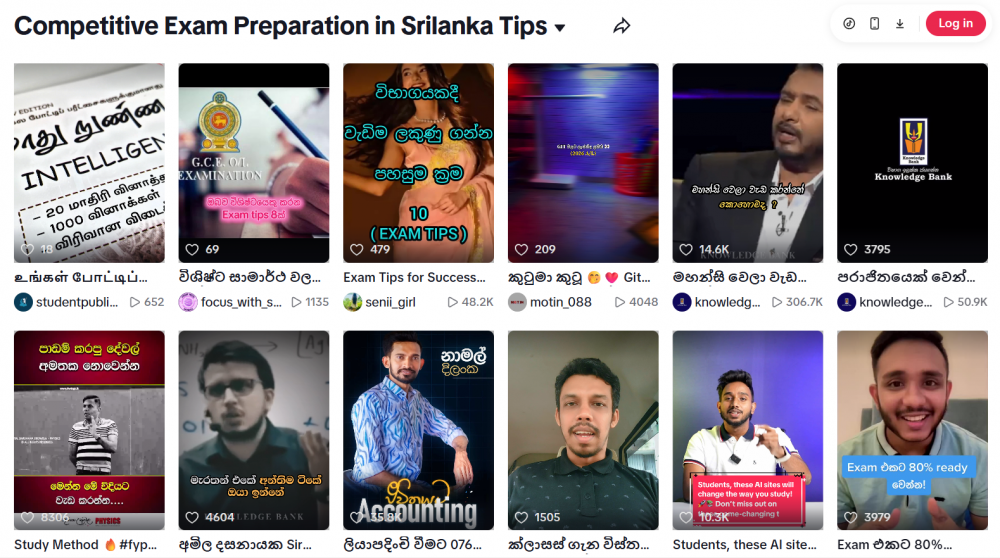
Exam preparation is no longer solely about mastering content; it is also about managing uncertainty. Students today face the challenge of not only deciding what to study but also determining how to study effectively in a highly competitive environment. Traditional support systems such as schools, tuition classes, and printed materials often provide instruction but lack insights into the preparation process. Consequently, many students turn to TikTok—not for direct answers to exam questions, but for insights into real-world preparation strategies.
What emerges from these searches is a form of peer benchmarking. Students encounter videos that document daily study schedules, subject-specific revision strategies, exam-week routines, and time management decisions. These videos vary widely; some depict intensive, structured preparation, while others show study sessions fitted around school, tuition, and family commitments. Some focus on efficiency and prioritization, while others address recovery after falling behind. Collectively, this content allows students to compare different approaches, identify trade-offs, and set realistic expectations—an aspect often missing from formal instruction.
The importance of this shift lies in how it reframes exam preparation. TikTok searches do not prescribe a singular “best” method or replace academic teaching. Instead, they reveal the variability in preparation methods. By observing how different students adapt to various constraints, search becomes a tool for decision-making rather than mere imitation. It helps students address a more nuanced question: not what is the right way to study, but what is a practical way to study, given their unique circumstances.
Education Pathways and Subject Choices in a Changing Global Landscape
Education choices are increasingly influenced by the shifts in the global economy. Emerging industries in technology, digital services, data, sustainability, and remote work are developing alongside traditional sectors, while automation and artificial intelligence continue to transform established professions. Consequently, the link between formal qualifications and long-term career outcomes is becoming less linear. Young people are more aware of this reality, leading them to prioritize relevance, flexibility, and future adaptability over reputation when choosing subjects and degrees.
This awareness is evident in how young people use TikTok’s search function. Instead of solely relying on prospectuses or rankings, they look for content that illustrates how different educational paths unfold in practice. Searches on fields of study, degree types, or post-school options surface short-form videos from current students and early-career professionals discussing workload, skill application, employability, and transitions into work. Some content compares academic streams or degree routes, while other videos document shifts in direction—such as switching subjects, combining formal education with certifications, or reassessing choices after encountering industry realities. In this way, TikTok’s search function enables young people to observe outcomes and compare trajectories in real time, against a backdrop of rapidly evolving labor markets.
Career Curiosity and the Rise of “Day-in-the-Life” Content
For years, insights into professional life were primarily obtained from limited sources like magazines, industry reports, or major career websites, offering curated glimpses into selected professions. Access to such perspectives was restricted in both scope and frequency. Today, career exploration is far more accessible and immediate.
Through #LearnonTikTok, young people gain firsthand accounts from individuals across diverse fields—structural engineers, laboratory researchers, astronomy students, early-career professionals in creative and technical disciplines, and those still in training. These short-form videos capture ordinary workdays, learning processes, setbacks, and progressions over time. Viewers witness not only outcomes but also routines, trial and error, and adjustments. TikTok’s search results surface subject-matter expertise and lived experiences, enabling young people to observe the realities of different careers at scale. What was once confined to limited editorial formats is now accessible through search, offering a more comprehensive and representative view of professional life than traditional career guidance.
Skill-Building as Experimentation, Not Enrolment
Young people today build skills in a fundamentally different sequence than previous generations. Learning no longer begins with commitment; it begins with experimentation. While earlier generations enrolled in courses first and discovered fit later, young people now use search to test relevance, difficulty, and applicability before investing time or money. This shift reflects a more cautious, strategic approach to learning, shaped by rapidly changing industries and the rising cost of formal education.
In this context, TikTok plays a distinct role. Young people are not searching solely for tutorials but for context. A student preparing for final exams might look up project management and encounter short-form videos demonstrating how the skill is applied in real roles, along with references to free courses or structured learning resources hosted elsewhere. Others searching for industry-relevant skills are exposed to discussions about what employers truly value—communication, analytical thinking, tool proficiency—often with clear pathways to deeper knowledge beyond TikTok itself. Thus, search acts as a connector rather than a destination, helping young people map learning pathways, assess returns on effort, and integrate skill-building alongside exams, degrees, or early work experiences in a deliberate, informed manner.
More Than a Search Bar…
This behavior shift highlights not a change in how much attention young people give to social platforms but a change in how those platforms are utilized. TikTok’s search function has evolved from a means of finding content into a tool for evaluating real-life choices. Young people use it to see how exams are managed under pressure, how education pathways translate into work, how careers develop beyond titles, and which skills carry weight in actual industries. The power of this lies in exposure: search surfaces lived reality at scale, allowing users to compare outcomes, recognize trade-offs, and assess risks before committing time, money, or effort—an advantage once limited to those with privileged access to mentors or professional networks.
This is why TikTok’s search function can no longer be viewed as a secondary feature of a social platform. It has become a practical decision-making tool shaping how young people prepare for exams, choose education paths, explore careers, and build skills. In a world where traditional routes no longer guarantee stability, search is less about finding quick answers and more about making informed, better decisions.