
Fitch Ratings has reaffirmed the National Long-Term Rating of Sri Lanka-based power generator WindForce PLC at ‘A+'(lka), with a Stable Outlook.
WindForce’s rating is bolstered by its expanding presence as a key renewable power generator in Sri Lanka and various regional markets. This is supported by its resource diversity and steady cash flows through long-term power purchase agreements (PPAs). However, the rating is limited by the credit profile of the Ceylon Electricity Board (CEB, A(lka)/Stable), which is a major off-taker, accounting for over 80% of WindForce’s earnings before interest and taxes (EBIT).
Fitch projects that WindForce’s EBITDA net leverage will increase in the financial year ending March 2027 (FY27) due to substantial debt-funded capital expenditure for new generation plants. It is expected to decline thereafter as these plants become operational, maintaining the Stable Outlook. Nonetheless, failure to reduce leverage in FY28 as anticipated could put pressure on WindForce’s rating.
Key Rating Drivers
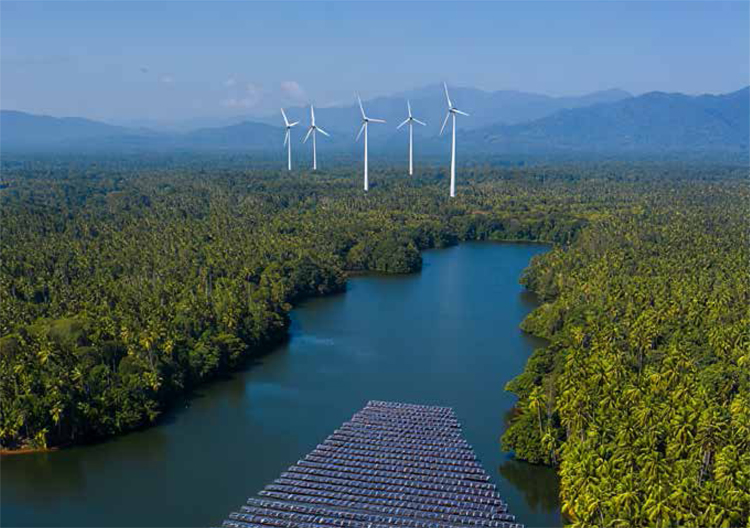
Temporarily High Leverage on Capex: WindForce anticipates capital expenditures exceeding LKR40 billion over the next two years for solar and wind power plants, with the bulk of spending in FY27. This includes a 100MW solar plant with integrated battery storage, recognized as Sri Lanka’s largest renewable energy project, developed in collaboration with Lakdhanavi Ltd (AA-(lka)/Stable). Fitch estimates that WindForce’s generation capacity will exceed 200MW by FY28 as a consequence.
EBITDA net leverage is expected to peak at approximately 6.8x in FY27, before decreasing to around 4.6x by FY28 as the plants commence operations. Execution risks for these projects remain minimal, facilitated by the company’s proven track record in similar projects, the straightforward construction processes of solar and wind projects, and the necessary regulatory approvals and offtake agreements already in place, with transmission lines established or rights-of-way secured. Additionally, the plants’ long-term PPAs with CEB are set at predetermined tariffs, which alleviates demand risk.
Counterparty Constrains Rating: WindForce’s rating is restricted by the credit profile of CEB, the sole electricity transmitter and distributor in Sri Lanka, despite CEB’s enhanced financial performance. CEB’s rating is reliant on support from the Sri Lankan sovereign (Long-Term Local-Currency Issuer Default Rating (IDR): CCC+; Long-Term Foreign-Currency IDR: CCC+). WindForce derived approximately 70% of its EBIT from CEB during FY23-FY25, with this share increasing to about 80% in FY25 following the commissioning of the Kebitigollewa solar project. It is anticipated that WindForce’s cash flow exposure to CEB will grow in FY26-FY29 once new projects are operational.
Risks to Cost-Reflective Tariffs: Fitch identifies risks to CEB’s execution of cost-reflective tariffs, potentially impacting its balance sheet and payment settlements to domestic power producers. This arises from the government’s competing priorities of managing inflation, CEB’s financial health, and the state’s finances. CEB’s EBIT turned negative in the first quarter of FY25 due to costs increasing faster than approved tariff hikes. However, subsequent tariff adjustments have improved CEB’s EBIT to breakeven levels in the first nine months of FY25. WindForce’s average receivable days remained stable at approximately 40 as of 30 September 2025, compared to a peak of around 350 days in FY23.
Steady EBITDA Margin: EBITDA margins are expected to improve from around 65% in FY25 to approximately 70% in FY26-FY28. This improvement reflects operating expenses normalizing after increased repairs and maintenance at wind plants, which were deferred from previous years. WindForce’s PPAs provide long-term cash flow visibility, with a weighted-average remaining contract life exceeding 10 years. However, generation volume may be affected by seasonal and climatic patterns, which is mitigated by its diversified portfolio, comprising wind (74MW), solar (55MW), and hydro (15MW), totaling 145MW on an alternating current equivalent basis (AC), across 23 power plants excluding associates and joint ventures.
Peer Analysis
WindForce is rated one notch below domestic power producer and engineering, procurement, and construction contractor Lakdhanavi. The difference is due to Lakdhanavi’s larger operating scale as a critical base-load power generator in Sri Lanka, along with its greater geographic and business diversification.
Both Lakdhanavi and WindForce have significant exposure to CEB. However, Lakdhanavi also provides operations and maintenance (O&M) services, manufactures transformers and switchgears, and offers galvanizing services, which provide a degree of diversification. It is also likely that CEB prioritizes payments to Lakdhanavi, even in financially challenging situations, as Lakdhanavi provides O&M services to one of Sri Lanka’s largest power plants and is investing in a major liquefied natural gas power plant, all crucial to Sri Lanka’s power generation and CEB’s future strategy.
Resus Energy PLC (A-(lka)/Stable), a domestic power producer, is rated two notches below WindForce. Resus also benefits from contractual revenue visibility via its PPAs with CEB. However, Resus’ lower rating reflects its tighter liquidity compared to WindForce and smaller operating scale with narrower access to domestic banks.
Vidullanka PLC (A+(lka)/Stable) is rated at the same level as WindForce. Although WindForce has larger operating capacity than Vidullanka and more diversified power generation resources, this is offset by Vidullanka’s exposure to the state-owned utility of Uganda (B/Stable) and concentration in hydropower generation. Most of Vidullanka’s cash flow originates from overseas, while most of its debt is onshore with Sri Lankan banks, exposing the company to potential repatriation risks. However, Vidullanka’s track record of overseas receipts has been stable.
Fitch’s Key Rating-Case Assumptions
- Revenue is expected to remain flat in FY26, then increase by over 30% annually in FY27 and FY28 from new projects.
- EBITDA margin is projected to be around 70% in FY26 and FY27.
- Receivable days are anticipated to remain steady at around 40.
- Capex is estimated at around LKR15 billion in FY26 and approximately LKR30 billion in FY27.
- Dividend payout is projected at 80% of the prior year’s profit.
Rating Sensitivities
Factors that Could, Individually or Collectively, Lead to Negative Rating Action/Downgrade:
- EBITDA net leverage above 5.0x for a sustained period.
- EBITDA interest coverage below 1.5x for a sustained period.
Factors that Could, Individually or Collectively, Lead to Positive Rating Action/Upgrade:
- A sustained and substantial reduction in counterparty risk, evidenced by continued improvement in CEB’s credit profile.
Liquidity and Debt Structure
WindForce’s liquidity relies on the timely collection of dues from CEB. As of 30 September 2025, the company reported over LKR1.3 billion in readily available cash and had access to approximately LKR7 billion in unutilized, yet uncommitted, credit lines from local banks against LKR1.4 billion of debt maturing in the next 12 months. The maturing debt mainly comprises the current portion of long-term debt obtained to finance investments in its power plants.
We anticipate that the company will generate negative free cash flow (FCF) in the near-to-medium term due to high capital expenditures. However, WindForce has adequate access to domestic banks, as most are willing to provide longer-tenured facilities for the company’s operational power plants, which have over 10 years remaining under their PPAs.
Issuer Profile
WindForce is a leading renewable power producer in Sri Lanka with an installed power generation capacity of approximately 145MW (excluding associates and joint ventures) as of 31 March 2025. Most of the installed capacity is located in Sri Lanka (132MW), with the remaining 13MW in Uganda. The company is listed on the Colombo Stock Exchange.
The post Fitch Affirms Sri Lanka’s WindForce at ‘A+(lka)’; Outlook Stable appeared first on Financial Chronicle Biz English | Sri Lanka Business News.