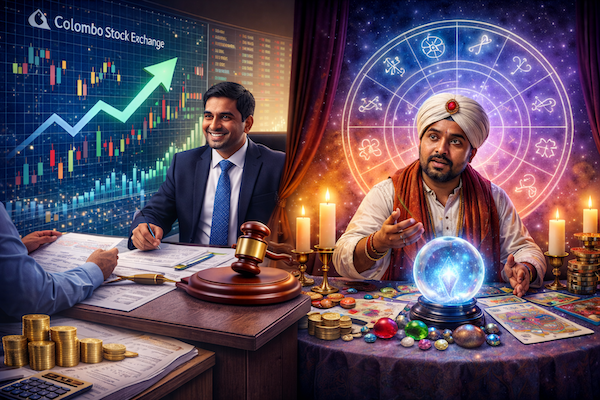
Every morning across Sri Lanka, television channels air astrology segments predicting fortunes, careers, marriages, travel prospects—and sometimes, the stock market. At the same time, the Colombo Stock Exchange (CSE) and the Securities and Exchange Commission of Sri Lanka (SEC) strictly regulate who can comment on share price movements, investment prospects, and market trends. Only registered Investment Advisors, who pass competency requirements and regulatory screening, are legally permitted to provide such guidance.
This contrast raises a curious regulatory question: if a licensed professional cannot publicly speculate on share prices without compliance obligations, how is it that an astrologer can go on national television and forecast financial fortunes tied to “planetary movements”—sometimes referencing markets, business sectors, or wealth outcomes—without any oversight?
“There are more people who listen to astrologers and make investments, including stock market investments, than those who are guided by investment advisors”
Under securities law, the trigger for regulation is not the speaker’s profession but the effect of the communication. If a statement amounts to investment advice, market influence, price speculation, or inducement to trade, it can fall within the SEC’s regulatory scope regardless of whether it comes from a financial analyst, social media influencer, or, theoretically, an astrologer. The law focuses on what is being said and how it may influence investor behavior, not whether the basis is financial models or horoscopes.
If an astrologer says, “This week is very favorable for those investing in banking shares,” or “The planetary alignment favors gains in the stock market,” such statements may cross from cultural commentary into unlicensed investment guidance. When broadcast to thousands, this could influence retail investor sentiment just as much as a market tip on social media. At that point, the content is no longer harmless mysticism—it begins to resemble market signalling.
The SEC’s mandate is to prevent market manipulation, misleading statements, and unlicensed advisory activity. Importantly, intent does not always matter. What matters is whether the communication can reasonably induce investment decisions. In that light, the difference between an astrologer’s televised prediction and an unregistered person posting a bullish stock tip online becomes legally thinner than it appears.
I know of a top business leader who doesn’t even talk to anyone on the phone during the “rahu” hours” said a leading Investment Advisor
There is also a fairness dimension. Registered Investment Advisors undergo examinations, continuing education, compliance audits, and legal accountability. They must base opinions on financial analysis, disclose conflicts, and operate within a professional code. Astrologers, meanwhile, can speak to the masses about wealth and markets with zero accountability, even if their words move sentiment.
This is not an argument to regulate astrology as a cultural practice. Rather, it is about recognizing a boundary: the moment astrology commentary enters the realm of financial market prediction, it may unintentionally step into regulated territory.
Globally, securities regulators have grappled with similar issues involving influencers, bloggers, and celebrities who casually comment on stocks without licenses. The principle is consistent: if you influence investment behavior in public, you fall within the regulator’s gaze. By that logic, astrologers are not exempt simply because their methodology is celestial rather than analytical.
Perhaps the real issue is not whether the SEC should “regulate astrologers,” but whether broadcasters and content creators should be mindful that market-related predictions—whatever their source—can carry regulatory consequences. A disclaimer that astrology is entertainment may not be sufficient if the content drifts into actionable financial suggestions.
In a market where regulators are tightening control over speculation, social media tips, and unlicensed advice, the paradox remains striking: the stars may be free to predict what licensed professionals cannot.
And that raises a final, uncomfortable question for the modern securities framework: when market sentiment can be influenced by anything—from tweets to horoscopes—where should regulation draw the line?