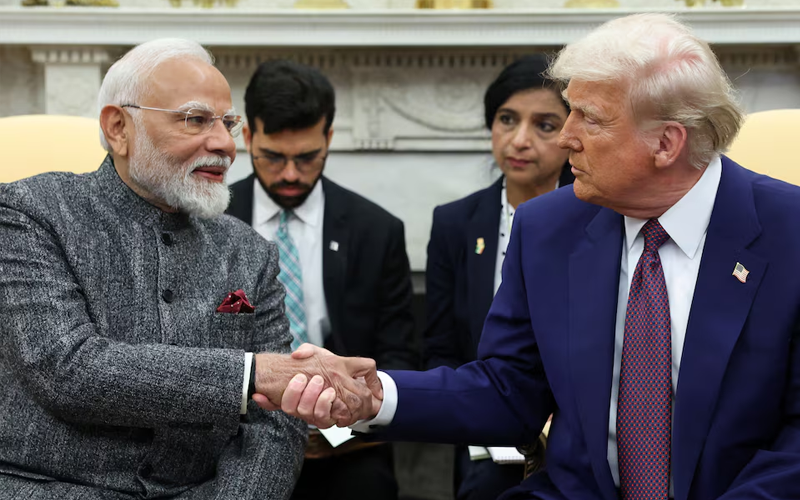
On Monday, U.S. President Donald Trump announced a new trade agreement with India, reducing U.S. tariffs on Indian imports from 50% to 18%. In return, India has agreed to cease purchasing oil from Russia and to lower trade barriers. Trump made the announcement via social media following a discussion with Indian Prime Minister Narendra Modi, indicating that India will now source oil from the U.S. and may consider Venezuelan options.
A White House official revealed that the U.S. would lift a punitive 25% duty imposed on Indian imports due to its previous Russian oil acquisitions. This duty was in addition to a 25% “reciprocal” tariff rate. The announcement positively impacted U.S.-listed shares of major Indian firms, with Infosys, Wipro, and HDFC Bank seeing significant gains, and the iShares MSCI India ETF rallying by 3%.
The news also buoyed investor sentiment towards semiconductor manufacturers and artificial intelligence sectors, contributing to a rise in major indexes. Furthermore, Trump highlighted India’s commitment to increase its purchases of U.S. goods, including over $500 billion in energy, technology, agricultural products, and more. He stated that India would work towards reducing tariffs and non-tariff barriers against the U.S. to zero.
Prior to Trump’s recent tariff increases, India had some of the highest global tariffs, with a simple applied rate of 15.6% and an effective rate of 8.2%, according to WTO data. However, details about the implementation of this new agreement, such as the timeline for tariff reductions and specifics on India’s cessation of Russian oil purchases, remain sparse. As of late Monday, no official proclamation or Federal Register notice had been issued. The White House and Indian government have not provided further information, nor has the Russian embassy in Washington.
While previous trade deals with Asian partners like Japan and South Korea included significant U.S. investment commitments, the India agreement lacks specific investment details. Economist Madhavi Arora from Emkay Global noted that the deal would align India’s tariff rates with those of other Asian peers, eliminating a significant drag on India’s exports and currency.
U.S. business groups responded with mixed reactions. The U.S. Chamber of Commerce expressed optimism, viewing the announcement as progress towards a comprehensive trade agreement. Conversely, a coalition of small businesses, “We Pay the Tariffs,” criticized the deal as a substantial tax increase on American businesses, warning of potential future tariff hikes.
Prime Minister Modi expressed gratitude to President Trump in a social media post, celebrating the reduced tariffs for Indian products. India’s Trade Minister Piyush Goyal stated that the agreement would enhance economic ties between the U.S. and India, unlocking opportunities for Indian industries and facilitating technology transfers from the U.S.
The announcement follows India’s recent trade agreement with the European Union, which aims to reduce or eliminate tariffs on a significant portion of traded goods. The Trump administration is actively pursuing trade deals with major partners before a Supreme Court ruling on Trump’s “reciprocal” tariffs under the International Emergency Economic Powers Act.
Moreover, Trump hinted at a potential agreement for India to purchase Venezuelan oil, following the U.S. military’s capture of Venezuelan President Nicolas Maduro. This development comes after prolonged negotiations between the U.S. and India, the world’s largest democracies. Trump’s previous tariff increases aimed to pressure India to reduce its reliance on Russian oil. By shifting to Venezuelan oil, India could offset its reduced Russian oil imports, a strategic move considering India’s heavy dependence on oil imports.
India has already begun decreasing its Russian oil purchases, with imports dropping to an expected 800,000 barrels per day by March, as reported by Reuters.