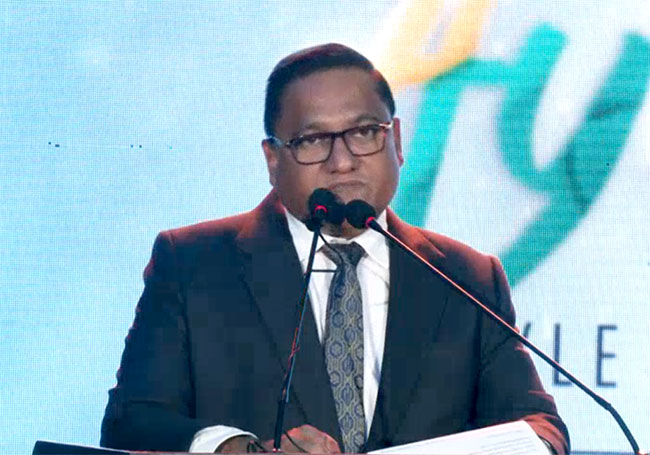
Sri Lanka’s foreign policy is heavily focused on economic diplomacy, prioritizing trade, investment, tourism, and innovation, according to Foreign Minister Vijitha Herath. During his address at the Chamber of Lankan Entrepreneurs (COYLE) Diplomats’ evening on Thursday, the Minister highlighted the active role of Sri Lanka’s diplomatic missions in promoting exports among other key responsibilities.
“Sri Lanka’s foreign policy today is firmly anchored in economic diplomacy. Our missions overseas are actively engaged in promoting exports, attracting foreign indirect investments, supporting tourism, and facilitating technology and knowledge transfer,” Herath stated to the attendees.
The Minister underscored the collaboration between diplomatic missions and the business community as they work together to explore new opportunities and markets. “Sri Lanka, with its compelling value proposition, strategically located at the crossroads of major shipping routes, serves as a natural hub for trade, logistics, and connectivity in the Indian Ocean region,” he noted.
He further emphasized that Sri Lanka’s skilled workforce, improving infrastructure, and expanding digital capabilities position the country well for partnerships in sectors such as manufacturing, renewable energy, IT, agriculture, tourism, and logistics.
Historically, Sri Lanka’s foreign policy was based on Non-Alignment, a strategy aimed at maintaining neutrality and balancing relations between global superpowers during the Cold War. In the post-war era, however, this policy shifted towards a transactional “debt-fueled diplomacy,” increasingly aligning with China. Successive governments sought large-scale Chinese investments for massive infrastructure projects like the Hambantota Port and Colombo Port City, which often lacked economic viability.
This realignment strained Sri Lanka’s traditional ties with India and Western nations, who viewed the expanding Chinese influence through a lens of maritime security and geopolitical rivalry. Instead of acting as a neutral bridge in the Indian Ocean, Sri Lanka became a stage for “Great Power Competition,” leading to diplomatic isolation and vulnerability during its severe economic crisis in 2022.
Sri Lanka’s foreign policy failures are also attributed to its inconsistency and personalization by political leaders. Rather than following a long-term, institutionalized national strategy, foreign relations were frequently shaped by the ideological whims or domestic survival needs of the ruling family or party. For example, some administrations adopted a confrontational approach toward the West and the United Nations on human rights and post-war accountability, resulting in the loss of crucial trade concessions like the EU’s GSP Plus.
The absence of a professionalized, stable foreign policy prevented Sri Lanka from leveraging its strategic location to integrate into global supply chains, leaving it without a strong “diplomatic safety net” during national emergencies.
Minister Herath affirmed Sri Lanka’s commitment to reforms aimed at enhancing transparency, ease of doing business, and investor confidence within its current foreign policy framework. “The government continues to engage closely with international partners and multilateral institutions to ensure macroeconomic stability and long-term resilience,” he concluded.
(Colombo/February 06/2026)