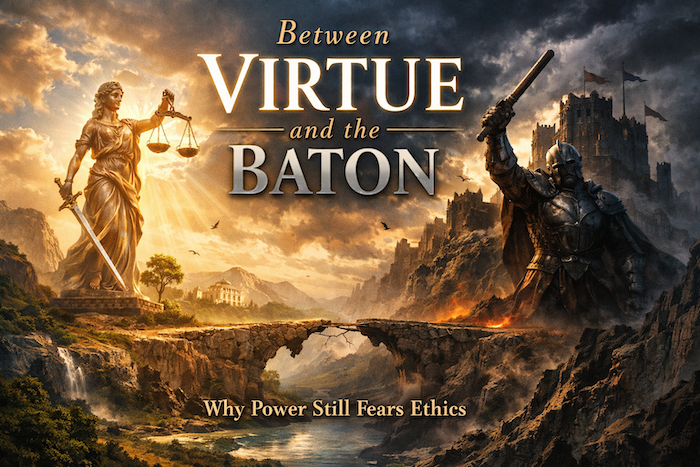
Two and a half thousand years ago, Confucius offered rulers an unsettling idea: govern by example, not by fear. If leaders behaved ethically, people would follow. No riot gear required. No slogans needed. Just decency, consistency, and restraint.
History, predictably, yawned.
Confucius lost most of his political battles while alive. Yet his ideas outlived emperors, JRJ, and likely to outlive MR, GR, RW, coups, constitutions, and revolutions. Why? Because he identified a truth modern politics still resists: systems don’t fail first—people do.
Across the world today, the pattern is familiar. When trust collapses, governments reach for lawbooks, batons, surveillance, and “emergency powers.” (Read PTA).
We are told order must be restored. Stability must be enforced. The citizen must be managed. It’s efficient. It’s decisive. It also quietly admits something damning—that moral authority has already evaporated.
This is not new. Ancient China tried the hard-line alternative called Legalism: strict laws, harsh punishment, zero tolerance. It built states quickly and broke them just as fast. Fear works—briefly. Resentment works— permanently.
In the West, Aristotle argued that laws matter, but character matters more. A society without virtue becomes a courtroom with electricity bills. Meanwhile, Buddha went further, warning that craving—for power, control, status—was the root of suffering. States listened politely and continued craving.
Fast forward to now. We live in an age of performance governance: press conferences instead of policy, commissions instead of conclusions, slogans instead of solutions.
Leaders speak of “the people” while insulating themselves from consequence. When institutions wobble, the reflex is not reform but regulation—more rules for those who didn’t break them, fewer consequences for those who did.
This is where Confucius still bites. He didn’t ask citizens to be obedient; he asked rulers to be worthy. He believed shame—public, moral, unavoidable—was more powerful than punishment. That idea terrifies modern power because it can’t be outsourced, spin-doctored, or enforced by decree.
The pro-people position is not naïve idealism. It’s evidence-based realism. Societies with trusted institutions need fewer laws.
Governments that explain honestly police less. Leaders who submit to standards don’t need to shout about authority. When ethics lead, enforcement follows quietly. When ethics vanish, enforcement takes centre stage—and stays there.
No ideology has solved this. Democracies stumble. Strong states overreach. Markets distort. Revolutions disappoint. The constant isn’t the system; it’s the human tendency to protect power rather than justify it.
So here’s the uncomfortable question Confucius left us with—and which every modern government still dodges:
If you need fear to govern, what exactly are you afraid of?
Until that’s answered, we’ll keep pretending laws can replace trust, force can replace legitimacy, and volume can replace virtue. History suggests otherwise. The people usually find out first.