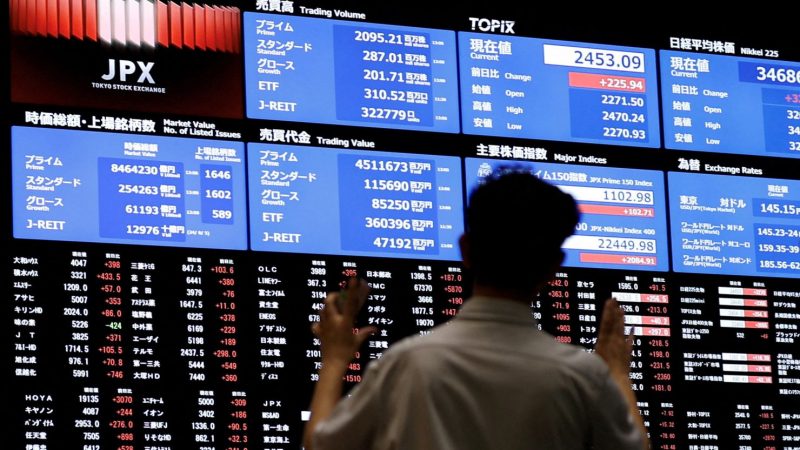
Asian markets experienced a significant boost on Monday following the decisive victory of Japanese Prime Minister Sanae Takaichi. This win has increased expectations for further reflationary policies, while investors also expressed relief at a rebound in U.S. chip stocks.
The rally in chip stocks, alongside bargain hunting in undervalued sectors such as silver, contributed to improved market sentiment. Additionally, expectations of further interest rate cuts by the U.S. Federal Reserve have grown, with a rate cut by June now seen as likely. Upcoming economic data on employment, inflation, and consumer spending are anticipated to support the case for continued stimulus.
Japan’s Nikkei index led the charge, surging 4.4% to reach record highs. The government’s strong majority is expected to pave the way for increased spending and tax reductions. Marc Jocum, a senior investment strategist at Global X ETFs Australia, noted, “The victory gives Takaichi a stable majority, enabling decisive action on fiscal stimulus, AI, semiconductors, energy security, and strategic reforms.” He added that Japan is now viewed as a reform-driven story with substantial momentum.
Despite the optimism, the prospect of increased borrowing pushed two-year yields to their highest level since 1996, reaching 1.3%.
The MSCI’s broadest index of Asia-Pacific shares outside Japan rose 2.2%, while South Korea’s tech-heavy index climbed 4.3%. Chinese blue-chip stocks increased by 1.3%, ahead of inflation data due on Wednesday, which is expected to indicate a decline in food prices and continued deflation in producer prices.
In Europe, EUROSTOXX 50 futures gained 0.4%, as did DAX futures, while FTSE futures increased by 0.5%. In the U.S., S&P 500 futures rose 0.1%, and Nasdaq futures added 0.3%, both having rebounded over 2% on Friday after a period of significant losses.
Chip stocks played a crucial role in the recovery, with Nvidia jumping nearly 8%, Advanced Micro Devices surging over 8%, and Broadcom rising 7%. However, there remain concerns regarding the vast sums being invested in AI and whether they will yield returns, as well as which companies will ultimately benefit.
Analysts at BofA noted, “Investors are sensibly rotating from AI spenders to beneficiaries, services to manufacturing, U.S. exceptionalism to global rebalancing. We are long Main St, short Wall St.”
To maintain the rally, upcoming U.S. data should support the prospect of rate cuts without threatening consumer demand and earnings. Payrolls are predicted to rise by 70,000 in January, maintaining the unemployment rate at 4.4%, though payroll growth for 2025 is anticipated to be revised downward significantly. Retail sales are expected to increase moderately by 0.4%, while both headline and core consumer price inflation are forecast to slow slightly to 2.5% in January.
Any disappointing data could lead to a decrease in Treasury yields and the dollar, although the yen and pound face their own challenges. Investors have already sold the yen in anticipation of Takaichi’s debt-funded expansionary policies, with the dollar dipping 0.3% to 156.74, away from the recent peak of 159.45. Analysts suggest that a move toward 160.00 could prompt intervention threats from Tokyo.
The euro saw a slight increase to $1.1821, remaining within a tight range over the past week, while sterling held at $1.3596 amid political uncertainty in the UK, with speculation about Prime Minister Keir Starmer’s potential job loss. Starmer’s chief of staff, Morgan McSweeney, resigned on Sunday, citing his responsibility for advising Starmer to appoint Peter Mandelson as ambassador to the U.S. despite Mandelson’s known links to Jeffrey Epstein.
Ruth Gregory, deputy chief UK economist at Capital Economics, commented, “Should Starmer be replaced, gilt yields initially rise and the pound weakens. The most likely longer-lasting influence is a loosening in fiscal policy that leads to higher gilt yields than otherwise and a weaker pound than otherwise.”
In the commodity markets, silver gained 3.9% to $81.03, following a volatile swing from a 15% loss to a 9% gain on Friday. The metal had plummeted in the preceding weeks due to leveraged positions facing margin calls and forced selling. Gold increased by 0.8% to $5,000 an ounce, having dipped as low as $4,403 last week.
Oil prices continued to fluctuate as markets awaited the outcome of discussions between the U.S. and Iran, which have yet to alleviate the risk of military conflict between the two nations. Brent crude decreased by 0.8% to $67.52 a barrel, while U.S. crude fell 0.7% to $63.09 per barrel.