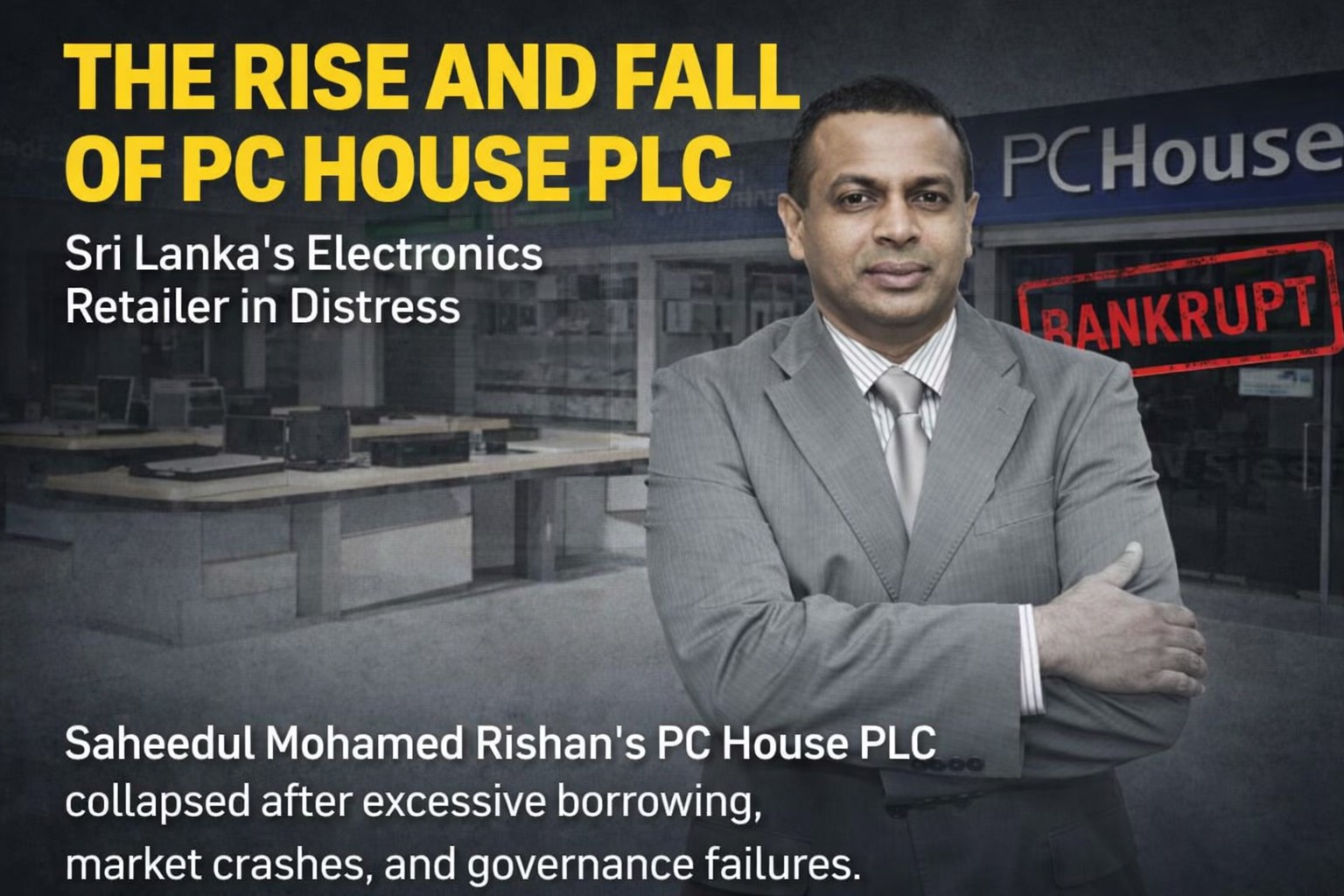
The story of PC House PLC is one of the most sobering corporate episodes in Sri Lanka’s listed retail history. What began in 1997 as a single computer retail outlet in Colombo grew, within little more than a decade, into one of the country’s most recognisable technology brands. Riding the wave of rising demand for personal computers, laptops, and IT equipment in the 2000s, PC House expanded aggressively across the island, establishing dozens of showrooms and positioning itself as a household name in electronics retail. By the time it listed on the Colombo Stock Exchange in 2010, the company symbolised ambition and confidence in Sri Lanka’s emerging IT retail industry. Its IPO was welcomed with optimism, and investors viewed the company as a modern retail success story poised to benefit from the country’s post-war economic momentum.
Beginnings and Rapid Growth (1997–2010)
PC House began in 1997 as a single retail outlet in Colombo selling computers and IT products. Its founder, S.H.M. Rishan, built the business against challenging conditions and grew it into one of Sri Lanka’s largest IT retail chains, with dozens of showrooms across the country. By the late 2000s it commanded a significant share of the local technology retail market.
The company’s initial public offering (IPO) in August 2010 was a milestone. About 25 % of the company was offered to the public, valuing it at over Rs. 2.5 billion, and the listing was widely seen as a symbol of optimism in Sri Lanka’s growing IT sector.
Early Signs of Trouble (2011–2012)
Despite the bullish market sentiment, trouble began to emerge soon after listing:
- In 2011, regulatory scrutiny hit PC House shares due to unusually high price volatility, with the Securities and Exchange Commission imposing price bands to curb wild trading.
- By 2012, the company’s financial performance started deteriorating sharply. Revenues plunged and profits evaporated, with some quarters showing as much as a 97 % drop in after-tax profit as sales slipped dramatically.
- Most striking was a mass resignation of non-executive directors in August–September 2012, citing weak corporate governance and lack of effective board oversight. This exodus of independent oversight was a major red flag for investors and stakeholders
Aggressive Borrowing and Risky Financial Moves
Behind the scenes, the collapse was driven by a combination of financial overreach and poor risk management:
- The controlling shareholder, Rishan, began leveraging his personal and corporate shareholdings to raise debt — pledging shares of PC House and related entities as collateral to fund speculative stock trading and acquisitions.
- Instead of focusing cash flows back into strengthening PC House’s core business, the company expanded into unrelated ventures through a complex network of listed entities (e.g., PCH Holdings, PC Pharma, Orient Garments), often at high prices with weak returns.
- This use of equity as collateral increased the firm’s financial leverage significantly, tightening liquidity when market conditions turned. As share prices fell, margin calls and debt obligations mounted.
Collapse of Operations and Revenue
The impact on PC House’s day-to-day business was stark:
- Many retail showrooms were closed, especially outside Colombo, shrinking the company’s national footprint.
- Government contracts — a key revenue source — began drying up, partly because PC House could not fulfill orders on time due to cash constraints.
- Salaries were delayed for months, causing a mass departure of experienced staff.
- By 2013, revenues had dropped by more than 70 % compared with the year earlier, and the company reported its first recorded net loss.
Shares that had once traded with optimism after the IPO slid precipitously — declining from over Rs. 30 to around Rs. 1.10 — wiping out value for minority shareholders.
Failed Rescue Attempts
In mid-2013, PC House attempted a rights issue, raising about Rs. 343 million to shore up its balance sheet. However, this came when investor confidence had already been severely eroded, and the company’s core cash flows continued to stall.
Attempts by founder Rishan to attract strategic investors were reported, but these failed to materialise into transformative capital injections.
Regulatory and Liquidation Developments
What followed was a prolonged period of non-compliance:
- By 2018, PC House had failed to submit interim and annual financial reports, leading the Colombo Stock Exchange to suspend trading of its shares alongside those of other dormant companies.
- In October 2018, official filings indicated that PC House PLC was under commercial liquidation proceedings, reflecting that its corporate existence was being wound up
Conclusion
The rise and fall of PC House PLC is not just a story of a failed retailer — it’s a case study in corporate governance failure, excessive financial risk, and the dangers of over-diversification without operational strength. It stands as a cautionary tale for investors, boards, and regulators alike in Sri Lanka’s growing capital market