

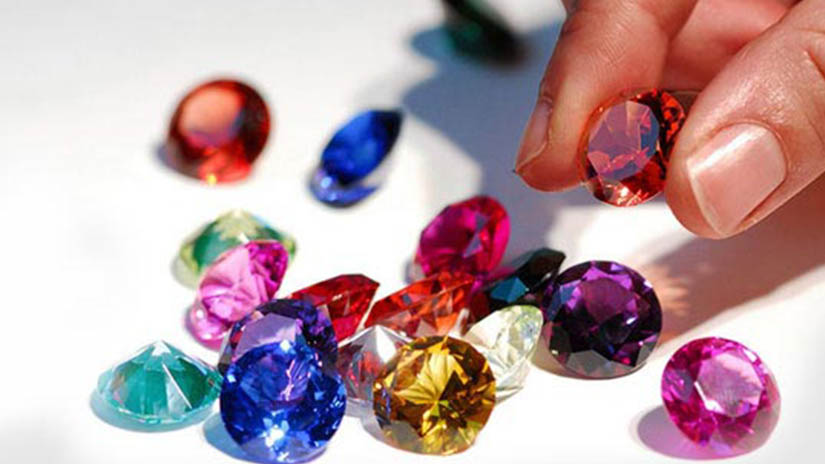
Sri Lanka is globally synonymous with gems. From sapphires and rubies to cat’s eyes and alexandrites, the island’s stones command premium prices in international markets. Yet in official export statistics, the country’s gem and jewellery sector barely registers as a heavyweight.
That contradiction has a name: leakage.
It is the widening gap between what Sri Lanka should be earning from precious and semi-precious stones — given its geology, reputation and global demand — and what actually appears in the country’s export and foreign- exchange figures.
The gap is no longer marginal. By most informed estimates, it is structural.
What the official numbers say
According to data from the National Gem and Jewellery Authority (NGJA) and the Central Bank of Sri Lanka, Sri Lanka’s declared gem and jewellery exports fluctuate between tens and low hundreds of millions of US dollars annually, depending on the year and category.
These figures include:
cut and polished stones rough stones exported legally finished jewellery
On paper, the sector is modest — respectable, but hardly transformational.
That is where the disbelief begins.
What the market reality suggests
Independent reporting, parliamentary disclosures, customs investigations, and industry insiders point to a vastly different picture.
Multiple sources — including lawmakers and trade observers — have spoken of an underground or unaccounted gem trade potentially exceeding USD 1 billion annually. Even if that figure is debated, few now dispute that a majority of Sri Lanka’s gem value does not pass through formal export channels.
Put plainly:
what leaves the ground does not leave the books.
Where the leakage occurs
The loss does not happen at one point. It happens across the chain. 1. Undervaluation at export
Gems that are legally exported are often declared at a fraction of their true market value. This reduces:
export duties
income tax liabilities
foreign-exchange repatriation
The stone leaves legally. The value does not.
2. Smuggling of high-value stones
Small, high-value gems are ideal for illicit trade: easy to conceal
hard to trace
difficult to value objectively
Stones exit through: passenger baggage informal courier networks transit via third countries
Once cut and certified abroad, origin becomes harder to prove — and Sri Lanka loses both revenue and attribution.
3. Weak certification and valuation systems
Sri Lanka lacks a universally trusted, rapid, state-backed valuation mechanism that exporters and customs can rely on without dispute.
Where valuation is negotiable, manipulation thrives.
4. Foreign buyer dominance
In many mining and trading areas, foreign buyers — operating through local fronts or informal arrangements — control pricing at source. Miners are paid cash, often below global rates. The real value is realised offshore.
Sri Lanka bears the environmental and social cost. Others capture the upside.
5. Incentives that favour informality
Cumbersome licensing, inconsistent enforcement, and mistrust of authorities push legitimate actors toward informal channels. When compliance is costly and enforcement selective, evasion becomes rational.
Why this matters now.
At a time when Sri Lanka is: negotiating debt sustainability pleading for foreign exchange taxing consumption heavily
the idea that billions may be leaving the country unrecorded is not merely an economic failure — it is a governance failure.
The gem sector should be a net FX generator of strategic importance. Instead, it functions as a parallel economy.
What must change to capture the value 1. Mandatory valuation and certification
A credible, independent, fast-track valuation authority — trusted by both exporters and the State — is essential.
No valuation, no export.
2. Incentivise declaration, not evasion
Lower duties, faster clearances, and predictable rules can pull trade into the formal system. Punitive regimes do the opposite.
3. End cash dominance at source
Traceable payments to miners and traders reduce laundering and under-reporting. Transparency begins at the pit, not the port.
4. Treat gems as strategic exports
Gems should be regulated with the seriousness applied to tea or apparel — with data integration between customs, NGJA and the Central Bank.
5. Political will
Leakage persists because it is tolerated. Smuggling networks do not survive without protection, indifference, or selective enforcement.
This is not a technical problem alone. It is an accountability problem.
NEWSLINE verdict
Sri Lanka does not lack gems. It lacks capture.
Until the country confronts the structural reasons why its most precious exports slip quietly into the shadows, every conversation about export growth, dollar shortages, and economic reform will remain incomplete.
The real scandal is not that gems leave Sri Lanka. It is that their value so rarely returns.