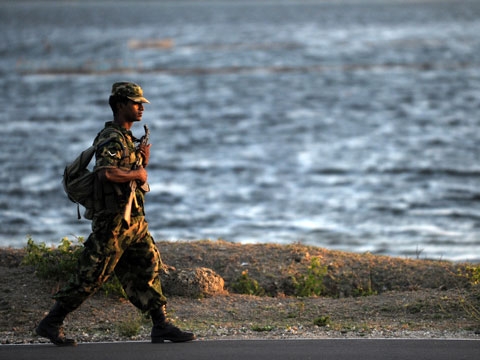
Seventeen years after the guns of war fell silent, a different question hangs in the air: Has Sri Lanka’s policing culture fully left the battlefield?
The civil conflict against the Liberation Tigers of Tamil Eelam (LTTE) formally ended in 2009. But institutions do not automatically reset when wars end. Training doctrines, threat perceptions, and reflex responses often outlive the conflict that shaped them.
And that is where the unease lies.
From Counter-Insurgency to Civilian Policing
During war, security doctrine is built on anticipation of ambush. Suspicion is survival. Split-second decisions are trained around threat neutralisation.
In a democracy at peace, policing is different.
The operating principle is not domination — it is proportionality.
The objective is not neutralisation — it is preservation of life.
Those are fundamentally different mindsets. The question is whether Sri Lanka has fully institutionalised that transition.
The Culture of “Maximum Caution”
In former conflict zones especially, officers are often conditioned to assume worst-case scenarios. A vehicle that fails to stop may be treated not as a traffic violation but as a potential attack.
That instinct was once understandable. But seventeen years later, if routine policing still carries counter- insurgency reflexes, then the system has not recalibrated.
A post-war democracy cannot function if civilian encounters are treated as tactical threats.
The Missing Middle Layer: Non-Lethal Capacity
Modern policing globally has evolved toward layered response:
Body cameras for accountability
Non-lethal tools (tasers, spike strips, vehicle barriers) De-escalation training
Psychological assessment of threat
How extensively are such tools integrated into Sri Lankan policing?
If firearms remain the primary escalation mechanism, then protocol reform is overdue.
A professional force is defined not by how quickly it fires — but by how effectively it avoids firing.
Accountability as Institutional Strength Every police shooting tests the system.
In a mature democracy:
Immediate independent review is automatic.
Evidence is preserved and disclosed.
Officers are cleared or charged based on transparent criteria.
Where investigations are opaque, public suspicion fills the void.
Trust is not sustained by uniformed authority. It is sustained by visible accountability.
The Political Layer
There is another discomfort.
Sri Lanka’s police have long operated within a politicised environment. Transfers, promotions, and operational culture have historically intersected with political influence. A post-war democracy requires insulation from that dynamic.
If officers fear political consequences more than professional misconduct findings, reform stalls.
The Real Standard
The standard for post-war policing is simple:
Does the system treat citizens first as civilians — not as threats?
If a fleeing suspect can be shot dead without exhaustive de-escalation, then that standard is not yet secure.
The rule of law is not proven during calm days. It is proven in moments of tension.
NEWSLINE Verdict
War ends with victory or defeat. Peace requires recalibration. Seventeen years after 2009, Sri Lanka must confront whether its policing doctrine has fully transitioned from survival instinct to democratic restraint. The uniform must project confidence — not fear.
Because if the public begins to fear the reflex of the State more than the crime itself, then the war may be over…
…but the mindset is not.