Three months after Cyclone Ditwah swept across Sri Lanka in late November 2025, the immediate headlines may have moved on. In many regions, floodwaters have receded, emergency support has reached the affected communities, and farmers are working tirelessly to salvage what they can and prepare for the upcoming season. However, the most pressing question now is not about how swiftly agriculture can return to “normal,” but whether Sri Lanka will rebuild in a manner that breaks the cycle of risks that made Ditwah so devastating initially.
Cyclone Ditwah was not merely a severe storm; it was a stress test for our food system, land and water management, and the institutions designed to protect livelihoods. It highlighted, in stark detail, how quickly losses accumulate when farms are situated in flood pathways, when irrigation and drainage systems are outdated, when safety nets are insufficient, and when early warnings fail to lead to timely actions.
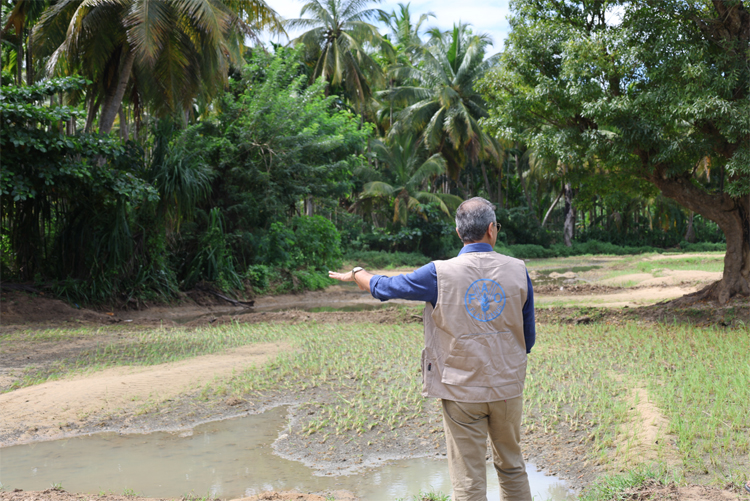
In the immediate aftermath, the damage was rightly measured in terms of flooded hectares, damaged canals and infrastructure, and families losing an entire season’s income overnight. These impacts remain significant. Yet, three months later, the clearer lesson is understanding why the shock spread so rapidly and extensively. Over time, exposure has become the norm: cultivation and settlement have expanded into floodplains and unstable slopes, driven by land pressure and inadequate enforcement of risk-informed planning. Infrastructure that should absorb shocks—such as tanks, canals, embankments, and culverts—often becomes a failure point due to lagging maintenance and outdated design standards. At the farm level, production risk remains concentrated, with limited diversification and high sensitivity to a single adverse event. Meanwhile, indebted households with delayed access to liquidity struggle to recover, and the information reaching farmers is often insufficient to prompt timely, practical decisions.
If Sri Lanka learns one lesson from Ditwah, it should be this: recovery spending alone does not equate to resilience. Rebuilding efforts must aim to reduce recurring losses, not merely replace what was damaged. This necessitates making sometimes politically and administratively challenging choices, which are far more cost-effective than repeating cycles of emergency, repair, and regret.
Firstly, Sri Lanka needs farming systems resilient enough to withstand prolonged waterlogging. This requires making diversification the norm, supporting farmers to adopt crop mixes and planting schedules that spread risk, expanding access to stress-tolerant and short-duration crop varieties, and considering soil health and field drainage as essential productivity infrastructure. Greater attention must also be paid to livestock and fisheries, where simple measures like safer siting, elevated shelters, protected feed storage, and better-designed ponds can prevent avoidable losses.
Secondly, infrastructure should no longer be rebuilt to outdated standards. Irrigation and drainage networks, rural roads, bridges, storage facilities, and market access are not just development assets; they are risk management systems. Every major repair should be evaluated with a simple question: will this investment reduce risk under current and future rainfall patterns, or will it perpetuate vulnerability for the next 20 years? Design standards should reflect projected intensities rather than historical averages. Water management from catchment to field must integrate engineered solutions with natural buffers like wetlands, riparian strips, and mangroves to mitigate surges, erosion, and siltation. Most importantly, hazard information must translate into enforceable land-use decisions, determining where rebuilding should not occur and where fair support is needed for safe relocation or livelihood shifts.
Thirdly, Sri Lanka must ensure fair risk-sharing among farmers, markets, and the state. Cyclone Ditwah revealed how quickly a climate shock can escalate into a debt crisis for rural households. Fast liquidity post-disaster is not a luxury; it is the difference between recovery and long-term impoverishment. Crop insurance needs to be expanded and improved beyond rice, covering high-value crops and ensuring quicker payouts. At the national level, rapid-trigger disaster financing can provide immediate fiscal space for early recovery without derailing budgets. Public funding and concessional climate finance should be channelled into a coherent pipeline of resilience investments rather than fragmented projects that do not lead to systemic change.
Fourthly, early warning should translate into early action. This requires not only better forecasts but also clearer, localized guidance that farmers can act on, linked to reservoir levels, flood risk, and the practicalities of protecting seeds, inputs, and livestock. Extension services must be equipped for a climate era, offering practical training in climate-smart practices and risk reduction. Data systems across meteorology, irrigation, agriculture, and social protection must be interconnected, enabling timely support when thresholds are crossed, instead of assembling aid after losses are already entrenched.
In practice, this means focusing on completing priority irrigation and drainage works with “build-back-better” standards, supporting replanting packages that include soil and drainage measures rather than seed alone, and preventing distress coping through temporary protection for the most vulnerable households. In the coming years, Sri Lanka should aim to implement climate-smart production and advisory schemes in selected river basins, institutionalize agriculture-focused post-disaster assessments that translate into funded plans, and pilot shock-responsive safety nets and rapid-trigger insurance in cyclone-prone districts. Over the long term, areas experiencing repeated losses should be reoriented towards flood-compatible systems and slope-stabilizing perennials, while catchment rehabilitation and natural infrastructure restoration should be treated as productivity investments, not merely environmental add-ons.
None of this is abstract. The cost of inaction manifests in failed harvests, lost income, higher food prices, and increased rural debt. The opportunity is equally tangible: if Sri Lanka uses the post-Ditwah period to modernize agriculture by making production more resilient, infrastructure smarter, finance quicker, and institutions more responsive, then Ditwah can become more than a disaster. It can mark the turning point where the country decides to stop repairing vulnerability and start building resilience.