The Principle Versus The Moment
The arrest of a former head of Military and State Intelligence Suresh Sallay under the Prevention of Terrorism Act has reopened an old wound — not only about Easter 2019, but about the law itself.
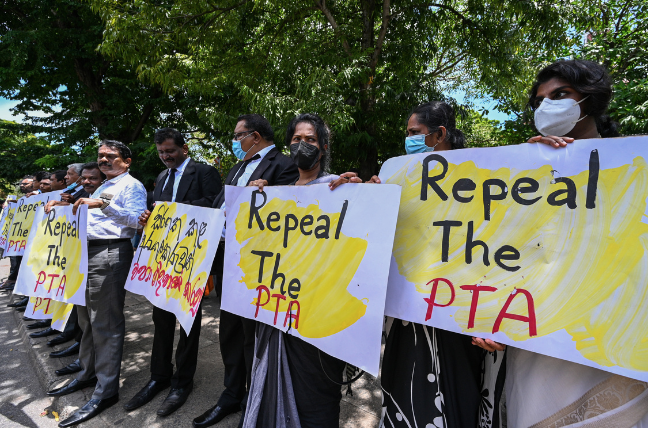
The PTA is one of the most controversial statutes in Sri Lanka’s legal architecture. For decades, it has been criticised domestically and internationally for enabling prolonged administrative detention and admitting certain confessions to senior police officers as evidence — provisions not ordinarily available under standard criminal procedure.
So the question is not emotional. It is structural. Was the use of the PTA justified in this instance? Or does it weaken the very case it seeks to advance?
Let us examine both sides.
The Case FOR Using the PTA
The Easter Sunday bombings were an act of terrorism. They were not ordinary crimes. Nearly 300 people were killed in coordinated suicide attacks. The legal framework governing terrorism in Sri Lanka remains the PTA.
If investigators believe that the alleged conduct under scrutiny falls within terrorism-related offences — including conspiracy, aiding, abetting, or failure linked to acts of terror — then the PTA is the governing statute available to them.
The PTA allows extended detention where investigations are complex, cross-border, intelligence-heavy, and potentially involve classified material. Terror cases are not street crimes. They involve networks, digital trails, intelligence coordination and sensitive state information.
In that context, the argument follows: if the law exists, and if the offence falls under its scope, then the state is entitled to use it.
Furthermore, the optics of applying a different legal standard because the suspect is a senior former official would raise its own fairness concerns. The law must apply equally.
If the PTA is still on the books, and if Parliament has not repealed it, can law enforcement be faulted for invoking it in a terrorism case?
That is the pro-PTA position.
The Case AGAINST Using the PTA
The counter-argument is grounded in principle.
The PTA allows administrative detention without immediate judicial oversight and contains evidentiary provisions that have historically drawn criticism — particularly regarding confessions made to police officers.
Critics argue that modern criminal procedure already allows arrest under other statutes, followed by judicially supervised detention orders extendable in 15-day increments. If sufficient evidence exists, indictment can follow under ordinary law.
The concern is not about whether the individual deserves investigation. It is about whether the state should continue relying on a law widely criticised for rights vulnerabilities — especially in a case of such national sensitivity.
If the prosecution ultimately relies on PTA-based confession evidence, the defence will challenge its integrity. International scrutiny may intensify. The credibility of the process could be questioned.
And then there is perception.
If the PTA is invoked selectively — condemned when used against one group but defended when used against another — the principle erodes.
The rule of law must be consistent.
The Deeper Question
This debate is larger than one arrest. It asks whether Sri Lanka still needs a special anti-terror law in its present form. It asks whether reform should precede reliance.
It asks whether justice for Easter requires exceptional tools — or unimpeachable procedure.
One thing is certain. The victims of Easter deserve accountability that is legally unassailable.If the case is strong, it should survive under any statute.
If the PTA is used, it must be used carefully, transparently, and without compromising evidentiary integrity. Justice delayed has already tested public patience.
Justice compromised would test public trust. The law must hold.
But it must also withstand scrutiny.