
What Does the U.S. Claim — and What’s Verified?
The U.S. administration has justified its military campaign against Iran by emphasising Iran’s missile capabilities and nuclear ambitions, framing them as a growing threat that could reach U.S. interests or allies. President Trump specifically cited concerns about Iran’s ability to strike targets, saying an “Iran armed with long- range missiles and nuclear weapons would be a dire threat.”
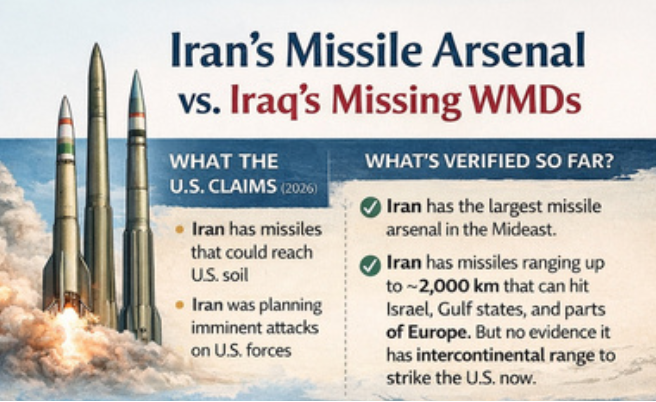
However, in a recent closed-door briefing with U.S. congressional staff, Pentagon officials acknowledged that there was no concrete intelligence indicating Iran planned to attack U.S. forces first — contradicting earlier public claims used to justify pre-emptive strikes.
Similarly, Reuters reported days ago that U.S. claims about Iran developing missiles capable of striking the United States are not supported by current intelligence, and that any intercontinental capability (ICBM) is likely years away even with external assistance.
In other words:
• The strategic concern about Iran’s missile program is real and longstanding.
• But claims of an imminent U.S. homeland missile threat — similar to the pre-Iraq War claims about WMDs — are not currently backed by clear, public intelligence evidence.
What Iran Actually Has — Verified Arsenal
According to multiple open-source analyses and reputable experts:
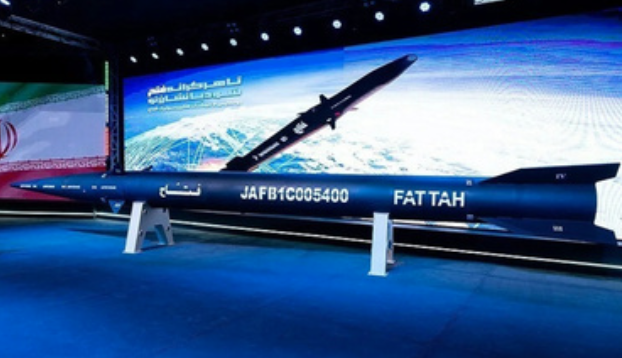
Iran maintains a large ballistic missile inventory, mainly short- and medium-range missiles with ranges up to about 2,000 km — enough to reach Israel, the Gulf and parts of eastern Europe, but not the continental U.S. without significant development.
The arsenal includes:
• SRBMs (short-range ballistic missiles) with ranges of 300–1,000 km
• MRBMs (medium-range) with up to 2,000 km range
• Multiple variants such as Shahab, Ghadr and newer systems like Qassem Bassir.
Independent research organisations note that these systems form the largest missile force in the Middle East, built for deterrence and regional leverage rather than trans-continental strike.
But there are no credible public confirmations that Iran currently possesses ballistic missiles capable of reliably striking the U.S. mainland — and assessments suggest such capability remains at least several years away.
So What’s the Real Endgame?
There are several plausible scenarios based on expert commentary and regional dynamics:
Deterrence Rather Than Invasion
Iran’s missile force has long been a central element of its defence doctrine — to deter hostile action on its soil and influence regional adversaries from direct invasion. Political Pressure
The U.S. appears to be seeking either:
• Regime change, as suggested by Trump’s rhetoric in his recent statements and media coverage; or
• A forced settlement limiting Iran’s long-range missile and nuclear capabilities.
Experts note that destroying physical assets like launchers is far easier than removing the political will and infrastructure underpinning a missile program.
Diplomacy vs Escalation
The U.S. also claims it has sought — or is willing to seek — renewed negotiation frameworks, though these are contested and politically fraught after decades of mistrust.
Comparison to Iraq and WMD Claims
The key difference between then and now:
• In 2003, the U.S. asserted Iraq had WMDs that were later not found in verified stockpiles, undermining the justification for invasion.
• In this case, Iran does have missiles, but the nature, immediacy, and target capabilityof that arsenal is much less certain than the U.S. has implied publicly as a justification for full-scale conflict.
Intelligence officials’ comments that no direct attack plan was detected reinforces this.
In short: the threat is real in a regional sense — Iran has missiles capable of hitting neighbouring states and U.S. forces in the region — but there is no verified evidence Iran was about to use long-range missiles against the U.S. homeland. The claim of an imminent “first strike” threat appears overstated based on current public intelligence disclosures.
Bottom Line
Iran’s missile arsenal is substantial and regionally significant.
It is verifiably real and part of Iranian defence doctrine. But the specific claims that drove the U.S. decision — particularly imminent strikes on U.S. forces and long-range capabilities — are not supported by publicly confirmed intelligence.
This raises questions about whether the justifications mirror past controversies where threat assessments were later shown to be incomplete or mischaracterised.
The endgame is likely less about immediate homeland attack and more about diplomatic leverage, deterrence signals, and political reshaping of Iran’s strategic posture — not unlike past great-power conflicts where military force is combined with negotiated settlement pressure.
Riyadh, Oil & The Quiet…
The West speaks of electric vehicles, net zero transitions, decarbonisation. Yet when missiles threaten the Strait of Hormuz, what moves first? Not lithium. Not hydrogen. Oil.
Suddenly, the free flow of crude once again becomes a security imperative. Naval patrols multiply. Diplomacy intensifies. Markets react. The world still calibrates risk in barrels.
There is something almost circular in that.
Saudi Arabia now finds itself in a position it knows well — custodian of sacred sites, steward of energy markets, architect of economic transformation. Vision 2030 depends on stability. Tourism depends on stability. Investment depends on stability.
And so Riyadh’s posture is measured.
Defensive systems active. Public calm projected. Religious institutions emphasising unity and restraint. No appetite for reckless escalation.
The Kingdom cannot afford hysteria. It cannot afford indulgence either.
Yamani once understood that oil was power — but also vulnerability. Push too hard and you finance your own obsolescence.
Today, the irony deepens: as the world speaks of moving beyond oil, it is oil once again that frames the geopolitical stakes.
In Riyadh, the mood reflects that dual awareness. Watchful. Controlled. Strategic. The region trembles.
The Kingdom steadies.
And somewhere in that steadiness lies a reminder from history: power is most effective not when shouted — but when balanced.