Fitch Ratings, based in Hong Kong, reported on February 22, 2026, that Bangladesh’s general election on February 12 has alleviated near-term political and policy uncertainties, which could potentially enhance macroeconomic stability. The Bangladesh Nationalist Party (BNP)-led alliance has achieved a parliamentary supermajority and garnered majority support in a referendum, paving the way for potential constitutional reforms. However, the country’s enduring credit challenges, such as weak governance, banking sector vulnerabilities, and fragile external liquidity, mean that the new government’s capacity to implement its macroeconomic and fiscal reform agenda will be crucial in determining the rating impact.
The election results have brought greater political clarity following the August 2024 overthrow of the Awami League government and a prolonged caretaker period that facilitated several significant reforms. The BNP secured 209 seats, with Jamaat-e-Islami and its allies obtaining 77, and smaller parties capturing the rest of the 299 contested seats. The BNP’s two-thirds parliamentary majority should bolster its ability to advance its policy agenda, also reducing the risk of a prolonged political vacuum that could complicate economic decision-making.
Despite the election victory, political risks persist. Bangladesh’s history of political polarization and occasional pre-election violence leaves room for renewed tensions if the government struggles to fulfill election promises or underperforms against expectations. The military may also continue to exert influence in political matters.
The referendum’s approval could facilitate constitutional changes aimed at strengthening institutions, such as transitioning to a bicameral system from a unicameral one, enhancing judicial independence, and instituting term limits for the prime minister. However, the implementation of these changes could be complex and time-consuming, keeping execution risk high.
The BNP’s manifesto indicates that the new government is likely to continue the economic and fiscal reforms initiated by the caretaker government. The agenda also suggests increased social spending, which could strain public finances if revenue mobilization measures fall short, challenging the authorities’ ability to balance growth and electoral commitments with fiscal consolidation.
This reform agenda aligns with the macro-stabilization program under the International Monetary Fund’s (IMF) USD5.5 billion initiative, which began in January 2023 and is set to continue through 2026-2027. However, uncertainties remain around the economic agenda, and the ongoing implementation and sustainability of these reforms beyond the IMF program will be crucial for achieving macroeconomic stability and growth.
The manifesto’s fiscal focus is on a medium-term goal to increase the tax-to-GDP ratio to 10% through tax administration reforms, reducing exemptions, and broadening the tax base, with a near-term revenue increase target of 2% of GDP. This is significant for credit quality, as Bangladesh’s structurally low revenue intake is a notable weakness. Projections indicate that general government revenue-GDP will rise to 8.6% by FY27, up from 7.8% in FY25.
The manifesto also emphasizes a pro-private-sector development agenda, including simplifying licensing, offering incentives for export-oriented sectors, and aiming to increase foreign direct investment to 2.5% of GDP from an estimated 0.4% of GDP in FY25. Its commitment to strengthening banking governance and addressing non-performing loans could, if successful, alleviate a key constraint on the sovereign credit profile.
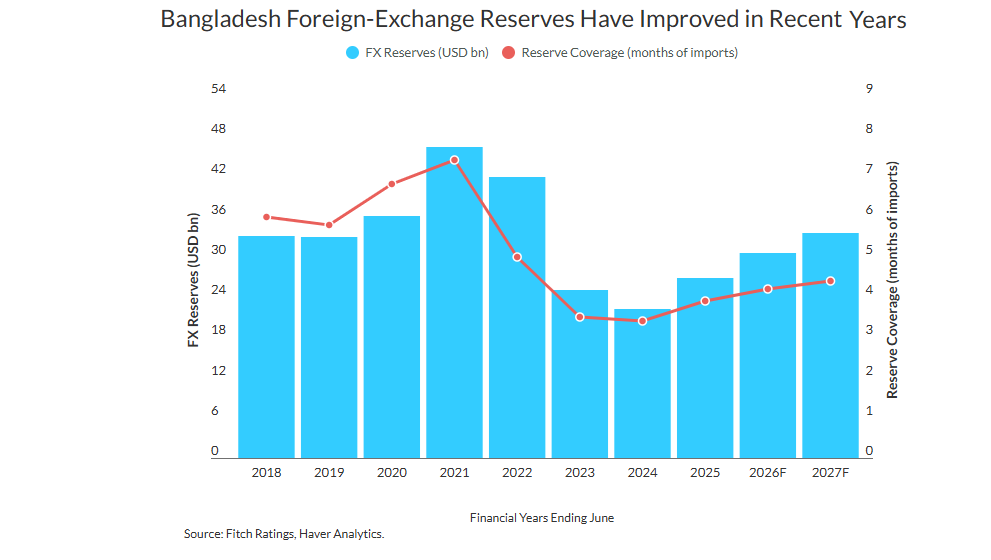
External liquidity remains a near-term indicator, even as reserves improve. Foreign-exchange reserves reached USD29.7 billion as of February 10, up from USD22.3 billion in the fiscal year ended June 2024 (FY24) and USD26.9 billion in FY25. A manageable external debt repayment profile and the prevalence of government-backed debt help contain refinancing risks but also highlight the importance of maintaining macro-stabilization policies to mitigate external financing risks.