Oil prices continued their upward trend on Monday, with Brent crude poised for a historic monthly increase, following the Yemeni Houthis’ initial attacks on Israel during the weekend. This escalation has further complicated the ongoing conflict involving the U.S., Israel, and Iran in the Middle East.
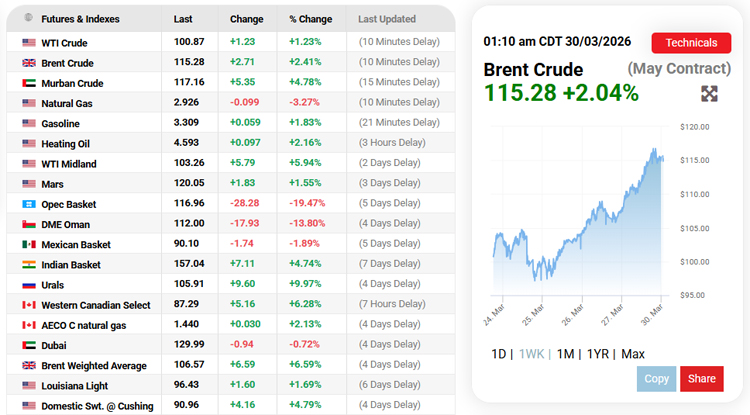
Brent crude futures surged by $2.43, or 2.16%, reaching $115 per barrel by 0342 GMT after a 4.2% rise on Friday. Meanwhile, U.S. West Texas Intermediate climbed to $101.50 per barrel, an increase of $1.86, or 1.87%, following a 5.5% gain in the previous session.
Vandana Hari, the founder of oil market analysis firm Vanda Insights, indicated that the market has largely dismissed the likelihood of a negotiated resolution to the conflict. Despite claims from former U.S. President Trump regarding ongoing “direct and indirect” discussions with Iran, the market is preparing for a significant escalation in military actions, which is seen as a bullish factor for crude prices amid considerable uncertainty regarding the outcome.
President Trump stated that negotiations between the U.S. and Iran have been occurring both directly and indirectly, noting that Iran’s new leadership appears to be “very reasonable.” This comes as additional U.S. troops are deployed to the region and as the Israeli military confirmed attacks on Iranian infrastructure in Tehran.
Brent crude has experienced a dramatic rise of 59% this month, marking the most significant monthly increase since the 1990 Gulf War. The ongoing conflict with Iran has effectively obstructed the Strait of Hormuz, a critical route responsible for transporting approximately one-fifth of the global oil and gas supply.
Initiated on February 28 with U.S. and Israeli military actions against Iran, the conflict has expanded throughout the Middle East. The Houthis, aligned with Iran, executed their first strikes on Israel over the weekend, raising alarms about the safety of shipping routes in the Arabian Peninsula and the Red Sea.
According to analysts at JP Morgan, led by Natasha Kaneva, the conflict has now spread beyond the Persian Gulf and the Strait of Hormuz, impacting the Red Sea and the Bab el-Mandeb Strait, both of which are vital chokepoints for crude and refined product transportation.
Data from analytics company Kpler revealed that Saudi Arabia’s crude exports, rerouted from the Strait of Hormuz to Yanbu port in the Red Sea, reached 4.658 million barrels per day last week.
Should disruptions occur at Yanbu, Saudi oil exports may need to shift towards Egypt’s Suez-Mediterranean (SUMED) pipeline to access the Mediterranean, as noted by JP Morgan analysts.
The weekend saw an increase in attacks in the region, including damage to Oman’s Salalah terminal, despite ongoing efforts to initiate ceasefire discussions.
Iran has expressed its readiness to retaliate against any U.S. ground invasion, accusing Washington of planning a land offensive while simultaneously seeking negotiations.
Meanwhile, Pakistan’s Foreign Minister Ishaq Dar mentioned that discussions had taken place regarding potential strategies to achieve an early and lasting resolution to the regional conflict, including prospects for U.S.-Iran talks in Islamabad.