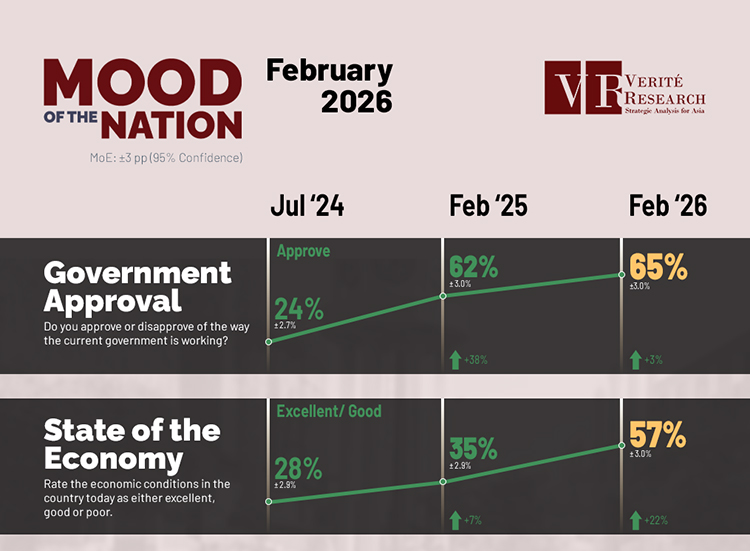
The government’s approval rating was recorded at 65% in early February 2026, according to the latest “Mood of the Nation” poll conducted by Verité Research. This figure, with a margin of error of ±3 percentage points, shows a statistically stable position from the 62% approval rating noted a year prior. The poll was conducted in collaboration with Vanguard Survey (Pvt) Ltd.
The disapproval rating remained low and unchanged compared to the previous poll conducted in February 2025.
For the first time in the four-year history of the poll, a greater percentage of respondents rated the current economic conditions as “good” or “excellent,” surpassing those who considered them “poor.”
Economic outlook perceptions have also improved, with 64% of respondents indicating that the economy is “getting better,” up from 55% a year ago. The percentage of individuals who felt the economy was “getting worse” remained largely unchanged, while those expressing no opinion decreased. This suggests an increase in certainty and optimism regarding the country’s economic direction.
All sentiments related to the economy are compiled into an Economic Confidence Index, which ranges from -100 to +100. The index registered a score of +36, marking a significant improvement from +14 a year ago.
Additionally, a majority of 59% expressed satisfaction with “the way things are going” in the country. This is the first instance in four years of polling that satisfaction levels have surpassed the 50% mark.
When evaluating various aspects in which the current government was compared to previous administrations, the most positive feedback was received for reducing drugs and crime, surpassing even the efforts to reduce corruption.
The “Mood of the Nation” poll is part of Verité Research’s Syndicated Surveys instrument, aimed at enhancing its regular macro political briefings. This tool permits other organizations to include survey questions to gauge the sentiments of Sri Lankans, with further polling results available to clients.
The recent survey was based on a nationally representative, multi-stage, randomized sample of 1,048 Sri Lankan adults from separate households, conducted from January 24 to February 3, 2026. The design ensures a maximum sampling error margin of ±3.0 percentage points at a 95% confidence level. However, error margins may be influenced by potential lapses during the implementation process.