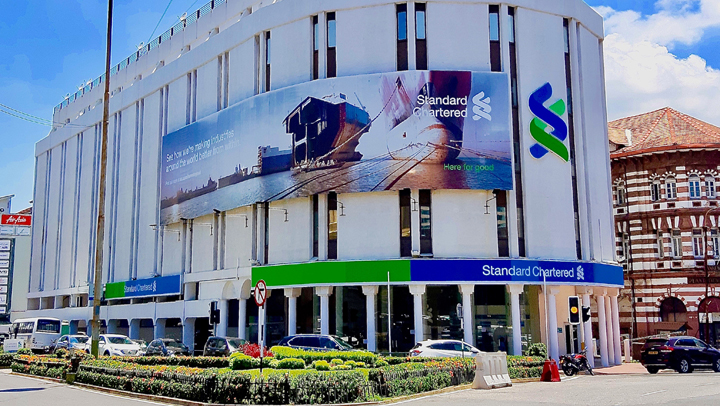
Fitch Ratings has reaffirmed the National Long-Term Rating of Standard Chartered Bank, Sri Lanka (SCBSL) at ‘AAA(lka)’, with a Stable Outlook. This decision reflects anticipated support from its parent company, Standard Chartered Bank, along with the recent sale of its retail business. The local entity’s wealth and retail banking business is being sold to DFCC Bank, with the transaction expected to complete in the third quarter of 2026.
Fitch expects SCBSL to concentrate on the corporate and institutional banking sector, where it holds a significant domestic presence. The affirmation of SCBSL’s rating is primarily driven by the high likelihood of support from Standard Chartered Bank’s head office, should it be necessary, subject to any regulatory limitations on remittances into Sri Lanka. This expectation is rooted in SCBSL’s role as a branch of Standard Chartered Bank, thereby being part of the same legal entity.
Standard Chartered Bank’s Long-Term Issuer Default Rating (IDR) stands considerably higher than Sri Lanka’s Long-Term Local-Currency IDR of ‘CCC+’, positioning the branch’s support-driven credit profile among the strongest of Fitch-rated domestic entities. As such, SCBSL’s rating is at the uppermost level of Sri Lanka’s National Rating scale.
The sale of SCBSL’s wealth and retail banking business (WRB) to DFCC Bank PLC is projected to conclude in the third quarter of 2026. SCBSL had announced in March 2025 its plan to divest its WRB business in line with its group strategy. The branch is expected to enhance its focus on the corporate and institutional banking segment, capitalizing on its solid domestic franchise.
The loan/deposit ratio (LDR) of SCBSL is anticipated to increase to between 40% and 50% from 34.5% as of the end of the third quarter of 2025, reverting to a normalized state post the divestment of its WRB business. This change is due to the WRB’s higher deposit balance relative to its loans. Despite this, the balance sheet is expected to remain liquid, with over 30% of assets held in government securities, supplemented by short-term placements with domestic banks and intragroup receivables, which constituted 36% of assets by the end of the third quarter of 2025.
SCBSL maintains high capital buffers, with a common equity Tier 1 (CET1) ratio at 38.1% by the end of the third quarter of 2025, compared to 41.6% at the end of 2024. It is estimated that the CET1 ratio could rise to approximately 45% when including profits from the first nine months of 2025. The branch has not repatriated profits since 2019 and is expected to retain earnings to support the tightening of single-borrower limits and an expanding loan portfolio.
SCBSL’s asset quality remains positive, with the stage 3 loan ratio improving to 3.3% by the end of the third quarter of 2025, from 7.5% at the end of 2024. This improvement is attributed to better borrower repayment capabilities and upgrades due to reduced country risks. Asset quality is anticipated to remain stable in the near term, supported by improved operating conditions. Profitability has been bolstered by significant credit write-backs, which accounted for over 10% of average gross loans in the first nine months of 2025, offsetting lower net interest income.
SCBSL’s National Rating could be downgraded if there’s a significant change in Fitch’s expectation of support from Standard Chartered Bank, such as a change in the branch’s legal status or divestment. A downgrade of the sovereign’s Long-Term Local-Currency IDR or other developments affecting the branch’s ability to meet its obligations could also lead to a multiple-notch downgrade of SCBSL’s National Rating.
There is no potential for an upgrade in the National Long-Term Rating, as it is currently at the apex of the rating scale.
(Colombo/Feb20/2026)