The recent experience of Cyclone Ditwa should serve as a national wake-up call. What the country witnessed was not merely the impact of a severe weather event, but the consequences of delayed interpretation, fragmented forecasting inputs, and hesitant decision-making. As climate change intensifies the frequency and severity of extreme weather, Sri Lanka can no longer afford to approach disaster preparedness as a purely domestic technical function. It must now be treated as a matter of national governance supported by global intelligence.
It must be stated clearly that Sri Lanka’s Meteorological Department comprises dedicated andcompetent professionals. However, modern weather forecasting—especially for cyclones, flash floods, and extreme rainfall—is no longer confined within national boundaries. It depends on real-time satellite observation, complex numerical modelling, and continuous data assimilation from multiple global centres. No small island state, situated in a highly volatile oceanic zone, can operate effectively in isolation.
Cyclone Ditwa exposed familiar systemic weaknesses: evolving forecasts that were not decisively interpreted, uncertainty about severity, and delays in translating scientific data intoadministrative action. These were not failures of intent but failures of structure. Early warning s not simply about detecting a storm; it is about understanding its changing dynamics and ensuring that knowledge flows rapidly into decision- making channels that trigger timely action on the ground.
One of the most compelling global examples of advanced meteorological capability is the National Satellite Meteorological Center (NSMC) in Beijing, operated by the China
Meteorological Administration. The NSMC manages the Fengyun (FY) series of meteorologicalsatellites, which provide high-resolution data on cloud formation, rainfall intensity, windpatterns, ocean- atmosphere interaction, and cyclone genesis. These systems are particularlyeffective over the Indian Ocean region, which directly influences Sri Lanka’s weather systems.
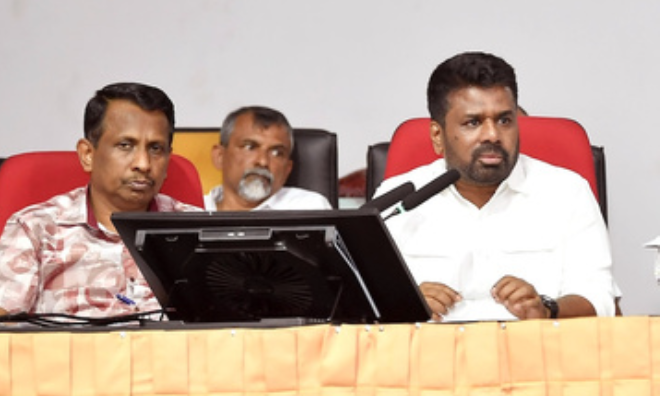
The relevance of the NSMC is not merely theoretical. During an official visit to the National Satellite Meteorological Center in Beijing on 27 March 2024, accompanying the Prime Minister,it was possible to observe firsthand the scale, sophistication, and real-time operational nature of modern satellite- based weather intelligence. What was striking was not only the technological depth of the systems in place, but the manner in which scientific data was seamlessly integrated into decision-support processes. Forecasting, monitoring, interpretation, and advisory functions operated as a continuous loop, rather than as isolated technical exercises.
That experience underscored a critical lesson for Sri Lanka: access to high-quality global data isonly meaningful when it is institutionally embedded and operationally linked to governance.
China’s approach demonstrates how satellite intelligence can move beyond academic
forecasting to become a core component of national preparedness and disaster risk reduction.China is, of course, not the only potential partner. Global best practice shows that resilientcountries maintain diversified meteorological intelligence networks.
India’s Meteorologica Department, supported by INSAT and Oceansat satellite systems, offers valuable regional insights due to shared oceanic and atmospheric conditions. Japan’s Meteorological Agency is internationally respected for its precision in typhoon modelling and early warning dissemination. The European Centre for Medium-Range Weather Forecasts remains the global benchmark for medium- range forecasting, while the United States’ NOAA provides extensive expertise in cyclone dynamics and ocean-climate interaction.
The objective for Sri Lanka should therefore be the creation of a networked meteorological
intelligence framework, drawing systematically from multiple global centres. Cross-validateddata reduces uncertainty, enhances confidence in forecasts, and allows authorities to actdecisively rather than cautiously. In the context of Ditwa, uncertainty proved more damagingthan surprise. When warnings are ambiguous or inconsistent, action is delayed, localadministrations hesitate, and communities remain exposed.
Why this is urgent:
Climate-driven extreme weather is now a permanent feature of Sri Lanka’s risk landscape. Thecost of delayed or uncertain decision-making far exceeds the investment required for
preparedness.
Key Policy Actions Required:
Formal International Partnerships
Establish institutional Memoranda of Understanding with leading global meteorological centres, including China’s NSMC, India’s IMD, Japan’s JMA, ECMWF, and NOAA, ensuring real-time data access and technical collaboration.
Dedicated Climate & Disaster Intelligence Cell Create a permanent inter-agency unit integrating the Meteorological Department, Disaster
Management Centre, irrigation authorities, local government, and security agencies, with directaccess to global satellite data.
Clear Decision Protocols
Link forecast thresholds to predefined administrative actions, reducing ambiguity and ensuringthat scientific warnings automatically trigger operational responses.
Capacity Building
Regular joint training programmes, scenario simulations, and data-interpretation exercises withinternational partners to strengthen local expertise.
Direct Reporting Line to National Leadership
Ensure that critical weather intelligence is communicated swiftly to the highest decision- makinglevels during evolving events.
Outcome:
A system that transforms early warning into early action, reducing loss of life, economic
damage, and public uncertainty.
Returning to Ditwa, the lesson is clear. The disaster was not simply the result of an unforeseenevent, but of an evolving situation that was not decisively interpreted and acted upon. This iswhere institutional reform becomes as important as technological access. Data confined totechnical silos serves little purpose. It must flow into clear governance pathways that empowertimely decisions.
Investment in global meteorological partnerships should not be viewed as an optional
expenditure. It is national insurance. The economic losses from a single poorly managed
disaster can outweigh decades of investment in preparedness. Moreover, as climate volatilityincreases, the frequency of such events will rise, not diminish.
Sri Lanka now stands at a crossroads. It can continue to treat disasters as episodic misfortunes,responding reactively after damage is done, or it can recognise that climate risk is a structuralreality requiring permanent preparedness. Strengthening institutional links with globalmeteorological centres—illustrated by the capabilities witnessed at the National SatelliteMeteorological Center in Beijing—is a decisive step toward the latter path.
Natural disasters may be unavoidable. National unpreparedness is not. Cyclone Ditwa has
delivered a warning that must not be ignored. The responsibility now lies with policymakers toensure that the next storm finds Sri Lanka informed, prepared, and ready to act.
By Tennekoon Rusiripala