Sri Lanka has a habit of arguing passionately about the wrong century.
While the world is reorganising education around problem-solving, adaptive thinking, and artificial intelligence, we are still debating syllabi as if the highest intellectual challenge facing a student is remembering who said what in a Victorian novel. Jane Austen was brilliant. Oscar Wilde was sharper still. But neither will help a 19-year-old graduate debug a system, model a supply chain, or solve a real-world logistics failure in Hambantota or Kurunegala.
This is not an argument against literature. It is an argument against confusing cultural refinement with economic readiness.
Artificial Intelligence is no longer a subject; it is an environment. It is the water future workers will swim in, whether legislators approve or not. The real question is whether Sri Lanka chooses to teach citizens to use the tools — or leaves them to be used by them.
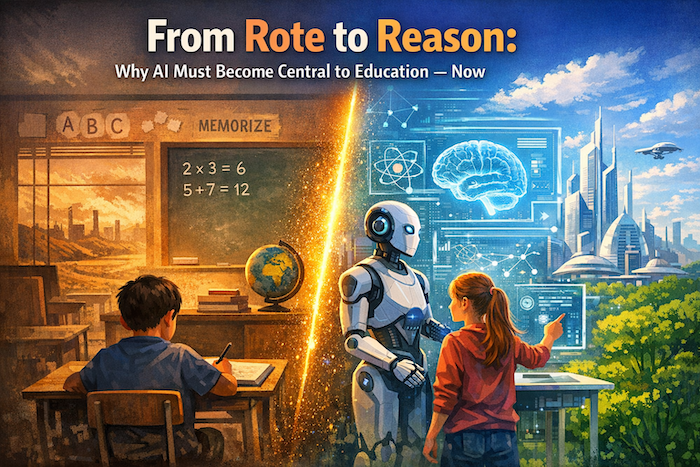
At present, our education system remains stubbornly content-heavy and context-light. Students are trained to absorb, reproduce, and regurgitate information — a skill set AI now performs faster, cheaper, and without exam anxiety. This is not progress; it is redundancy.
What AI demands instead is a shift from content learning to problem learning.
In a problem-solving model, students are not judged by how much they remember, but by:
how they frame questions, how they test assumptions, how they evaluate outputs, and how they correct errors.
These are not abstract skills. They are the backbone of modern work — from agriculture and healthcare to finance, manufacturing, and public administration.
A student who knows how to think with AI is infinitely more employable than one who merely knows about things.
This is where legislators must stop romanticising education and start modernising it.
The role of Parliament is not to protect syllabi from discomfort. It is to protect citizens from irrelevance. Every year we delay meaningful AI integration into education, we widen the gap between what students are taught and what the economy actually needs. And that gap is paid for by families, not policymakers.
The fear, of course, is that AI will “replace teachers” or “dumb down thinking.” This is the wrong anxiety. AI does not eliminate thinking; it punishes lazy thinking. It exposes weak questions, shallow logic, and copied answers instantly. Used properly, it forces clarity, precision, and intellectual honesty — qualities our examination culture has quietly discouraged for decades.
A student working with AI must explain why an answer works, not merely what the answer is. That is education with consequences.
For a country that claims to want social mobility, AI is not a threat — it is an equaliser. It gives a rural student access to the same analytical scaffolding as an urban one. It reduces dependency on expensive tuition. It shifts advantage from memorisation to reasoning. That is profoundly pro-people.
Yet policy discussions remain timid, fragmented, and occasionally nostalgic. We hear endless talk of “values,” “heritage,” and “tradition,” as if teaching children to solve real problems somehow erodes civilisation. It does not. It strengthens it.
Jane Austen will survive without syllabus protection.
The Sri Lankan student may not survive without AI literacy. This is not a call for reckless adoption. It is a call for urgent, structured integration: teacher training, curriculum redesign, assessment reform, and ethical safeguards — led by lawmakers who understand that education is not a museum, but a launchpad.
The choice before us is simple.
We can continue producing students who know the importance of being earnest —
or we can produce citizens who know how to solve problems earnestly.
History will not mark us kindly if we choose nostalgia over necessity.