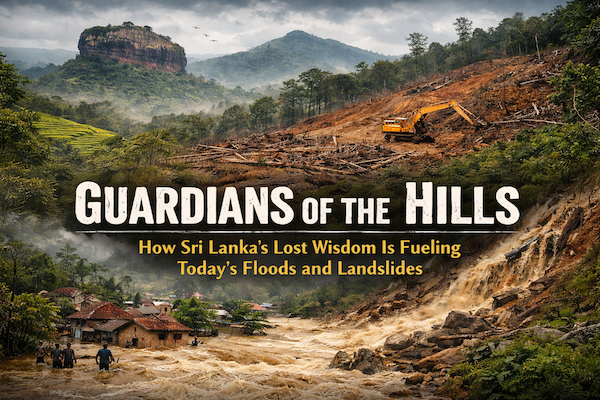
Sri Lanka’s central hills are not just a geographical feature; they are the silent foundation of a civilisation that flourished for over 2,500 years. These are the very hills that ancient kings who built global wonders such as the Lion Rock Castle (Sigiriya) deliberately chose not to touch. While cities, palaces, and stupas rose in the dry zone, the central highlands were left intact, respected, and protected.
This restraint was not accidental. It was wisdom.
Our ancestors built over 33,000 tanks and intricate cascade systems, creating one of the world’s most advanced hydrologic civilisations. Without clearing the central hills, they fed a large part of Asia, earning Sri Lanka the titles “Rice Bowl of Asia” and “Granary of the East.” The hills were preserved as catchments and watersheds, sustaining 103 rivers and countless tank cascades that supported agriculture, livelihoods, and ecological balance across the island.
For centuries, these hills stood untouched until colonial greed intervened.
The British systematically vandalised the central highlands for coffee and later tea plantations. To achieve this, forests were cleared without regard for slope stability, soil conservation, or hydrology. In the process, more than 6,000 elephants and thousands of leopards were killed to “open up” the land. What had been a living, breathing ecological shield was reduced to an extractive landscape serving an empire.
Independence did not bring wisdom back to the hills. Instead, local agents of colonial thinking –Kalusuddas following the same destructive playbook accelerated the damage. Large reservoirs, aggressive land clearing, and unplanned agriculture under schemes such as the Mahaweli system created new villages and economic activity, but at a heavy ecological cost. Catchments were compromised, slopes destabilised, and river basins weakened.
More recently, the assault has taken a new form. Real estate companies, often proudly carrying the word “LANDS” at the end of their names, have carved up our Bhoomi without shame. Hills have been cut, forests fragmented, and natural drainage altered fueling landslides, floods, and recurring disasters that are now described as “natural,” though they are anything but.
Today, we are finally talking about preservation. The proposal to protect land above 5,000 feet the so-called Red Zone has even been acknowledged at the highest level, with the President himself speaking about it. This recognition is welcome, but words alone will not stabilise slopes, restore soils, or revive rivers.
What Sri Lanka urgently needs is meaningful, enforceable action.
The central highlands and the 103 river basins must be preserved in their entirety through Nature-Based Solutions reforestation with native species, strict land-use controls, restoration of degraded catchments, and the complete prohibition of further fragmentation in sensitive zones. This is not an anti-development argument; it is a pro-survival one. The stability of the hill country is directly linked to the safety of the plains, the security of food systems, and the resilience of the economy.
Our ancient civilisation understood this truth without modern science or climate models. They protected the hills so the island could thrive.
The question now is simple and unforgiving:
Will we finally relearn that wisdom, or will we continue to pay for centuries of vandalism with disasters of our own making.