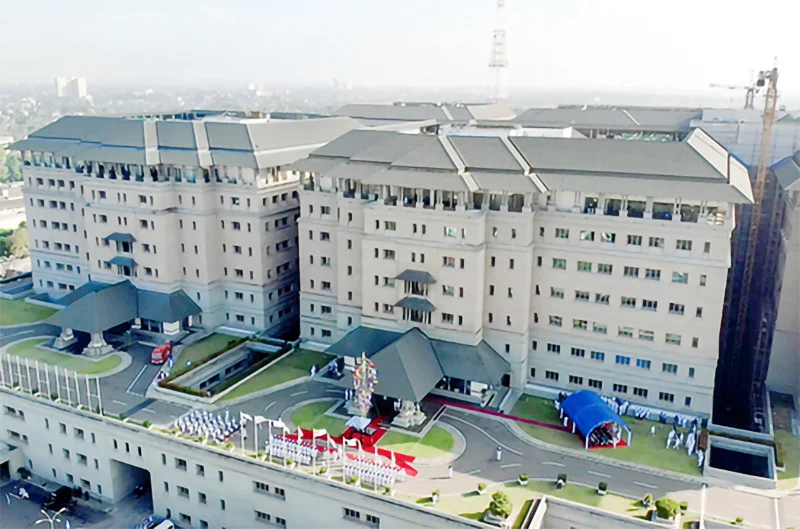
The Navy ceremonially occupied its new Headquarters (Block No. 3) at the Defence Headquarters Complex (DHQC) at Akuregoda, Battaramulla, on 09 December, 2025. On the invitation of the Commander of the Navy, Vice Admiral Kanchana Banagoda, the Deputy Minister of Defence, Major General Aruna Jayasekara (Retd) attended the event as the Chief Guest.
Among those present were Admiral of the Fleet Wasantha Karannagoda, the Defence Secretary, Air Vice Marshal Sampath Thuyacontha (Retd), Commander of the Army, Lieutenant General Lasantha Rodrigo, Commander of the Air Force, Air Marshal Bandu Edirisinghe, Inspector General of Police, Attorney-at-Law Priyantha Weerasooriya and former Navy Commanders.
With the relocation of the Navy at DHQC, the much-valued project to shift the Ministry of Defence (MoD) and Headquarters of the war-winning armed forces has been brought to a successful conclusion. The Army was the first to move in (November 2019), the MoD (May 2021), the Air Force (January 2024) and finally the Navy (in December 2025).
It would be pertinent to mention that the shifting of MoD to DHQC coincided with the 12th anniversary of bringing back the entire Northern and Eastern Provinces under the government, on 18 May, 2009. LTTE leader Velupillai Prabhakaran was killed on the following day.
The project that was launched in March 2011, two years after the eradication of the Liberation Tigers of Tamil Eelam (LTTE), suffered a severe setback, following the change of government in 2015. The utterly irresponsible and treacherous Yahapalana government halted the project. That administration transferred funds, allocated for it, to the Treasury, in the wake of massive Treasury bond scams perpetrated in February and March 2015, within weeks after the presidential election.
Maithripala Sirisena, in his capacity as the President, as well as the Minister of Defence, declared open the new Army Headquarters, at DHQC, a week before the 2019 presidential election. Built at a cost of Rs 53.3 bn, DHQC is widely believed to be the largest single construction project in the country. At the time of the relocation of the Army, the then Lt. Gen. Shavendra Silva, the former Commanding Officer of the celebrated Task Force I/58 Division, served as the Commander.
Who made the DHQC a reality? Although most government departments, ministries and armed forces headquarters, were located in Colombo, under the Colombo Master Plan of 1979, all were required to be moved to Sri Jayewardenepura, Kotte. However successive administrations couldn’t go ahead with the massive task primarily due to the conflict. DHQC would never have been a reality if not for wartime Defence Secretary Gotabaya Rajapaksa who determinedly pursued the high-profile project.
The absence of any reference to the origins of the project, as well as the significant role played by Gotabaya Rajapaksa at the just relocated Navy headquarters, prompted the writer to examine the developments related to the DHQC. The shifting of MoD, along with the Armed Forces Headquarters, was a monumental decision taken by Mahinda Rajapaksas’s government. But, all along it had been Gotabaya Rajapaksa’s determination to achieve that monumental task that displeased some within the administration, but the then Defence Secretary, a former frontline combat officer of the battle proved Gajaba Regiment, was not the type to back down or alter his strategy.
GR’s maiden official visit to DHQC
Gotabaya Rajapaksa, who made DHQC a reality, visited the sprawling building in his capacity as the President, Defence Minister and the Commander-in-Chief of the Armed Forces on the morning of 03 August, 2021. It was Gotabaya Rajapaksa’s maiden official visit to the Army Headquarters, located within the then partially completed DHQC, eight months before the eruption of the externally backed ‘Aragalaya.’ The US-Indian joint project has been exposed and post-Aragalaya developments cannot be examined without taking into consideration the role played by political parties, the Bar Association of Sri Lanka, media, as well as the weak response of the political leadership and the armed forces. Let me stress that a comprehensive probe should cover the period beginning with the Swiss project to humiliate President Gotabaya Rajapaka in November, 2019, by staging a fake abduction, and the storming of the President’s House in July 2022. How could Sri Lanka forget the despicable Swiss allegation of sexual harassment of a female local employee by government personnel, a claim proved to be a blatant lie meant to cause embarrassment to the newly elected administration..
Let me get back to the DHQC project. The war-winning Mahinda Rajapaksa government laid the foundation for the building project on 11 May, 2011, two years after Sri Lanka’s triumph over the separatist Tamil terrorist movement. The high-profile project, on a 77-acre land, at Akuregoda, Pelawatta, was meant to bring the Army, Navy, and the Air Force headquarters, and the Defence Ministry, to one location.
President Gotabaya Rajapaksa’s visit to Akuregoda would have definitely taken place much earlier, under a very different environment, if not for the eruption of the Covid-19 pandemic, just a few months after his victory at the November 2019 election. The worst post-World War II crisis that had caused devastating losses to national economies, the world over, and delivered a staggering blow to Sri Lanka, heavily dependent on tourism, garment exports and remittances by its expatriate workers.
On his arrival at the new Army headquarters, President Gotabaya Rajapaksa was welcomed by General Shavendra Silva, who also served as the Chief of Defence Staff. Thanks to the President’s predecessor, Maithripala Sirisena, the then Maj. Gen Shavendra Silva was promoted to the rank of Lt. Gen and appointed the Commander of the Army on 18 August, 2019, just three months before the presidential poll. The appointment was made in spite of strong opposition from the UNP leadership and US criticism.
President Gotabaya Rajapaksa hadn’t minced his words when he publicly acknowledged the catastrophe caused by the plunging of the national income and the daunting challenge in debt repayment, amounting to as much as USD 4 bn annually.
The decision to shift the tri-forces headquarters and the Defence Ministry (The Defence Ministry situated within the Army Headquarters premises) caused a media furor with the then Opposition UNP alleging a massive rip-off. Defence Secretary Gotabaya Rajapaksa reiterated his commitment to the project. If not for the change of government in 2015, the DHQC would have been completed during Mahinda Rajapaksa’s third term if he was allowed to contest for a third term successfully. Had that happened, Gotabaya Rajapaksa wouldn’t have emerged as the then Opposition presidential candidate at the 2019 poll. The disastrous Yahapalana administration and the overall deterioration of all political parties, represented in Parliament, and the 19th A that barred Mahinda Rajapaksa from contesting the presidential election, beyond his two terms, created an environment conducive for Gotabaya Rajapaksa’s emergence as the newly registered SLPP’s candidate.
Shangri-La move
During the 2019 presidential election campaign, SLPP candidate Gotabaya Rajapaksa strongly defended his decision to vacate the Army Headquarters, during Mahinda Rajapaksa presidency, to pave the way for the Shangri-La Hotel in Colombo. Shangri-La was among the hotels targeted by the Easter Sunday bombers – the only location targeted by two of them, including mastermind Zahran Hashim.
President Gotabaya Rajapaksa is on record as having said that vacation of the site had been in accordance with first executive President J.R. Jayewardene’s decision to move key government buildings away from Colombo to the new Capital of the country at Sri Jaywardenepura. Gotabaya Rajapaksa said so in response to the writer’s queries years ago.
Gotabaya Rajapaksa said that a despicable attempt was being made to blame him for the Army Headquarters land transaction. “I have been accused of selling the Army Headquarters land to the Chinese.”
Rajapaksa explained that Taj Samudra, too, had been built on a section of the former Army Headquarters land, previously used to accommodate officers’ quarters and the Army rugger grounds. Although President Jayewardene had wanted the Army Headquarters shifted, successive governments couldn’t do that due to the war and lack of funds, he said.
President Maithripala Sirisena and Prime Minister Ranil Wickremesinghe declared open Shangri-La Colombo on 16 November, 2017. The Hong Kong-based Shangri-La Asia invited Gotabaya Rajapaksa for dinner, the following day, after the opening of its Colombo hotel. Shangri-La Chairperson, Kuok Hui Kwong, the daughter of Robert Kuok Khoon Ean, was there to welcome Gotabaya Rajapaksa, who had cleared the way for the post-war mega tourism investment project. Among those who had been invited were former President Mahinda Rajapaksa, former External Affairs Minister Prof. G.L. Peiris, former Presidential Secretary Lalith Weeratunga, and President’s Counsel Gamini Marapana, PC.
The Cabinet granted approval for the high-profile Shangri-La project in October 2010 and the ground-breaking ceremony was held in late February 2012.
Rajapaksa said that the Shangri-La proprietor, a Chinese, ran a big operation, based in Hong Kong, Malaysia and Singapore. Another parcel of land was given to the mega ITC hotel project, also during the previous Rajapaksa administration. ITC Ratnadipa, a super-luxury hotel by India’s ITC Hotels, officially opened in Colombo on April 25, 2024
Following the change of government in January 2015, the remaining section of the Army headquarters land, too, was handed over to Shangri-La.
Gotabaya Rajapaksa emphasised that the relocation of the headquarters of the Army, Navy, and Air Force, as well as the Defence Ministry, had been part of JRJ’s overall plan. The change of government, in January 2015, had caused a serious delay in completing the project and it was proceeding at a snail’s pace, Rajapaksa said. Even Parliament was shifted to Kotte in accordance with JRJ’s overall plan, Gotabaya Rajapaksa said, explaining his move to relocate all security forces’ headquarters and Defence Ministry into one complex at Akuregoda.
Acknowledging that the Army Headquarters had been there at Galle Face for six decades, Rajapaksa asserted that the Colombo headquarters wasn’t tactically positioned.
Rajapaksa blamed the inordinate delay in the completion of the Akuregoda complex on the Treasury taking hold of specific funds allocated for the project.
Over 5,000 military workforce

Gotabaya Rajapaksa’s maiden visit to DHQC on 3 August, 2021. General
Shavendra Silva is beside him
Major General Udaya Nanayakkara had been the first Director, Project Management Unit, with overall command of approximately 5,000 tri-forces personnel assigned to carry it out. The Shangri-La transaction provided the wherewithal to implement the DHQC project though the change of government caused a major setback. Nanayakkara, who had served as the Military Spokesman, during Eelam War IV, oversaw the military deployment, whereas private contractors handled specialised work such as piling, AC, fire protection and fire detection et al. The then MLO (Military Liaison Officer) at the Defence Ministry, Maj. Gen Palitha Fernando, had laid the foundation for the project and the work was going on smoothly when the Yahapalana administration withheld funds. Political intervention delayed the project and by September 2015, Nanayakkara was replaced by Maj Gen Mahinda Ambanpola, of the Engineer Service.
In spite of President Sirisena holding the Defence portfolio, he couldn’t prevent the top UNP leadership from interfering in the DHQC project. However, the Shangri-La project had the backing of A.J.M. Muzammil, the then UNP Mayor and one of the close confidants of UNP leader Ranil Wickremesinghe. Muzammil was among those present at the ground breaking ceremony for Shangri-La held on 24th February, 2012 ,with the participation of Minister Basil Rajapaksa.
Having identified the invaluable land, where the Army Headquarters and Defence Ministry were situated, for its project, Shangri-La made its move. Those who had been aware of Shangri-La’s plans were hesitant and certainly not confident of their success. They felt fearful of Defence Secretary Rajapaksa’s reaction.
But, following swift negotiations, they finalised the agreement on 28 December, 2010. Lt. Gen. Jagath Jayasuriya was the then Commander of the Army, with his predecessor General Fonseka in government custody after having been arrested within two weeks after the conclusion of the 2010 26 January Presidential poll.
Addressing the annual Viyathmaga Convention at Golden Rose Hotel, Boralesgamuwa, on 04 March, 2017, Gotabaya Rajapaksa, perhaps for the first time publicly discussed his role in the Shangri-La project. Declaring that Sri Lanka suffered for want of, what he called, a workable formula to achieve post-war development objectives, the war veteran stressed the pivotal importance of swift and bold decision-making.
Gotabaya Rajapaksa explained how the government had acted swiftly, and decisively, to attract foreign investments though some such efforts were not successful. There couldn’t be a better example than the government finalising an agreement with Shangri-La Hotels, he declared.
Declaring that the bureaucratic red tape shouldn’t in any way be allowed to undermine investments, Rajapaksa recalled the Chairman/CEO of Shangri-La Hotels and Resorts, Robert Kuok Khoon Ean, wanting the Army Headquarters land for his Colombo project. In fact, the hotels chain, at the time, had proposed to build hotels in Colombo, Hambantota and Batticaloa, and was one of the key investors wanting to exploit Sri Lanka’s success in defeating terrorism.
“Khoon-Ean’s request for the Army Headquarters land caused a serious problem for me. It was a serious challenge. How could I shift the headquarters of the war-winning Army? The Army had been there for six decades. It had been the nerve centre of the war effort for 30 years,” said Rajapaksa, who once commanded the First Battalion of the Gajaba Regiment (1GR)
Rajapaksa went on to explain how he exploited a decision taken by the first executive president J.R. Jayewardene to shift the Army Headquarters to Battaramulla, many years back. “Within two weeks, in consultation with the Secretary to the Finance Ministry, Dr. P.B. Jayasundera, and the Board of Investment, measures were taken to finalise the transaction. The project was launched to shift the Army, Navy and Air Force headquarters to Akuregoda, Pelawatte, in accordance with JRJ’s plan.”
The Hong Kong-based group announced the purchase of 10 acres of state land, in January 2011. Shangri-La Asia Limited announced plans to invest over USD 400 mn on the 30-storeyed star class hotel with 661 rooms.
The hotel is the second property in Sri Lanka for the leading Asian hospitality group, joining Shangri-La’s Hambantota Resort & Spa, which opened in June 2016.
Rajapaksa said that the top Shangri-La executive had referred to the finalisation of their Colombo agreement to highlight the friendly way the then administration handled the investment. Shangri-La had no qualms about recommending Sri Lanka as a place for investment, Rajapaksa said.
The writer explained the move to shift the Army Headquarters and the Defence Ministry from Colombo in a lead story headlined ‘Shangri-La to push MoD, Army Hq. out of Colombo city: Army Hospital expected to be converted into a museum’ (The Island, 04 January, 2011).
Yahapalana chaos
In the wake of the January 2015 change of government, the new leadership caused chaos with the suspension of the China-funded Port City Project, a little distance away from the Shangri-La venture. Many an eyebrow was raised when the then Finance Minister Ravi Karunanayake declared, in March, 2015, that funds wouldn’t be made available to the DHQC project until the exact cost estimation of the project could be clarified.
Media quoted Karunanayake as having said “Presently, this project seems like a bottomless pit and we need to know the depth of what we are getting into. From the current state of finances, allocated for this project, it seems as if they are building a complex that’s even bigger than the Pentagon!”
The insinuating declaration was made despite them having committed the blatant first Treasury bond scam in February 2015 that shook the Sirisena-Wickremesinghe administration to its core.
In June 2016, Cabinet spokesperson, Dr. Rajitha Senaratne, announced the suspension of the Akuregoda project. Citing financial irregularities and mismanagement of funds, Dr. Senaratne alleged that all Cabinet papers on the project had been prepared according to the whims and fancies of Gotabaya Rajapaksa.
The then Minister Karunanayake spearheaded the campaign against the DHQC project alleging, in the third week of January, 2015, that Rs 13.2 billion, in an account maintained at the Taprobane branch of the Bank of Ceylon had been transferred to the Consolidated Fund of the Treasury. The matter was being investigated as the account belonged to the Ministry of Defence, he added. The Finance Minister stressed that the MoD had no right to maintain such an account in violation of regulations and, therefore, the opening of the account was being investigated. The Minister alleged that several illegal transactions, including one involving Samurdhi, had come to light. He estimated the Samurdhi transaction (now under investigation) at Rs. 4 billion.
Having undermined Shangri-La and the DHQC projects, the UNP facilitated the expansion of the hotel project by releasing additional three and half acres on a 99-year lease. During the Yahapalana administration, Dayasiri Jayasekera disclosed at a post-Cabinet press briefing how the government leased three and a half acres of land at a rate of Rs. 13.1 mn per perch whereas the previous administration agreed to Rs 6.5 mn per perch. According to Jayasekera the previous government had leased 10 acres at a rate of Rs 9.5 mn (with taxes) per perch.
The bottom line is that DHQC was built with Shangri-La funds and the initiative was Gotabaya Rajapaksa’s whose role as rock solid wartime Secretary of Defence to keep security forces supplied with whatever their requirements could never be compared with any other official during the conflict.
courtesy : www.island.lk