Begum Khaleda Zia, Bangladesh’s first woman Prime Minister and one of South Asia’s most consequential political leaders, has died aged over 80, bringing to a close a political era defined as much by democratic restoration as by deep and enduring division.
For more than three decades, Khaleda Zia stood at the centre of Bangladesh’s political gravity. Her leadership of the Bangladesh Nationalist Party (BNP) shaped the country’s post-authoritarian trajectory, even as her rivalry with Sheikh Hasina entrenched a politics of confrontation that repeatedly tested institutions, markets, and governance.
Zia entered public life through tragedy, following the assassination of her husband, President Ziaur Rahman. What followed was not a ceremonial inheritance but a determined political ascent. In 1991, she led Bangladesh’s return to parliamentary democracy after years of military rule — a transition widely regarded as one of the most significant constitutional moments since independence.
Her governments presided over periods of economic stabilisation and early liberalisation, navigating structural adjustment, export-led growth, and the expansion of Bangladesh’s garment sector — now the backbone of the economy. Fiscal discipline during her first term helped restore donor confidence, while private sector participation expanded cautiously under a still-evolving regulatory framework.
Yet, her tenure also reflected the costs of political volatility. Recurrent strikes, confrontational street politics, and institutional paralysis created uncertainty that periodically unsettled investment sentiment and slowed reform momentum. Bangladesh’s economic story advanced — but often in spite of politics rather than because of it.
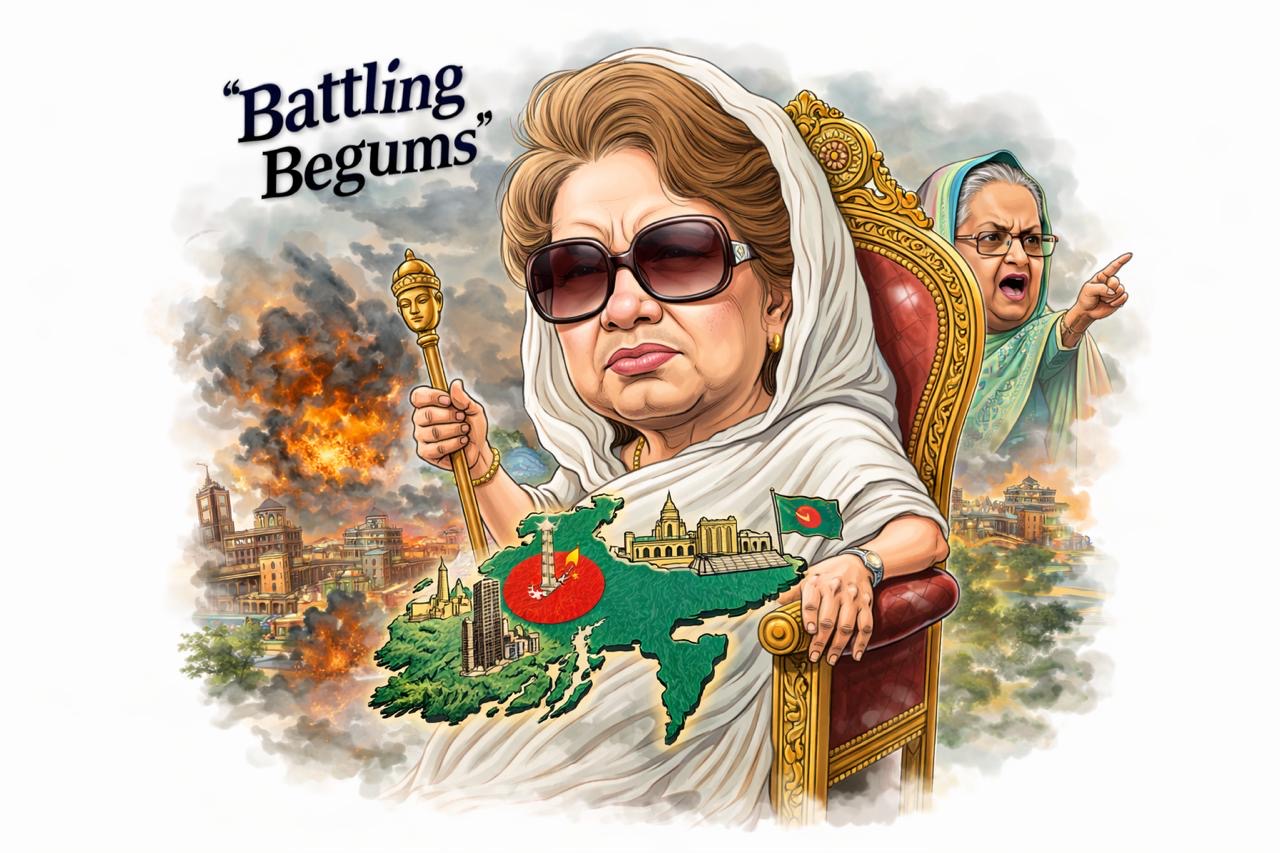
The long rivalry between Khaleda Zia and Sheikh Hasina — popularly termed the “Battling Begums” — came to define not only electoral competition but the tone of governance itself. Power alternated, consensus evaporated, and state institutions were increasingly perceived through partisan lenses. Markets adapted, but governance credibility suffered.
In her later years, Zia’s political life narrowed to courtrooms and hospital wards. Corruption convictions, which she and her party consistently described as politically motivated, effectively removed her from active politics for nearly a decade. International human rights organisations raised concerns over due process, while Western governments urged restraint and political inclusion amid shrinking democratic space.
Following her death, tributes arrived from across the world.
The United Nations acknowledged her role in Bangladesh’s democratic transition, while the European Union recalled her leadership during a formative phase of parliamentary consolidation, reiterating its long-standing emphasis on political pluralism and institutional balance. Regional leaders noted her status as a pioneer for women in South Asian politics — a leader who did not merely break a ceiling, but governed in its shadow.
From an economic standpoint, Khaleda Zia’s legacy is best described as consequential but incomplete. She governed during a period when Bangladesh began its long climb toward middle-income status, laying early foundations for export competitiveness and macroeconomic stability. Yet, sustained reform — particularly in state institutions, financial transparency, and regulatory independence — remained elusive, repeatedly constrained by political brinkmanship.
Her death comes at a time when Bangladesh faces renewed economic pressures: foreign exchange constraints, debt sustainability questions, and the challenge of sustaining growth amid global uncertainty. The political culture shaped by her era — one of dominance rather than dialogue — continues to cast a long shadow over economic governance.
History will not render Khaleda Zia a simple verdict. She restored democracy, yet presided over polarisation. She strengthened party politics, yet weakened consensus. She expanded space for women in leadership, yet governed within a system increasingly resistant to reform.
What is beyond dispute is scale. Few individuals so thoroughly defined their nation’s political rhythm.
With her passing, Bangladesh closes a chapter that shaped its institutions, its economy, and its political temperament. Whether the next chapter brings reconciliation, reform, and stability — the conditions markets and citizens alike require — remains an open question.
Khaleda Zia leaves behind a country still negotiating the costs of the politics she embodied. Her era is over. Its consequences endure.