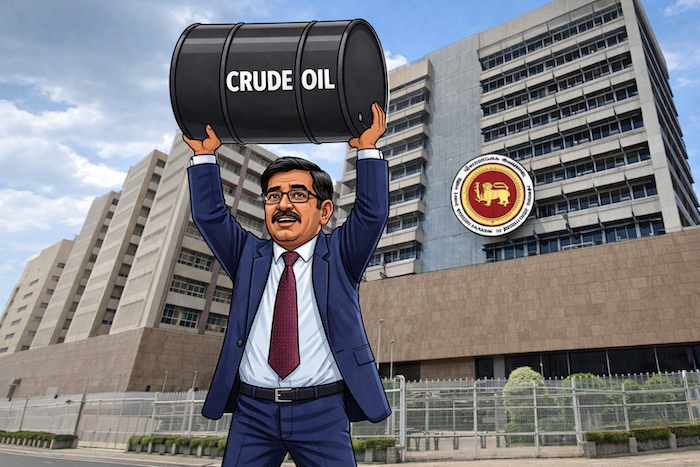
Sri Lanka’s fragile external finances remain highly sensitive to fluctuations in global crude oil prices, with even modest increases in energy costs capable of significantly widening the country’s foreign currency outflows.
As an island nation that imports nearly all of its petroleum requirements, Sri Lanka spends billions of dollars annually on fuel purchases. Energy economists estimate that the country consumes roughly 90,000 to 100,000 barrels of petroleum products per day, translating to around 35 million barrels annually.
Because oil is traded globally in U.S. dollars, every increase in the price of crude directly raises Sri Lanka’s demand for foreign currency.
According to energy sector analysts, a $10 increase in the global price of crude oil can raise Sri Lanka’s annual fuel import bill by approximately $300–350 million. If prices climb by $20 per barrel, the country’s foreign currency requirement for fuel could increase by more than $700 million per year.
Central Bank Governor Nandalal Weerasinghe said Sri Lanka currently has greater resilience to absorb such shocks, pointing to the country’s foreign exchange reserves of more than $7 billion, a sharp improvement from the near-depleted reserve levels during the 2022 crisis.
“We are much better prepared compared to the past,” Weerasinghe said in remarks to Bloomberg. During the peak of the economic crisis, Sri Lanka faced inflation approaching 70 percent, alongside a severe shortage of foreign exchange that made it impossible for the country to finance essential imports, including fuel.
“If such a conflict had occurred under those conditions, it would have been much worse and incredibly difficult,” he said.
Fuel imports already represent one of Sri Lanka’s largest categories of expenditure in foreign currency. In recent years, the country’s annual petroleum import bill has ranged between $3 billion and $5 billion, depending on global prices and domestic demand.
Critics have also raised concerns about recent market activity in which the government has reportedly been purchasing U.S. dollars in the domestic foreign exchange market, even as global oil prices climb.
In February 2026, the Central Bank of Sri Lanka (CBSL) acquired USD 461 million from the domestic foreign exchange market, according to recent data released by the central bank. The report highlighted that no US dollars were sold by the central bank during this period, underscoring ongoing efforts to bolster foreign reserves.
In the preceding month, January 2026, the CBSL purchased USD 209.8 million from the domestic forex market while selling USD 9.5 million, culminating in a net purchase of USD 200.3 million for that month. Consequently, over the first two months of 2026, the central bank has achieved a net purchase of USD 661.3 million from the domestic foreign exchange market.
These strategic acquisitions have elevated Sri Lanka’s official reserve assets to USD 7.28 billion by the end of February 2026. Notably, this is the first instance since August 2020 that the country’s official reserves have surpassed the USD 7 billion threshold.
Market analysts argue that such intervention may be counterproductive during a period when higher oil prices will naturally increase the country’s demand for foreign currency to finance imports.
“Accumulating dollars by purchasing them from the market while an oil price shock is emerging can tighten dollar liquidity and put unnecessary pressure on the exchange rate,” one Colombo-based financial analyst said. “If oil prices remain elevated, the economy will already require additional foreign currency to pay for fuel imports.”
The Sri Lankan rupee was quoted at 311.50/312.00 against the US dollar in the spot market on Monday, showing a notable weakening from Friday’s close of 311.00/20, according to dealers. Bond yields opened higher as a reaction to oil prices surging over 20% and surpassing $100 per barrel
The impact of higher oil prices extends well beyond the energy sector. Increased fuel costs place pressure on the country’s trade balance, widen the current account deficit, and accelerate the depletion of foreign exchange reserves. As more dollars are required to pay for energy imports, the Sri Lankan rupee may also come under depreciation pressure.
Transport remains the largest consumer of petroleum in the country, accounting for nearly 60 percent of total fuel demand, primarily through diesel used by buses, trucks and trains and petrol consumed by private vehicles and motorcycles. The power generation sector also relies on petroleum-based fuels during periods when hydropower output declines.
Higher oil prices also filter quickly through the broader economy. Increased transport costs raise the price of goods and services, while higher fuel costs in electricity generation can push up power tariffs, contributing to inflationary pressure.
Sri Lanka’s vulnerability to energy price shocks became starkly evident during the 2022 economic crisis, when soaring global oil prices coincided with a collapse in the country’s foreign reserves. The government struggled to finance fuel imports, leading to severe shortages and long queues across the country.
Since then, policymakers have sought to reduce exposure to global oil markets by accelerating renewable energy projects, including solar and wind power, while encouraging greater energy efficiency and exploring alternatives such as liquefied natural gas.
Nevertheless, economists caution that Sri Lanka’s external stability will remain closely tied to global energy markets for the foreseeable future.
“With such a high dependence on imported petroleum, fluctuations in oil prices translate almost immediately into foreign exchange pressures,” an energy economist in Colombo said. “Managing energy demand and diversifying power generation will be critical to reducing that vulnerability.”
As global energy markets remain volatile amid geopolitical tensions and shifting supply dynamics, Sri Lanka’s policymakers continue to monitor oil prices closely — aware that movements in distant commodity markets can have immediate consequences for the country’s financial stability.