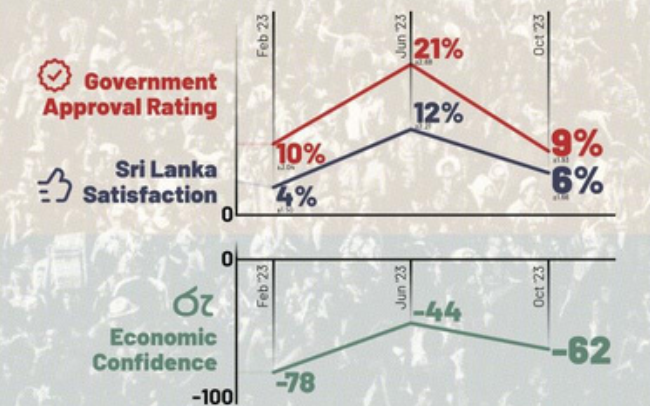
Colombo – A new “Mood of the Nation” survey by Verité Research indicates a marked shift in public sentiment, with government approval holding firm and economic confidence reaching its highest point in four years.
The February 2026 poll places approval of the current administration at 65%, up from 62% a year earlier. Within a ±3 percentage point margin of error, the increase suggests consolidation rather than volatility. Disapproval levels remain comparatively muted.
In isolation, approval ratings can reflect short-term sentiment. In context, however, these findings arrive at a politically significant moment: Sri Lanka is emerging from prolonged economic distress, fiscal restructuring, and institutional recalibration. Public mood, once dominated by uncertainty and protest, appears to be stabilising.
Economic Perception Turns Positive
For the first time since the survey’s inception, more respondents rated present economic conditions as “good” or “excellent” than “poor.” Additionally, 64% said the economy is “getting better,” compared to 55% one year ago.
These perceptions are reflected in Verité’s Economic Confidence Index, which rose sharply to +36, from +14 a year earlier — the highest reading in the poll’s four-year history.
While economic fundamentals remain subject to external pressures — including global commodity volatility, debt restructuring commitments, and structural reform requirements — public perception appears to be moving ahead of hard indicators. In politics, perception often precedes momentum.
Satisfaction and Governance Signals
Fifty-nine percent of respondents reported satisfaction with “the way things are going” in the country — the first time this metric has crossed the 50% threshold in four years.
Comparatively, respondents gave the administration its strongest marks for efforts to reduce drugs and crime, ranking these above perceived anti-corruption measures. This may reflect a public desire for visible order and enforcement following years of instability.
The findings suggest that law-and-order performance, rather than purely economic policy, may be shaping broader approval patterns.
Political Implications
For the administration of President Anura Kumara Dissanayake, the numbers provide evidence of regained public trust. For the opposition, they underscore the difficulty of mobilising discontent in an environment where economic expectations are trending upward.
However, political durability will depend on whether optimism proves resilient to future shocks. Sri Lanka’s recovery remains structurally sensitive to inflationary pressures, fiscal constraints, and reform fatigue.
Sustained confidence requires not only improved perception, but consistent delivery.