A Life at the Crossroads of Science, Conscience and
Politics
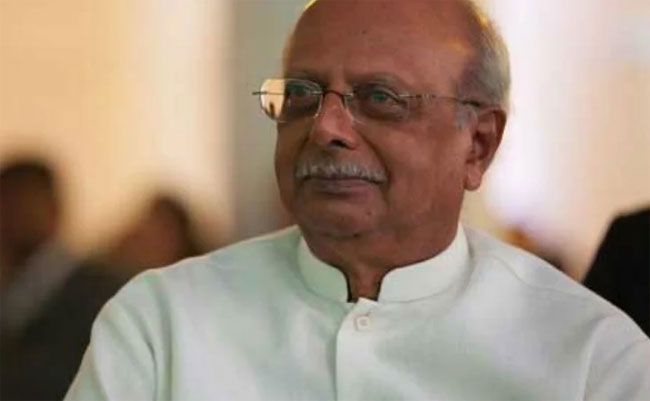
Professor Tissa Vitharana, one of Sri Lanka’s most distinguished public servants, passed away yesterday 13/2/26 at the age of 91. Family sources confirm he died at his residence in Sri Jayawardenepura Kotte after a period of illness.
His departure closes a chapter in Sri Lankan public life that stretched from scientific inquiry to political intervention, from laboratory to legislature — and always, at its core, a commitment to public purpose.
From Medicine to Microbiology to National Service
Born in Nuwara Eliya on 30 August 1934, Tissa Vitharana’s journey began in medicine. He graduated with an MBBS from the University of Ceylon before advancing into bacteriology and virology with postgraduate study in the United Kingdom.
He served as Director of the Medical Research Institute (MRI) in Colombo from 1983 to 1994, and later as a professor of microbiology at the University of Sri Jayewardenepura, mentoring generations of medical scientists. His contributions to public health and research were recognized when he was awarded the prestigious Vidya Jyothi title in 2017.
A Leftist Intellectual in the Arena of Politics
Professor Vitharana was not content with intellectual influence alone. In 1974, he joined the Lanka Sama Samaja Party (LSSP), one of Sri Lanka’s oldest leftist movements, bringing scientific rigor to political engagement.
In Parliament, he served multiple terms as a National List MP, entering the Assembly in 2004 and later during successive legislatures. His portfolios included Minister of Science and Technology, Minister of Technology and Research, and Senior Minister of Scientific Affairs under successive administrations.
He also served as Governor of the North Central Province from 2019 to 2020, demonstrating a breadth of service across both central and provincial domains.
The Measure of His Contribution
Tissa Vitharana’s life was an embodiment of dual commitments that too often run in parallel but do not intersect — hard science and public policy.
In an age where technocracy and politics frequently speak different languages, he was fluent in both.
His advocacy went beyond titles and ministries:
He promoted evidence-based policy.
He championed scientific research as national infrastructure.
He spoke openly on minority rights, constitutional reform, and reconciliation, earning respect across political lines.
His voice was considered authoritative not only in academic circles but in the corridors of power.
A Quiet Personal Legacy
He was married to Kamini Meedeniya, and they had a son, Ranil. His personal life was anchored in family and scholarship, even as his public life drew him into the national spotlight.
Students remember him as mentor; colleagues as peer; opponents as principled adversary.
Newsline Reflection
If Sri Lanka’s post-independence history is measured in crumbling dynasties, shifting coalitions, and momentary political flair, Professor Vitharana’s legacy is measured in durability — the long arc of commitment over decades, the belief that science and conscience can inform governance.
He lived through eras of optimism and upheaval, and he remained, to the end, a figure rooted in principle rather than partisanship.
Sri Lanka has lost one of its enduring public intellectuals.
And in an age desperately short of sober voices, that loss will be felt keenly.
Professor Tissa Vitharana 1934–2026
May his memory be a reminder that public service is not only about power — but purpose.