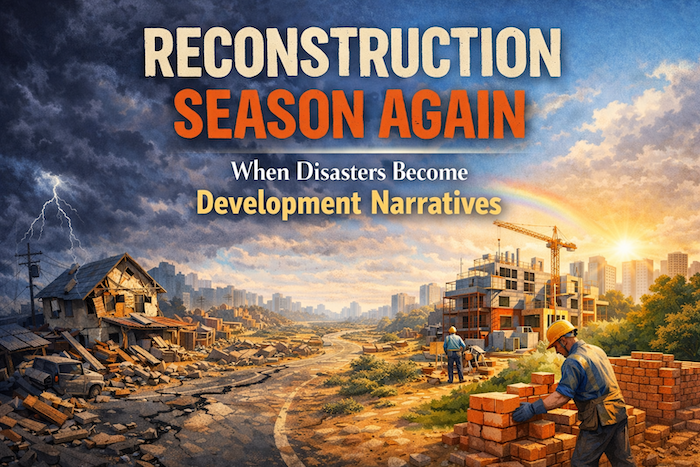
Sri Lanka’s Sunday papers this week were thick with images of bridges reopened, roads cleared, and ministers pointing at freshly laid concrete. Cyclone recovery, once again, has been framed as a national mobilisation story — resilience, unity, and rebuilding against the odds.
There is truth in this narrative. Infrastructure repairs matter. Connectivity matters. Communities cut off by floods and landslides cannot wait for perfect governance conditions. When bridges collapse, they must be rebuilt — quickly.
But Sri Lanka has a habit of confusing reconstruction with reform.
Disaster recovery projects are politically convenient. They unlock donor funds, bypass normal procurement scrutiny under “emergency” provisions, and create visible outputs — bridges, culverts, housing schemes — that photograph well. What they rarely do is address why the same districts flood every year, why drainage systems remain neglected, or why land-use regulations are selectively enforced until disaster strikes.
This is not a failure of engineering. It is a failure of institutional memory.
Each cyclone resets the national conversation. Each recovery effort is treated as exceptional. And each time, long-term mitigation — zoning enforcement, early-warning systems, maintenance budgets — slips quietly back into the background once the waters recede.
Sunday headlines spoke of websites tracking damage and reconstruction progress. Transparency is welcome. But disclosure after the fact is not the same as prevention before the event. A dashboard does not substitute for drainage maintenance. A ribbon-cutting does not compensate for a missing flood plain.
The uncomfortable truth is this: disasters have become a parallel development model. They allow spending without strategy, urgency without accountability, and political visibility without structural reform.
Sri Lanka does not lack the capacity to rebuild. It lacks the discipline to stop rebuilding the same things, in the same places, for the same reasons.
Until disaster mitigation is treated as infrastructure — boring, budgeted, and permanent — recovery will remain a recurring headline rather than a closing chapter.
Forty-One Convictions, Thousands of Questions: The Theatre of Anti-Corruption
The conviction of 41 individuals in bribery and corruption cases made Sunday headlines as proof that accountability is finally catching up with impunity. On paper, it is progress. In political reality, it is more complicated.
Convictions matter. They signal that institutions still function, that laws still bite, and that misconduct carries consequences. In a country long starved of accountability, even incremental enforcement feels like movement — and the public response reflects that hunger.
But numbers can mislead.
Who were the convicted? What positions did they hold? What scale of corruption was addressed — administrative bribery or systemic capture? These distinctions rarely make front pages, but they matter deeply.
Sri Lanka’s corruption problem has never been about petty bribes alone. It is about procurement opacity, policy manipulation, regulatory capture, and political insulation. Forty-one convictions do not automatically indicate progress against those structural risks.
There is also the timing question. Anti-corruption drives often accelerate when political incentives align — during transitions, fiscal negotiations, or donor engagements. Enforcement becomes selective not because institutions are weak, but because priorities are political.
Sunday papers reported convictions. They did not report recoveries. How much stolen public money has been retrieved? How much institutional damage has been reversed? Accountability without restitution is incomplete justice.
The deeper issue is credibility. When enforcement appears episodic, public trust remains fragile. Citizens do not measure anti-corruption success by press releases, but by predictability — whether rules are enforced consistently, regardless of proximity to power.
Sri Lanka does not need dramatic crackdowns. It needs boring enforcement: routine audits, automatic disclosures, predictable consequences. Until then, each conviction will be read with cautious approval — and lingering suspicion.