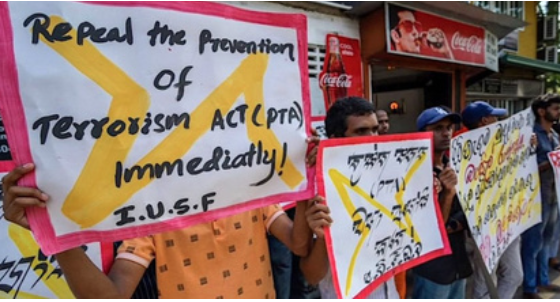
For decades, Sri Lanka’s Prevention of Terrorism Act (PTA) has stood as one of the most controversial statutes in the country’s legal architecture. Criticised domestically and internationally for enabling prolonged detention, weak judicial oversight, and documented abuse, the PTA became emblematic of the excesses of emergency-era governance.
The current administration under President Anura Kumara Dissanayake pledged reform. In its place, the government has proposed new counter-terror legislation — commonly referred to as the Protection of the State from Terrorism Act (PSTA) — positioning it as a modernised framework better aligned with contemporary security needs.
Yet across legal circles, rights organisations, and minority advocacy groups, a pressing question has emerged: does the proposed replacement represent substantive reform — or structural continuity?
Broad Powers, Familiar Concerns
One of the most consistent criticisms from civil society is that the draft legislation retains expansive executive powers similar to those embedded in the PTA.
Groups including Human Rights Watch have argued that certain detention provisions, arrest powers, and definitional clauses remain sufficiently broad to permit discretionary application.
The concern is not merely theoretical. Critics contend that vague terminology in counter-terror statutes historically enables uneven enforcement and prolonged pre-trial detention.
The debate centres on whether the proposed safeguards meaningfully constrain these powers — or merely recalibrate them.
The Question of Definition
At the heart of the controversy lies language.
Civil society actors have warned that expansive or ambiguous definitions of “terrorism” could risk encompassing forms of protest, dissent, or political mobilisation. In a country with a long and sensitive history of ethnic conflict and political unrest, definitional precision carries constitutional weight.
Legal commentators argue that any counter-terror framework must clearly distinguish between violent extremism and lawful political expression.
Without that clarity, critics fear that the law could chill democratic participation — particularly among minority communities and activist groups.
Judicial Oversight and Democratic Confidence
Another axis of concern relates to oversight mechanisms.
While the proposed legislation introduces revised procedural structures, some members of the legal community have questioned whether judicial review provisions are sufficiently robust and timely.
Counter-terror laws inevitably expand state authority. Democratic legitimacy therefore depends on visible and enforceable safeguards.
In this context, perception matters as much as drafting technique. If oversight mechanisms appear weakened or procedural thresholds diluted, public confidence may suffer — regardless of legislative intent.
Consultation and Process
Civil society groups have also scrutinised the consultation process itself. Although public submissions were invited, critics argue that meaningful engagement requires demonstrable recommendations. incorporation of substantive recommendations.
Security legislation, by its nature, sits at the intersection of sovereignty and civil liberty. Its durability depends not only on parliamentary approval but on societal legitimacy.
Reform in Substance or Structure?
The repeal of the PTA has long been framed as a step toward reconciling security policy with democratic standards. The proposed successor now carries that burden of expectation.
Supporters of the new framework argue that evolving security threats require modern legal tools and that the draft represents an improvement over emergency-era law. Critics respond that reform must be measured not by title but by operational effect.
Sri Lanka’s history with counter-terror legislation has been complex and fraught. The present debate is not about whether the state should have the capacity to address genuine threats. It is about where the line is drawn between necessary security and disproportionate power.
For a nation seeking consolidation after crisis, the durability of reform will depend on whether the new law strengthens both safety and constitutional trust — rather than asking the public to choose between them.