

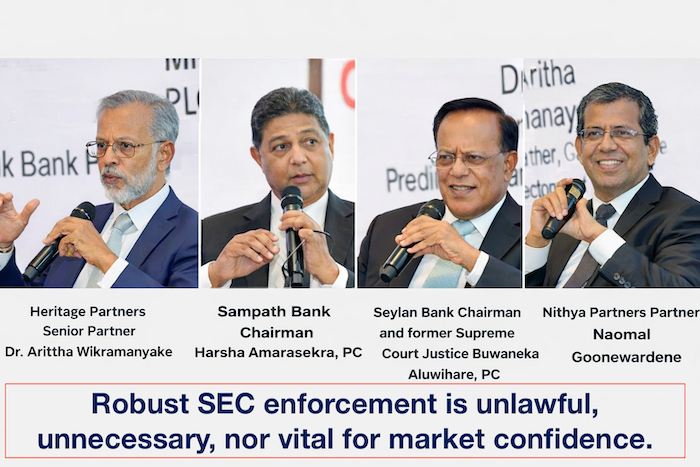
The debate at the Bar Association of Sri Lanka’s Capital Market Symposium has rightly drawn national attention. When senior practitioners such as Dr. Arittha Wikramanayake, Harsha Amarasekera PC, Justice Buwaneka Aluwihare PC and Naomal Goonewardene raise concerns about the trajectory of securities enforcement, their arguments cannot be dismissed as mere discomfort with regulation. They are articulating foundational constitutional anxieties that merit careful consideration.
- Interventions by Dr. Arittha Wikramanayake, Harsha Amarasekera PC, Justice Buwaneka Aluwihare PC, Naomal Goonewardene, Kithsiri Gunawardena and Chandaka Jayasundara viewed as highlighting debate, but not establishing constitutional infirmity in the Act
- Publication at show-cause stage defended as transparency mechanism to protect investors and maintain orderly markets, not as punitive “naming and shaming”
- Regulatory scrutiny of complex commercial and inter-group transactions justified as essential oversight in preventing disguised manipulation
- Illiquid market conditions cited as reason for stronger, not weaker, supervision given susceptibility to price distortion
- Institutional capacity challenges framed as argument for greater autonomy and resourcing of the SEC rather than dilution of statutory authority
- Robust enforcement presented as reinforcing foundational legal principles of equality, fairness and investor protection in public markets
The Securities and Exchange Commission of Sri Lanka Act undoubtedly modernised Sri Lanka’s enforcement framework. But modernisation must remain tethered to constitutional discipline under the Constitution of Sri Lanka. Parliament’s plenary legislative power under Article 75 is not unbounded; it operates within a framework of entrenched rights, including equality before the law under Article 12(1) and the broader guarantees of fairness embedded in Sri Lanka’s criminal justice tradition.
Dr. Wikramanayake’s remark that “presumption of innocence is not optional” strikes at the heart of the matter. The shift to a possession-based insider dealing standard significantly broadens exposure. While global practice has evolved in that direction, the constitutional inquiry is local. When statutory presumptions effectively shift the evidential burden onto an accused person in complex commercial contexts, the risk is not theoretical. Sophisticated transactions may involve layered information flows, ambiguous timing and internal corporate deliberations that are not easily reconstructed years later. A framework that presumes culpability from possession alone may, in practice, invert the classical burden of proof.
Justice Aluwihare’s caution that statutory presumptions cannot displace fundamental criminal law principles is not a rejection of regulation; it is a warning against erosion of the presumption of innocence. Even under international norms such as Article 14 of the International Covenant on Civil and Political Rights, evidential presumptions must remain reasonable and proportionate. Where liberty, reputation and livelihood are at stake, proportionality is not a technicality but a constitutional imperative.
The question of publication at the show-cause stage illustrates the tension between transparency and fairness. Dr. Wikramanayake’s observation that early disclosure can function as punishment before adjudication reflects a practical reality. In capital markets, reputational damage is immediate and often irreversible. A notice issued at an investigative stage, before findings are tested or determined, can trigger commercial consequences far exceeding any eventual sanction. Transparency must not morph into trial by publicity. The Constitution’s commitment to equality and fairness cannot coexist comfortably with processes that impose de facto penalties absent adjudication.
Harsha Amarasekera PC’s concern about the widened perimeter of insider dealing liability underscores another structural risk. When the boundary of criminal exposure expands, clarity becomes essential. Market participants must be able to predict the legal consequences of their conduct. A regime perceived as elastic or interpretively unpredictable may deter legitimate commercial activity as effectively as it deters misconduct. Regulation that chills lawful behaviour can undermine the very market development objectives the SEC is also tasked with advancing.
The issue of institutional structure further complicates the picture. When the same body investigates, evaluates evidence, determines liability and imposes administrative sanctions, the appearance of concentration of power is unavoidable. While administrative law permits such arrangements, constitutional culture demands visible safeguards. Structural separation or independent adjudicative mechanisms can enhance legitimacy without weakening enforcement. The concern expressed at the symposium was not that the SEC lacks authority, but that authority must be counterbalanced by demonstrable procedural insulation.
The debate over market manipulation in an illiquid market is equally nuanced. Dr. Wikramanayake correctly observed that volatility in a thinly traded counter cannot automatically be equated with manipulation. In small markets, price movements may reflect liquidity constraints rather than engineered distortion. Retrospective reconstruction of intent years after a transaction occurred carries evidential fragility. Commercial judgment, even when controversial or unprofitable, is not synonymous with criminal intent. Naomal Goonewardene’s warning against conflating governance failures or pricing disputes with manipulation speaks to the need for disciplined statutory interpretation.
The reopening of older transactions raises constitutional sensitivities. While ex post facto criminalisation is prohibited, aggressive retrospective investigation particularly in politically sensitive contexts risks undermining confidence in regulatory neutrality. Legal certainty requires that enforcement not appear reactive to public controversy or shifting political winds.
Compounding powers, though efficient, also require caution. Where significant financial penalties are attached to settlement, the practical pressure to resolve rather than contest allegations may be substantial. In theory, the right to litigate remains. In practice, reputational risk and commercial uncertainty can tilt the balance. Efficiency must not displace voluntariness.
None of these concerns amount to a plea for regulatory weakness. They are arguments for calibration. Effective markets require both deterrence and predictability. Enforcement that is perceived as expansive, retrospective or reputationally punitive may generate defensive compliance and capital flight rather than confidence.
The most constructive intervention at the symposium may have been the call for institutional autonomy and structural clarity. A regulator insulated from political pressure, adequately resourced and procedurally transparent is better positioned to wield strong statutory tools responsibly. Independence strengthens enforcement; it also reassures those subject to it.
Sri Lanka’s capital market stands at a delicate juncture. Credibility depends not only on the certainty of sanction but on the certainty of fairness. The Constitution demands both. Strong statutes are necessary. But strength without restraint risks unsettling the very confidence regulation seeks to protect.
The path forward lies not in dismantling the SEC’s authority, nor in dismissing the warnings of experienced jurists. It lies in ensuring that expanded powers are exercised with proportionality, clarity and visible procedural safeguards. Markets flourish where regulation is firm and unquestionably fair.