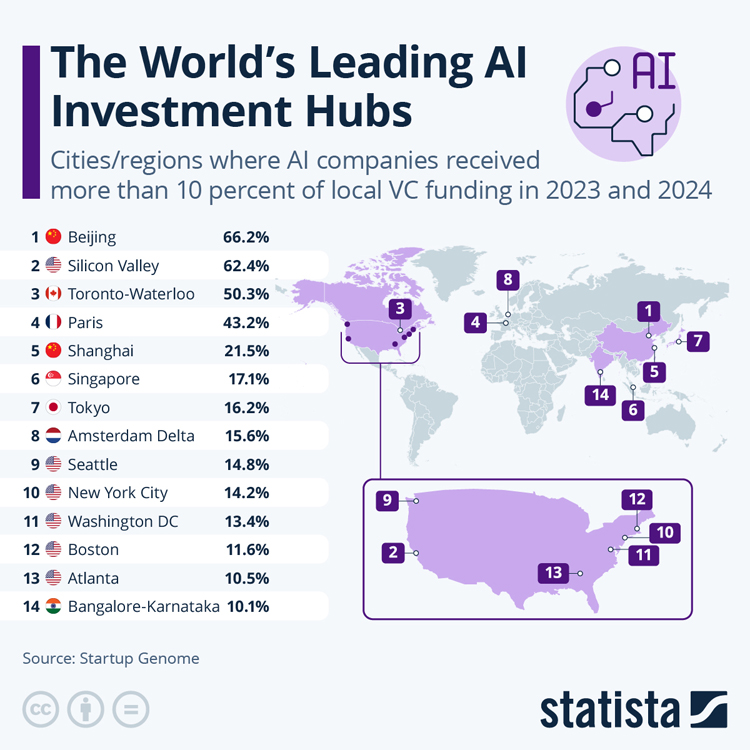
China organizes its socioeconomic development through structured five-year plans (FYPs). The recommendations for the 15th Five-Year Plan (2026–2030) of the People’s Republic of China have been released, highlighting national priorities in socioeconomic development. These priorities incorporate insights from industry experts in science and technology, ecological civilization, and ecosystem conservation, which are pivotal for driving high-quality growth in socialist China. Consequently, advancing Artificial Intelligence (AI) from merely usable to highly effective levels is viewed as a strategic necessity to secure competitive advantages for China.
In contrast, while Sri Lanka has not traditionally adhered to such planning, the country has seen government changes approximately every six years. Reflecting on this journey, some may argue that Sri Lankans have lacked the foresight to plan even short-term endeavors, suggesting that AI could help fill these gaps. Despite past challenges, Sri Lankans opted for a socialist government in 2024, aspiring to achieve “a rich country with a beautiful life.”
For China, the 15th FYP is crucial as the nation advances towards becoming a moderately prosperous socialist republic, known as Xiaokang, supported by AI tools. Chinese policymakers recognize the rapid evolution of the global technological landscape, significantly influenced by AI. Therefore, China appears to be strategically advancing its internal AI capabilities from usable to effective levels. Presently, China is among the global leaders in AI applications and aims to extend its influence beyond its borders, leveraging its vast data reserves and industrial connections, particularly through the Belt and Road Initiative (BRI), the modern-day Silk Road.
The strategic emphasis on domestic AI during the 15th FYP is vital for China to achieve significant advancements in science and industry, essential for national security and economic growth. Historically, China has not colonized other countries, thus it has not sought to impose its systems externally. It is anticipated that China will make breakthroughs in fundamental AI research on a self-sufficient foundation. Given China’s traditionally peaceful international approach, Chinese AI tools are expected to serve global benefit, exemplified by platforms like iFlytek’s Spark, which supports over 130 languages. China aims to foster a thriving AI application ecosystem, recognizing that only prosperous ecosystems can sustain long-term vitality. As the world’s second-largest economy, China can easily encourage the adoption of domestic AI, contributing to the global AI landscape.
Despite significant investments in AI, socialist China acknowledges its current lag behind developed nations in fundamental AI aspects, such as basic theory, original algorithms, and high-end chips. This recognition is a valuable lesson for those who overestimate their capabilities. It is a timely reminder for Sri Lankans to avoid overestimating their intelligence and to swiftly adopt global lessons.
Views expressed are personal. Photo source: www
The post “Socialists should be intelligent than Artificial Intelligence” by Prof. Samitha Hettige appeared first on Adaderana Biz English | Sri Lanka Business News.