FINANCIAL CHRONICLE – The Central Bank of Sri Lanka has decided to keep its Overnight Policy Rate (OPR) unchanged at 7.75%. This decision was announced in a statement that highlighted the bank’s consideration of evolving developments and the outlook on both domestic and global fronts, particularly the uncertainties arising from the ongoing conflict in the Middle East.
The statement noted, “The sharp increase in global energy prices and trade disruptions amidst heightened uncertainty due to the escalation of geopolitical tensions necessitated a significant upward adjustment in domestic energy prices.”
The Central Bank further stated, “The current low level of inflation, at 1.6% (year-on-year) in February 2026, relative to the target of 5%, provides sufficient space to accommodate the impact of higher energy prices and their spillovers on inflation.”
In detail, the Central Bank’s statement on the policy rate outlined the following key points:
The Monetary Policy Board, during its meeting held yesterday, decided to maintain the OPR at the current level of 7.75%. This decision was made after a thorough consideration of the evolving developments and outlook concerning both the domestic and global economies, with particular focus on the uncertainties stemming from the ongoing Middle East conflict.
It was mentioned that the sharp rise in global energy prices and trade disruptions, alongside heightened geopolitical tensions, has led to a necessary adjustment in domestic energy prices.
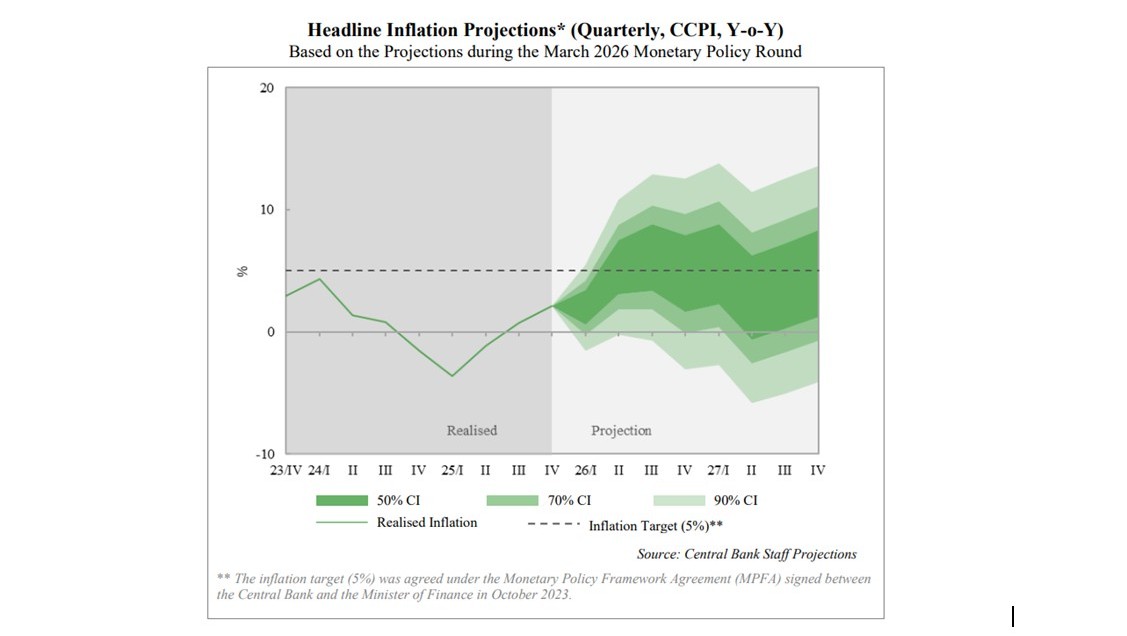
The low inflation rate of 1.6% (year-on-year) in February 2026, compared to the target of 5%, allows for the absorption of the impacts of increased energy prices on overall inflation. Current projections indicate that inflation is expected to reach the target of 5% in the second quarter of 2026, earlier than previously anticipated, and is expected to remain around this target thereafter.
Despite disruptions caused by Cyclone Ditwah towards the end of 2025, the economy recorded a strong real growth of 5.0%. Leading economic indicators suggest a robust recovery in early 2026 following the cyclone. However, the ongoing conflict may have adverse effects on domestic economic activity if it persists.
The external sector has shown resilience in the first two months of 2026, bolstered by higher export earnings compared to imports, along with increased remittances and tourism revenues. Gross Official Reserves rose to USD 7.3 billion at the end of February 2026, with the Central Bank purchasing a significant amount of foreign exchange from the market during this period. Nonetheless, the ongoing conflict in the Middle East poses risks to Sri Lanka’s external sector outlook, especially concerning energy, tourism, trade, and remittance flows, although the overall extent of the impact remains uncertain. Although the Sri Lankan rupee has remained relatively stable in early 2026, some depreciation pressures have been noted due to the onset of the conflict, akin to trends observed in regional currencies.
The Board is prepared to implement appropriate policy measures to ensure that inflation stabilizes around the target while also supporting the economy to achieve its potential.
The next regular statement on the monetary policy review is scheduled for release on 26 May 2026. (Colombo/March 25/2026)