Petrol 95 should be Rs. 420 per Litre whilst Super Diesel Should be more than Rs. 400 per Litre
Sri Lanka’s fuel prices have risen modestly in recent weeks following the sharp increase in global oil prices triggered by the escalating conflict in the Middle East. However, a comparison between international crude oil movements and domestic pump prices suggests that Sri Lanka’s retail fuel prices remain significantly below the levels implied by global market trends.
A useful lesson can be drawn from the final months of the previous government that presided over Sri Lanka’s economic collapse. In the run-up to the 2022 crisis, authorities repeatedly delayed adjustments to fuel prices despite rapidly rising global oil costs and a severe shortage of foreign exchange. The decision to hold domestic fuel prices artificially low placed enormous financial pressure on the fuel import system, quickly draining reserves and creating acute supply shortages. Long queues for petrol and diesel soon became one of the most visible symbols of the crisis, fuelling public anger and mass protests that ultimately contributed to the collapse of the government itself. The current administration would do well to remember that delaying necessary fuel price adjustments may provide short-term political relief, but if global oil prices remain elevated and supply becomes strained, failure to act decisively could recreate the very conditions that triggered Sri Lanka’s last political upheaval.
In December 2025, before the geopolitical shock, Brent crude oil traded at approximately US$62 per barrel. During this period, the Ceylon Petroleum Corporation (CPC) maintained stable domestic fuel prices.
By March 2026, crude oil prices surged to around US$100 per barrel, representing an increase of about 61–62 percent. Despite this sharp rise in global oil costs, Sri Lanka’s retail fuel price adjustment has been comparatively modest.
On 9 March 2026, CPC announced revised prices with only moderate increases across petroleum products.
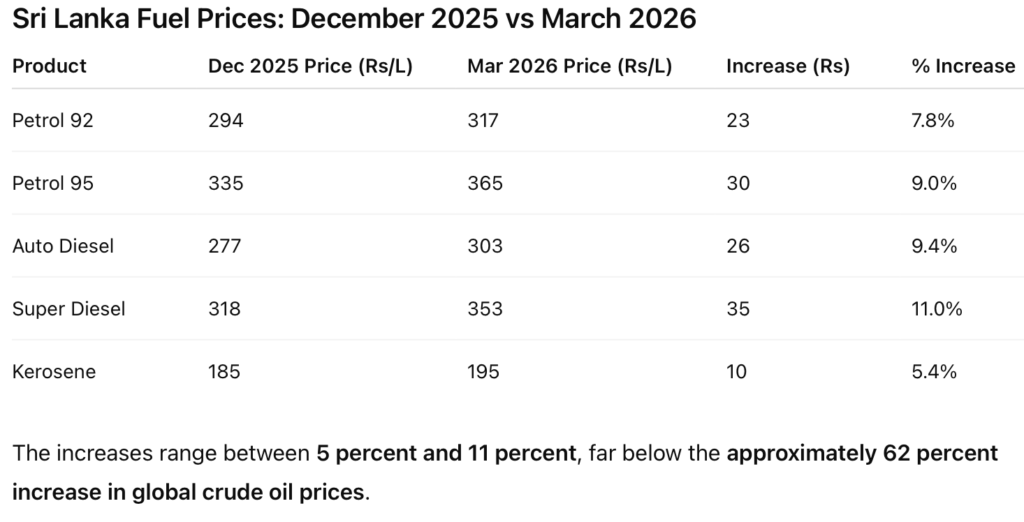
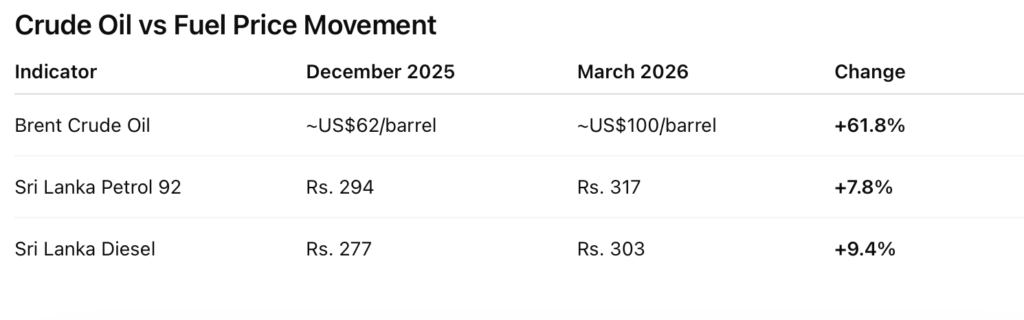
This gap highlights the fact that crude oil represents only part of the final retail fuel price. Pump prices also include refining costs, shipping and insurance charges, exchange rate effects, distribution costs, and government taxes.
Energy economists generally estimate that crude oil accounts for roughly 35–45 percent of the final retail fuel price.
When this structure is applied to the current crude oil increase, the expected retail fuel price adjustment in Sri Lanka would likely be around 20–25 percent rather than the 60 percent increase seen in crude markets.
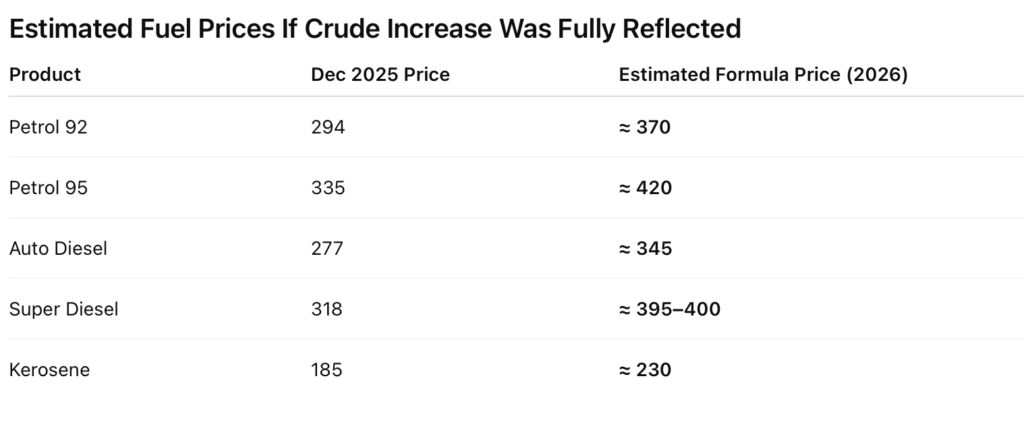
Based on this calculation, Petrol 92 would likely be closer to Rs. 370 per litre, while Auto Diesel could approach Rs. 345 per litre if the crude oil increase were fully transmitted through Sri Lanka’s pricing structure.
The relatively small increase in retail fuel prices suggests that Sri Lanka may be delaying or smoothing the full pass-through of global oil price increases.
Fuel price hikes have broad economic consequences. Transport costs, bus fares, logistics expenses, food prices, and electricity generation costs are all closely linked to petroleum prices. A sudden large increase could quickly feed into inflation and public dissatisfaction.
For a country still recovering from the 2022 economic crisis, policymakers appear cautious about allowing global energy shocks to pass directly and immediately into domestic fuel prices.
However, if global crude oil prices remain elevated, Sri Lanka may eventually face pressure to adjust pump prices further. The longer domestic prices remain below levels implied by international oil markets, the greater the financial strain on the fuel import system.
For now, the gap between crude oil costs and retail fuel prices indicates that Sri Lanka is absorbing part of the global energy shock, shielding consumers from the full impact at least temporarily.